Returning to Core Exercise After Birth
Start with gentle movement that fits your recovery, and let pain or pelvic symptoms change the plan.
There’s no single day when everyone is ready for core exercise after birth. If you’re recovering comfortably, a gentle starting point is a side-lying movement that engages your lower belly as you breathe out, then lets it relax. Follow any activity instructions you received after delivery, especially after a cesarean birth. If movement brings on urine leakage, pelvic heaviness or pain, get an assessment rather than pushing through. 8723
Start with the recovery you’re having
A return to core exercise doesn’t need to begin with a plank or a workout. Pregnancy can leave the two muscles down the middle of your abdomen separated, and childbirth can affect the pelvic floor. You may also be dealing with pain or discomfort. Those differences matter more than reaching a date on a calendar. 83
If you’ve been given instructions about walking, stairs or other activity after delivery, use those as your starting point. After a cesarean birth, don’t assume that advice for someone recovering from a vaginal birth applies to you. A supervised postpartum exercise pilot adapted its program to participants’ needs, including type of birth, but it did not establish a universal home routine or a start date for abdominal exercise. 76
Make the first movement gentle
If you’re recovering comfortably and ready to try a little core movement, the NHS describes a side-lying exercise: with your knees slightly bent, let your belly relax as you breathe in. As you breathe out, gently draw in the lower part of your belly and contract your pelvic floor muscles. Keep breathing normally, then release both. This is an example of gentle movement, not a test you have to pass before doing anything else. 8
The release matters as much as the contraction: this isn’t a cue to keep your stomach pulled in all day. The same guidance suggests leaving sit-ups, planks and high-impact exercise out of your initial return. That’s a starting distinction, not a rule that those movements are permanently off-limits. 8
If a small movement feels comfortable, you can build activity gradually rather than jump straight to a demanding routine. If it hurts or brings on a new symptom, don’t treat that as a reason to work harder. Ask for an assessment that takes your recovery and goals into account. Postpartum physical problems can be raised with a clinician whenever they’re bothering you. 68
Let pelvic symptoms change the plan
Urine leakage during exercise deserves attention. Leakage with exertion can be a sign of stress urinary incontinence; a sudden, intense urge followed by leakage is a different pattern. Both are worth describing when you seek care, because the next step depends on what’s happening, not simply on how strong your abs feel. 34
A feeling of heaviness or pressure in the vagina, or a bulge you can feel or see, also warrants assessment. These can be symptoms of pelvic organ prolapse, though the symptoms alone don’t tell you what’s causing them. If prolapse is diagnosed, treatment depends on its severity and how much it bothers you. 2
You don’t have to solve leakage by adding more abdominal exercises. For stress or mixed urinary incontinence, NICE recommends a supervised pelvic floor muscle training trial as first-line treatment, with an assessment to confirm the correct contraction before supervised training begins. That’s a treatment path for a specific problem, not a general core routine for everyone who has given birth. 1
What if you notice an abdominal gap?
A gap between the abdominal muscles, called diastasis recti, is common after pregnancy. The separation usually becomes smaller as you recover. If the gap is still obvious around eight weeks after birth, contact your clinician for an assessment, even if it isn’t bothering you. You can also raise abdominal discomfort sooner. That eight-week point is guidance about checking an ongoing gap, not a date when you should start core exercise. 8
Be wary of a program that promises to “close” the gap with one particular exercise. A systematic review of seven randomized trials involving 381 postpartum women found very low-quality evidence for recommending a specific abdominal or pelvic floor exercise program to treat diastasis recti. The trials used different exercises and measurements, and their findings didn’t establish a reliable plan for an individual woman. You can work toward feeling stronger without making a smaller gap the only measure of progress. 5
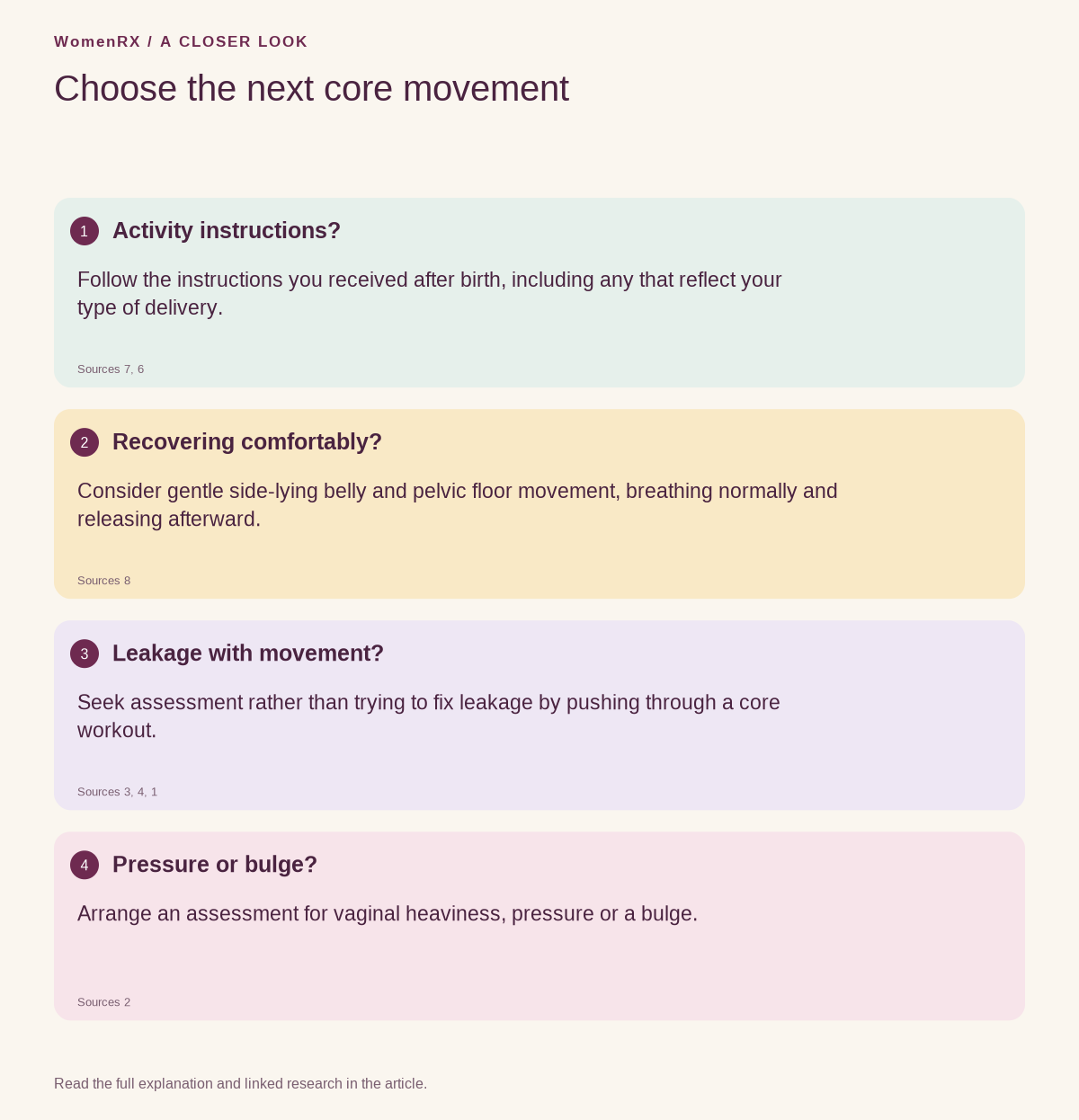
Choose the next core movement
Activity instructions?: Follow the instructions you received after birth, including any that reflect your type of delivery.76
Recovering comfortably?: Consider gentle side-lying belly and pelvic floor movement, breathing normally and releasing afterward.8
Leakage with movement?: Seek assessment rather than trying to fix leakage by pushing through a core workout.341
Pressure or bulge?: Arrange an assessment for vaginal heaviness, pressure or a bulge.2
Read the figure as text
Start with your recovery and symptoms rather than a date on the calendar.- Activity instructions?: Follow the instructions you received after birth, including any that reflect your type of delivery.76
- Recovering comfortably?: Consider gentle side-lying belly and pelvic floor movement, breathing normally and releasing afterward.8
- Leakage with movement?: Seek assessment rather than trying to fix leakage by pushing through a core workout.341
- Pressure or bulge?: Arrange an assessment for vaginal heaviness, pressure or a bulge.2
Sources you can check
- Recommendations | Urinary incontinence and pelvic organ prolapse in women: management | Guidance | NICEAccessed 2026-09-25Return to first citation
- Pelvic organ prolapse - NHSAccessed 2026-09-25Return to first citation
- Urinary incontinence - NHSAccessed 2026-09-25Return to first citation
- Urinary incontinence - Symptoms - NHSAccessed 2026-09-25Return to first citation
- What is the evidence for abdominal and pelvic floor muscle training to treat diastasis recti abdominis postpartum? A systematic review with meta-analysis.Gluppe S, Engh ME, Bø K. · Brazilian journal of physical therapy · 2021Return to first citation
- Feasibility of a Supervised Postpartum Exercise Program and Effects on Maternal Health and Fitness Parameters-Pilot Study.Brites-Lagos C, Ramos L, Szumilewicz A, Santos-Rocha R. · Healthcare (Basel, Switzerland) · 2023Return to first citation
- Postpartum Care: MedlinePlusAccessed 2026-09-25Return to first citation
- Your post-pregnancy body - NHSAccessed 2026-09-25Return to first citation