When BV Keeps Returning: What to Discuss Next
Repeated symptoms deserve a fresh check and a plan, not an assumption that every episode is BV.
If BV-like symptoms keep coming back, ask to be evaluated while symptoms are present so testing can confirm BV and check for other causes. Review which treatments you’ve used and what happened afterward. If BV is confirmed again, you can discuss another treatment course or, for repeated symptomatic episodes, whether clinician-supervised suppressive metronidazole gel is appropriate and how you’ll follow up. 1 2 6
Start with what the symptoms are telling you
A thin, grayish-white discharge with a strong fishy smell can fit bacterial vaginosis (BV). But symptoms alone can’t reliably tell you what’s causing vaginal changes. Yeast, sexually transmitted infections, and noninfectious causes can also produce recurring symptoms, and itching or soreness is not typical of BV for many people. Testing during an episode can help confirm BV rather than repeating treatment for the wrong cause. 1 6
When you contact a clinician, say that the symptoms have returned and ask whether you can be assessed while they’re happening. The evaluation may include questions about your symptoms, an exam, and a sample of vaginal discharge to test for BV and other infections. 1 6
Bring the treatment history into the conversation
A short timeline can make the visit more useful. Note when symptoms returned, what treatment you used, whether the symptoms improved, and roughly how long before they came back. Include any irritation or yeast symptoms during or after treatment, and whether episodes seem to occur around sex or your period. These patterns don’t prove a trigger, but they can help guide a discussion; BV can recur, and a specific cause isn’t always clear. 1 2
Useful questions include:
- “Can we confirm this is BV, and check for other causes of these symptoms?”
- “Does my past treatment history change what you recommend now?”
- “If BV is confirmed, what are the options for this episode?”
- “Given how often it’s returned, should we discuss suppressive treatment?”
- “What symptoms or side effects should prompt me to contact you, and when should we follow up?”
What suppressive treatment can and can’t do
For people whose symptomatic BV has been successfully treated but keeps recurring, a clinician may discuss suppressive vaginal metronidazole gel. A randomized trial compared twice-weekly gel with placebo for 16 weeks after an initial treatment. During those 16 weeks, recurrence was reported in 25.5% of the metronidazole group and 59.1% of the placebo group. Across the full 28-week follow-up, including 12 weeks after treatment ended, recurrence was 51.0% versus 75.0%. The benefit was meaningful, but it did not mean BV would never return. Vaginal yeast infection occurred more often with metronidazole. 2
Those results come from one trial of women with recurrent BV who first responded to treatment. They support a conversation about suppression, not a guarantee that it will work for you or that it’s the right fit. Ask how the possible reduction in recurrence weighs against treatment burden and yeast symptoms in your situation. 2 4
Other proposed approaches have weaker evidence. For example, a retrospective, uncontrolled review of boric acid added to antibiotics cannot show how much benefit came from boric acid or establish that the regimen works better than standard care. Don’t start an intravaginal product or a prolonged antibiotic plan on your own; ask your clinician what evidence and safety considerations apply to the option being discussed. 3 5
Agree on what happens if symptoms return
Before you leave, try to make the next step clear: what to do if symptoms come back, whether you should be retested before another course, and when to check in if symptoms don’t improve. Repeated symptoms aren’t a reason to blame yourself or assume hygiene is the cause. The useful next move is to confirm what’s happening and choose a plan together.
If you’re pregnant and have symptoms, contact your pregnancy care team for individualized advice rather than waiting for a routine follow-up. BV is linked to a small chance of pregnancy complications, although most pregnancies with BV have no problems. 1
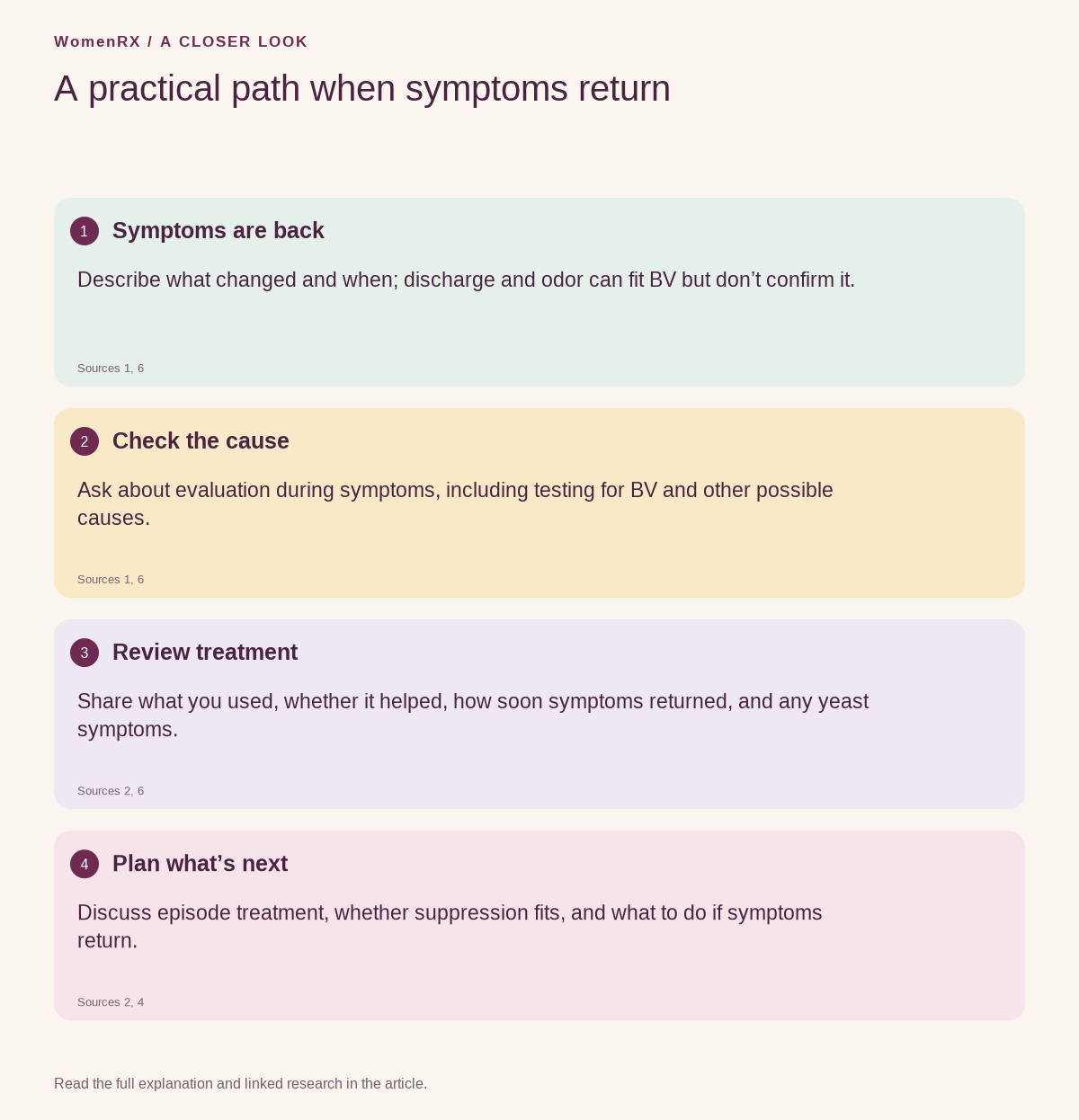
A practical path when symptoms return
Symptoms are back: Describe what changed and when; discharge and odor can fit BV but don’t confirm it.16
Check the cause: Ask about evaluation during symptoms, including testing for BV and other possible causes.16
Review treatment: Share what you used, whether it helped, how soon symptoms returned, and any yeast symptoms.26
Plan what’s next: Discuss episode treatment, whether suppression fits, and what to do if symptoms return.24
Read the figure as text
Use this sequence to organize the conversation: confirm the cause, review what has happened, discuss suitable options, and agree on what comes next.- Symptoms are back: Describe what changed and when; discharge and odor can fit BV but don’t confirm it.16
- Check the cause: Ask about evaluation during symptoms, including testing for BV and other possible causes.16
- Review treatment: Share what you used, whether it helped, how soon symptoms returned, and any yeast symptoms.26
- Plan what’s next: Discuss episode treatment, whether suppression fits, and what to do if symptoms return.24
More questions, answered
Does BV coming back mean the previous treatment failed?
Not necessarily. BV often returns within a few months, and symptoms returning can also have another cause. A new evaluation can help distinguish recurrence from a different infection or a noninfectious problem. 1 6
Is suppressive metronidazole a permanent fix?
No. In a randomized trial, recurrence was less common with suppressive gel during treatment, but recurrence still occurred and the difference narrowed after treatment ended. Ask about the likely benefit, yeast symptoms, and follow-up before deciding whether it suits you. 2
Sources you can check
- Bacterial vaginosis - NHSAccessed 2026-09-25Return to first citation
- Suppressive antibacterial therapy with 0.75% metronidazole vaginal gel to prevent recurrent bacterial vaginosis.Sobel JD, Ferris D, Schwebke J, Nyirjesy P, Wiesenfeld HC, Peipert J, Soper D, Ohmit SE, Hillier SL. · American journal of obstetrics and gynecology · 2006Return to first citation
- Boric acid addition to suppressive antimicrobial therapy for recurrent bacterial vaginosis.Reichman O, Akins R, Sobel JD. · Sexually transmitted diseases · 2009Return to first citation
- Lessons from Suppressive Therapy and Periodic Presumptive Treatment for Bacterial Vaginosis.Balkus JE, Carter KA, McClelland RS. · Current infectious disease reports · 2019Return to first citation
- Recurrent Bacterial Vaginosis: An Unmet Therapeutic Challenge. Experience With a Combination Pharmacotherapy Long-Term Suppressive Regimen.Surapaneni S, Akins R, Sobel JD. · Sexually transmitted diseases · 2021Return to first citation
- Recurrent Infectious Vaginitis: A Practical Approach for the Primary Care Clinician.Yazdy GM, Mitchell C, Sobel JD, Tuddenham S. · The Medical clinics of North America · 2024Return to first citation