How to Exercise While Taking Tirzepatide
Build activity you can recover from, and let nausea, food intake, and strength matter more than the number on the scale.
Aim for activity you can manage and recover from while taking tirzepatide. If you’re losing weight, try manageable resistance exercises to work on strength, alongside movement you can do consistently. Increase the challenge gradually as you feel ready. Eat enough to support training, and choose an easier session or rest when nausea or poor intake makes your plan feel like too much.45
Train for what you want to keep doing
Choose a useful strength goal for your routine: carrying groceries, climbing stairs, or getting up from a chair. Notice how these movements feel as you build a repeatable exercise habit. Resistance exercise can support strength, so these everyday tasks give your training a practical purpose.4
Resistance exercise gives your muscles work to adapt to. That might mean weights, resistance bands, or movements that use your body weight. If you’re new to it, you could start with a few controlled movements, such as getting up from a chair, pushing against a wall, and pulling a resistance band. Choose versions you can manage, leave room to recover before repeating them, and add repetitions or resistance gradually as they become easier. If you’re still struggling to recover, keep the next session easier instead of increasing the work. Regular resistance training can increase muscle-fiber size, and adequate protein helps support the training response and recovery.4
Let the day’s symptoms shape the workout
Tirzepatide can cause nausea, vomiting, diarrhea, constipation, and reduced appetite. In a review of six randomized trials involving people with type 2 diabetes, these gastrointestinal symptoms were more common in tirzepatide groups than in comparator groups.5
Use how you feel to make a practical choice, rather than treating your planned workout as a requirement. If you’re eating and drinking comfortably, you might do the session you planned. If nausea has made a full workout unappealing, a shorter or easier session is an option. If you’re vomiting, have diarrhea, or feel dizzy, you may decide that a strenuous session is too much today. Vomiting, diarrhea, and exercise in hot weather can contribute to dehydration; thirst and dizziness are possible signs.13
If you’re having trouble keeping liquids down, try small sips. Confusion alongside possible dehydration needs medical help right away.1
Fuel the training you can actually do
Reduced appetite can make it easy to overlook meals while you’re thinking about exercise. You don’t need to turn eating into a complicated workout schedule. Instead, notice whether your usual intake is giving you enough energy to complete a session and recover before the next one. Protein-containing foods, such as eggs, yogurt, beans, fish, or tofu, can help you include protein across meals. Protein is needed to build, maintain, and repair muscle; sufficient dietary protein supports the response to exercise.45
A supplement isn’t automatically the answer. If reduced appetite or ongoing stomach symptoms are making it hard to eat or drink enough, bring that up with the clinician managing your treatment. The problem to solve is whether you can meet your needs and tolerate activity, not whether you can push through a workout.
Make room for your life stage
After menopause, bone health belongs alongside strength in the picture. Lower estrogen raises osteoporosis risk, and osteoporosis can be present without symptoms until a fracture occurs.9 Resistance exercise works your muscles and puts stress on bones; weight-bearing movement such as walking also works bones, while balance practice can help reduce falls. For example, you might pair manageable strength movements with walks and a balance activity that suits your abilities. If you have low bone density, osteoporosis, or physical limitations, get help choosing exercises that are safe for you before starting a new program.8
Postpartum recovery calls for a different decision. In the weeks after birth, rest and basic care may take much of your energy, and bleeding can continue on and off. Follow the activity instructions you were given for walking, stairs, and other movement. Before adding or increasing strength work, check how it fits those instructions rather than using an ordinary weight-loss routine as your return-to-exercise plan.2
The useful goal is a routine you can repeat and recover from. On a good day, that may include a strength session and other movement you enjoy. On a difficult day, doing less can leave you better able to return when you feel well.
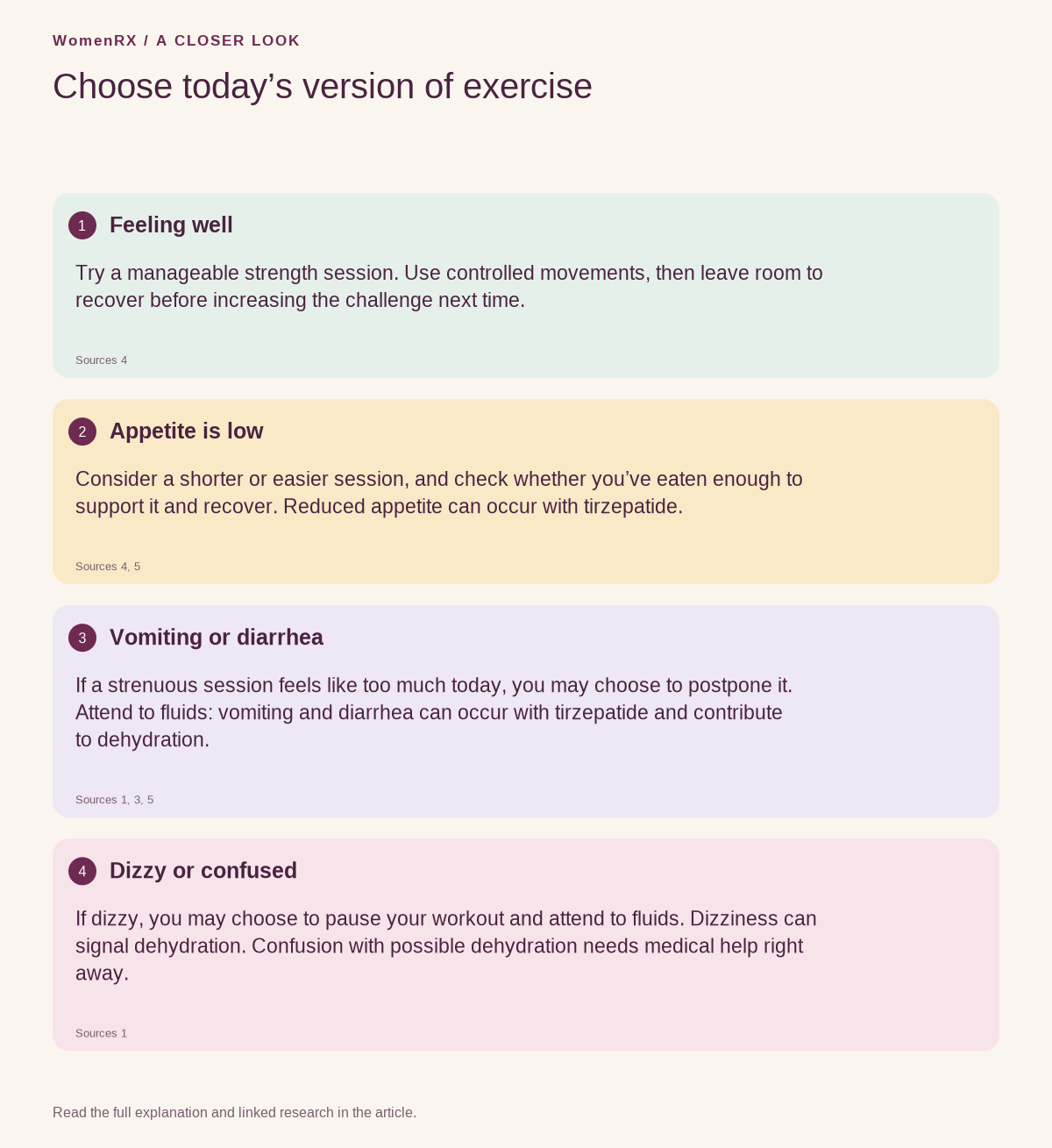
Choose today’s version of exercise
Feeling well: Try a manageable strength session. Use controlled movements, then leave room to recover before increasing the challenge next time.4
Appetite is low: Consider a shorter or easier session, and check whether you’ve eaten enough to support it and recover. Reduced appetite can occur with tirzepatide.45
Vomiting or diarrhea: If a strenuous session feels like too much today, you may choose to postpone it. Attend to fluids: vomiting and diarrhea can occur with tirzepatide and contribute to dehydration.135
Dizzy or confused: If dizzy, you may choose to pause your workout and attend to fluids. Dizziness can signal dehydration. Confusion with possible dehydration needs medical help right away.1
Read the figure as text
Match today’s activity to how you’re eating, drinking, feeling, and recovering.- Feeling well: Try a manageable strength session. Use controlled movements, then leave room to recover before increasing the challenge next time.4
- Appetite is low: Consider a shorter or easier session, and check whether you’ve eaten enough to support it and recover. Reduced appetite can occur with tirzepatide.45
- Vomiting or diarrhea: If a strenuous session feels like too much today, you may choose to postpone it. Attend to fluids: vomiting and diarrhea can occur with tirzepatide and contribute to dehydration.135
- Dizzy or confused: If dizzy, you may choose to pause your workout and attend to fluids. Dizziness can signal dehydration. Confusion with possible dehydration needs medical help right away.1
More questions, answered
Does the scale tell me whether I’m losing muscle?
No. Weight alone cannot separate fat from lean mass, and lean mass is not the same thing as skeletal muscle. Pay attention to changes in strength and everyday function too, while recognizing that those observations do not measure muscle mass.67
Sources you can check
- Dehydration: MedlinePlusAccessed 2026-09-25Return to first citation
- Postpartum Care: MedlinePlusAccessed 2026-09-25Return to first citation
- Dehydration - NHSAccessed 2026-09-25Return to first citation
- Dietary Supplements for Exercise and Athletic Performance - Health Professional Fact SheetAccessed 2026-09-25Return to first citation
- Tirzepatide-Induced Gastrointestinal Manifestations: A Systematic Review and Meta-Analysis.Karrar HR, Nouh MI, Nouh YI, Nouh MI, Khan Alhindi AS, Hemeq YH, Aljameeli AM, Aljuaid JA, Alzahrani SJ, Alsatami AA, Alkredees MA, Almuqati AO, Abanmi SN, Alshehri AM. · Cureus · 2023Return to first citation
- LEAN mass Preservation with Resistance Exercise and Protein during semaglutide and tirzepatide therapy (LEAN-PREP study): a protocol for a randomised controlled trial.Alawadhi AA, Alroudhan D, Alsaeed DJ, Almarshad BW, Alshehabi DH, Allahou BA, Mashankar A, Al Ozairi E, Gray S. · BMJ open · 2026Return to first citation
- Increasing skeletal muscle mass and strength during incretin-based weight loss.Mendias CL, Awan TM. · Obesity pillars · 2026Return to first citation
- Exercise for Your Bone Health | NIAMSAccessed 2026-09-26Return to first citation
- Osteoporosis Causes, Risk Factors, & Symptoms | NIAMSAccessed 2026-09-26Return to first citation