Does Insulin Sensitivity Change Around Perimenopause?
Perimenopause doesn’t automatically mean insulin resistance, and age-related changes can be hard to separate from changes tied to menopause itself.
Research doesn’t show that every woman becomes more insulin resistant during perimenopause. In one large study of women ages 45 to 60, insulin resistance didn’t differ across age groups, although some other glucose and metabolic measures did. Because the study compared age groups rather than following women through the transition, it can’t tell us which changes came from aging and which from menopause. 3
The short answer is: insulin sensitivity may change for some women, but perimenopause alone doesn’t tell you whether it has. A useful review looks at your overall metabolic risk, not just your life stage.
What the research can, and can’t, separate
A cross-sectional study of 4,194 nondiabetic women in Taiwan, ages 45 to 60, compared metabolic measures across age groups. Women in the older group, age 52 or above, had higher average body mass index, blood pressure, fasting glucose, LDL cholesterol, triglycerides, and second-phase insulin secretion. Their glucose effectiveness, the body’s ability to lower glucose apart from insulin’s action, was lower. The study found no age-related change in its measures of insulin resistance or first-phase insulin secretion. 3
That’s a more nuanced picture than “perimenopause causes insulin resistance.” But the study compared women of different ages at one point in time. It didn’t track the same women as they moved through menopause, so it can’t cleanly distinguish menopause-related change from aging or other differences between participants. It also doesn’t establish that the results apply to every population.
Insulin resistance is one part of a broader picture
Insulin helps move glucose from the blood into cells. When the body doesn’t respond to insulin properly, blood glucose can rise. Insulin resistance can contribute to metabolic risk, but it’s only one factor among others, including age, genetics, activity level, and excess abdominal weight. Several risk factors can occur together. 1
That distinction matters because one number or one life-stage label doesn’t tell the whole story. A review might consider blood glucose and blood fats alongside measurements and health history; metabolic syndrome is assessed using a physical exam and blood tests, rather than inferred from symptoms alone. 1 2
What to discuss at a checkup
If you’re entering perimenopause or noticing changes in your health, you can ask whether your overall risk profile makes a glucose check or other metabolic review appropriate. Useful context includes family history, prior test results, blood pressure, weight or waist changes, and other health conditions. The point isn’t to request a special insulin-resistance test just because your periods are changing. It’s to decide whether standard metabolic checks make sense for you as a whole.
You might ask:
- “Given my health history and risk factors, should we review my blood glucose or other metabolic markers?”
- “How do my results compare with my previous results?”
- “Could changes in weight, activity, medications, or another health condition be part of the picture?”
Metabolic syndrome is identified by several risk factors, not a single result. The useful next step is interpreting results in context, including whether more than one risk factor is present. 1
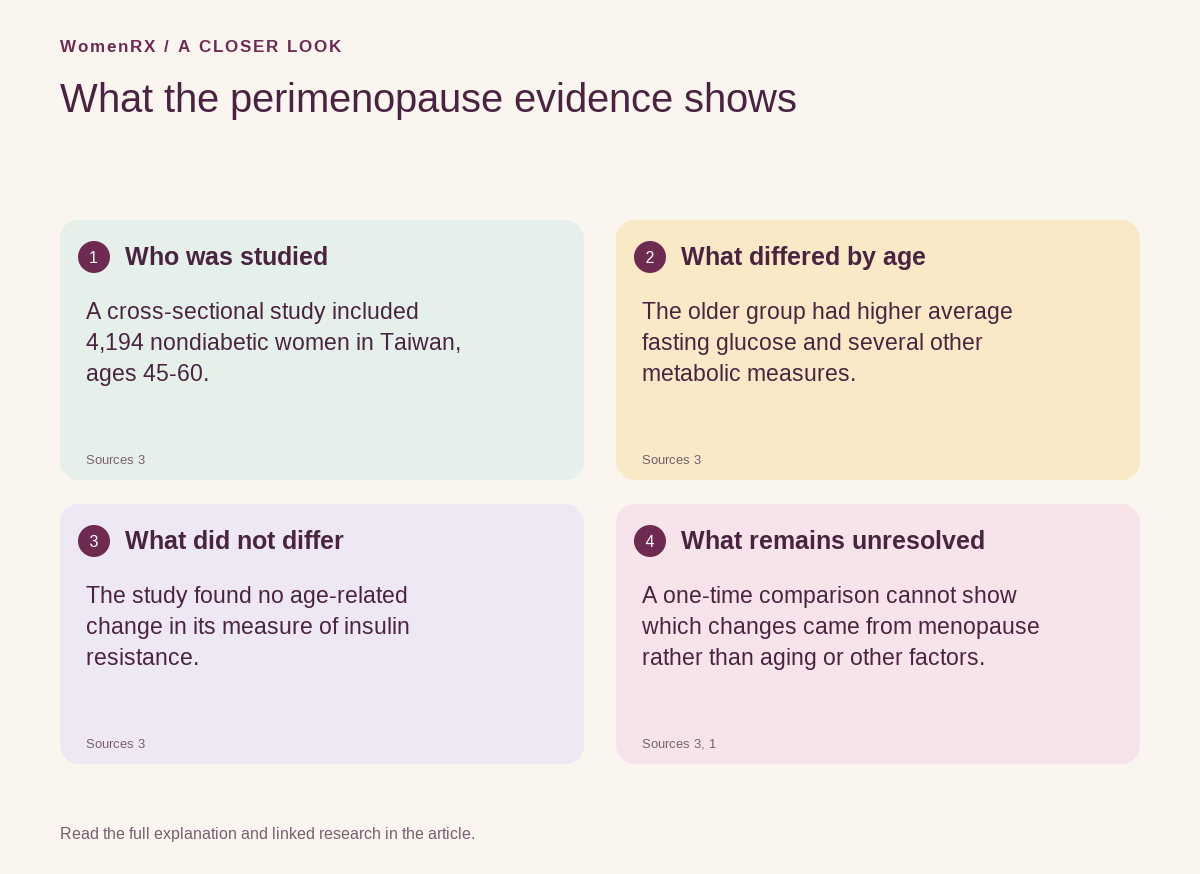
What the perimenopause evidence shows
Who was studied: A cross-sectional study included 4,194 nondiabetic women in Taiwan, ages 45-60.3
What differed by age: The older group had higher average fasting glucose and several other metabolic measures.3
What did not differ: The study found no age-related change in its measure of insulin resistance.3
What remains unresolved: A one-time comparison cannot show which changes came from menopause rather than aging or other factors.31
Read the figure as text
Age-group comparisons offer clues, but they cannot by themselves separate menopause-related change from aging or other risk factors.- Who was studied: A cross-sectional study included 4,194 nondiabetic women in Taiwan, ages 45-60.3
- What differed by age: The older group had higher average fasting glucose and several other metabolic measures.3
- What did not differ: The study found no age-related change in its measure of insulin resistance.3
- What remains unresolved: A one-time comparison cannot show which changes came from menopause rather than aging or other factors.31
More questions, answered
Does the research prove menopause has no effect on insulin sensitivity?
No. The study found no difference in its insulin-resistance measure across age groups, but it was cross-sectional, so it couldn’t follow individual women through the transition or isolate menopause from aging. 3
Should I ask for an insulin-resistance test just because I’m perimenopausal?
The Taiwan study doesn’t establish a need for testing based on perimenopausal stage alone. You can ask whether your health history and other risk factors make a review of blood glucose or other metabolic markers useful. 3 1 2
Sources you can check
- Metabolic Syndrome | MedlinePlusAccessed 2026-09-25Return to first citation
- Metabolic syndrome - NHSAccessed 2026-09-25Return to first citation
- Changes in insulin resistance, glucose effectiveness, and first and second phases of insulin secretion in women aged 45-60 years old in Taiwan.Wang CY, Wu CZ, Chen FY, Pei D, Huang LY. · Journal of the Chinese Medical Association : JCMA · 2023Return to first citation