Diarrhea on GLP-1s: What to Watch For
Diarrhea can happen with GLP-1 treatment, but its timing alone doesn’t prove the medicine is the cause.
Diarrhea is a reported gastrointestinal side effect of GLP-1 medicines, but infections and other causes can produce the same symptom. Track how long it lasts, how often you have loose stools, and whether you can keep up with fluids. For an adult, contact your care team if it lasts more than two days, sooner for dehydration or severe abdominal pain, and get immediate help for confusion. 1 2 3 4
Start with the pattern, not an assumption
GLP-1 medicines can cause gastrointestinal side effects, including diarrhea. But diarrhea can also come from an infection or another cause, so starting treatment around the same time doesn’t settle the question by itself. A review of trials in adults with type 2 diabetes found gastrointestinal side effects across the medicines studied; another review examined people with overweight or obesity who did not have diabetes. Neither finding can identify the cause of one person’s symptoms. 1 4 5
For tracking, note when the diarrhea began, how many loose stools you have each day, whether symptoms are getting better or worse, and whether you can drink enough. Three or more loose stools in a day meets MedlinePlus’s definition of diarrhea. You can also note other symptoms, such as fever, chills, blood in the stool, or abdominal pain. Fever, chills, and bloody stools can occur with an infection, another reason not to assume the medicine is responsible. 1
A practical guide to what to do next
If it’s mild and improving: Keep drinking fluids to replace what you’re losing. Water and salty broths are among the options MedlinePlus lists for adults with diarrhea. As symptoms improve, soft, bland foods may be easier to manage. Keep an eye on whether the diarrhea is settling and whether you’re able to drink. 1
If it lasts more than two days: Contact your care team or prescriber. MedlinePlus advises adults to contact a health care provider when diarrhea lasts more than two days. You don’t need to wait that long if symptoms are severe, you’re showing signs of dehydration, or you have severe abdominal or rectal pain. 1
If you’re losing more fluid than you can replace: Diarrhea can cause dehydration. The risk is more concerning when you’re also vomiting or can’t keep fluids down. Sunken-looking eyes can be a sign of dehydration. Contact your care team promptly if you’re concerned you’re becoming dehydrated; confusion is a reason to get medical help right away. 1 2
If you have persistent or severe abdominal pain: Get prompt medical assessment, particularly if the pain radiates to your back, with or without nausea or vomiting. The U.S. prescribing information for liraglutide (Saxenda) identifies this pattern as a possible sign of pancreatitis. It also reports postmarketing cases of acute kidney injury, often in people who had gastrointestinal symptoms that led to dehydration. These are reasons to take severe symptoms seriously, not evidence that every episode of diarrhea signals a complication. 3
What the research says about women and pregnancy
The trial reviews summarize diarrhea among participants overall, without sex-specific rates in their reported results. One review included adults with type 2 diabetes; another focused on people with overweight or obesity without diabetes. Those group-level findings can’t establish whether diarrhea risk differs between women and men. 4 5
Pregnancy is a separate context: the review of adults with type 2 diabetes excluded pregnant and breastfeeding participants, so its findings cannot explain diarrhea or treatment decisions during pregnancy. For liraglutide specifically, the Saxenda prescribing information says to discontinue treatment when pregnancy is recognized and explains that weight loss offers no benefit during pregnancy and may cause fetal harm. That product-specific direction should not be generalized to every medicine in the class. 3 4
Don’t treat every episode as a medication side effect
If symptoms are brief, improving, and you can replace lost fluids, monitoring the pattern may help you describe what’s happening to your prescriber. If diarrhea persists, worsens, or comes with dehydration or severe pain, the next step is assessment rather than simply labeling it a routine side effect. Bring your notes on duration, stool frequency, other symptoms, and fluid intake; those details help distinguish a manageable episode from one that needs closer attention.
A symptom-based next step
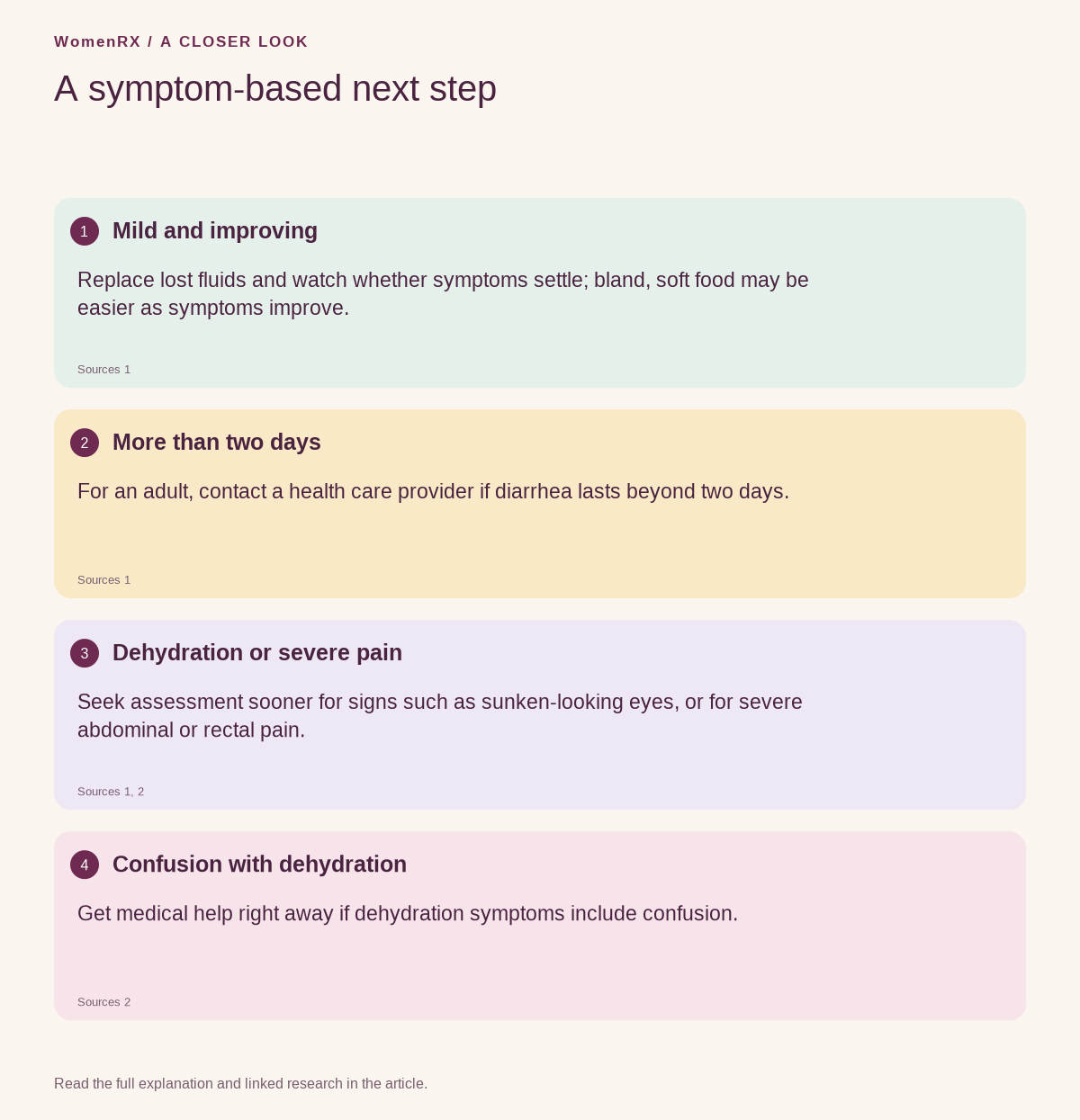
Mild and improving: Replace lost fluids and watch whether symptoms settle; bland, soft food may be easier as symptoms improve.1
More than two days: For an adult, contact a health care provider if diarrhea lasts beyond two days.1
Dehydration or severe pain: Seek assessment sooner for signs such as sunken-looking eyes, or for severe abdominal or rectal pain.12
Confusion with dehydration: Get medical help right away if dehydration symptoms include confusion.2
Read the figure as text
Use duration, hydration, and pain to decide whether to keep monitoring or seek assessment.- Mild and improving: Replace lost fluids and watch whether symptoms settle; bland, soft food may be easier as symptoms improve.1
- More than two days: For an adult, contact a health care provider if diarrhea lasts beyond two days.1
- Dehydration or severe pain: Seek assessment sooner for signs such as sunken-looking eyes, or for severe abdominal or rectal pain.12
- Confusion with dehydration: Get medical help right away if dehydration symptoms include confusion.2
More questions, answered
When does diarrhea count as diarrhea?
MedlinePlus defines diarrhea as loose, watery stools three or more times in one day. How long it lasts and whether you can replace lost fluids also matter when deciding what to do next. 1
Should I take an antidiarrheal medicine?
Not automatically. Treatment depends on what’s causing the diarrhea, which could be an infection or another condition rather than the GLP-1 medicine. If you also have symptoms such as fever or bloody stools, don’t assume an antidiarrheal is the right response. 1
Sources you can check
- Diarrhea | MedlinePlusAccessed 2026-09-25Return to first citation
- Dehydration: MedlinePlusAccessed 2026-09-25Return to first citation
- SAXENDA (LIRAGLUTIDE) INJECTION, SOLUTION [NOVO NORDISK PHARMACEUTICAL INDUSTRIES, LP] | US prescribing information and patient instructionsAccessed 2026-09-25Return to first citation
- Comparative gastrointestinal adverse effects of GLP-1 receptor agonists and multi-target analogs in type 2 diabetes: a Bayesian network meta-analysis.Xie X, Yang S, Deng S, Liu Y, Xu Z, He B. · Frontiers in pharmacology · 2025Return to first citation
- Gastrointestinal adverse events associated with GLP-1 RA in non-diabetic patients with overweight or obesity: a systematic review and network meta-analysis.Ismaiel A, Scarlata GGM, Boitos I, Leucuta DC, Popa SL, Al Srouji N, Abenavoli L, Dumitrascu DL. · International journal of obesity (2005) · 2025Return to first citation