Can Menopause Cause Diarrhea? What to Watch For
Diarrhea isn’t established as a typical menopause symptom, so consider other causes and pay attention to how long it lasts.
Diarrhea can happen during the menopause transition, but research doesn’t show that changing reproductive hormones are a clear cause. One study of women in midlife found that age and tension, not hormone measures, were associated with diarrhea severity. A brief episode may pass, but seek care for dehydration, severe pain, black stools, or diarrhea lasting more than two days. 3 1
The menopause link is possible, but not established
A change in bowel habits during midlife can feel connected to menopause, especially when other symptoms are changing too. But diarrhea isn’t established as a characteristic or inevitable menopause symptom. In a study following women through the menopause transition and early postmenopause, reproductive hormone measures were not significant predictors of diarrhea severity in the researchers’ multivariable analysis. Age and tension were associated with severity. That finding doesn’t prove either one caused diarrhea, or rule out a connection for every woman. 3
The study followed 291 women recruited in the Seattle area, with a subset providing urine samples for hormone measurements. It offers a useful clue, not a definitive explanation for a particular episode. 3
Consider what else changed
A short bout can occur with an infection. Diarrhea may also be a medication side effect: in pooled trials of fezolinetant for menopause-related hot flashes, diarrhea was reported in 2.3% to 3.2% of participants taking the medication. Those trial results don’t show that fezolinetant explains diarrhea for someone taking it, but they illustrate why a new medicine is worth considering when symptoms begin. 1 2
Ongoing or recurring diarrhea can also be a sign of a digestive condition. The menopause-transition study doesn’t identify the cause of an individual woman’s symptoms, so don’t assume that timing alone explains them. Notice whether symptoms started after an illness or medication change, and whether they keep returning. 1 3
What you can do for a brief episode
The immediate concern with diarrhea is losing more fluid and electrolytes than your body can replace. Drink fluids; water, broth, and sports drinks are among the options MedlinePlus lists for adults. As symptoms improve, soft, bland foods may be easier to eat. 1
If the episode is mild and improving, watch how it changes rather than treating menopause as the default explanation. If you take a medication and suspect a side effect, ask the prescriber or pharmacist about that specific medicine rather than stopping it on your own.
When to get medical care
For an adult, MedlinePlus advises contacting a health care provider for signs of dehydration, severe abdominal or rectal pain, black and tarry stools, or diarrhea lasting more than two days. 1
Diarrhea lasting at least four weeks is considered chronic and can be a symptom of a chronic disease. It deserves evaluation even if it comes and goes or seems to coincide with menopause. 1
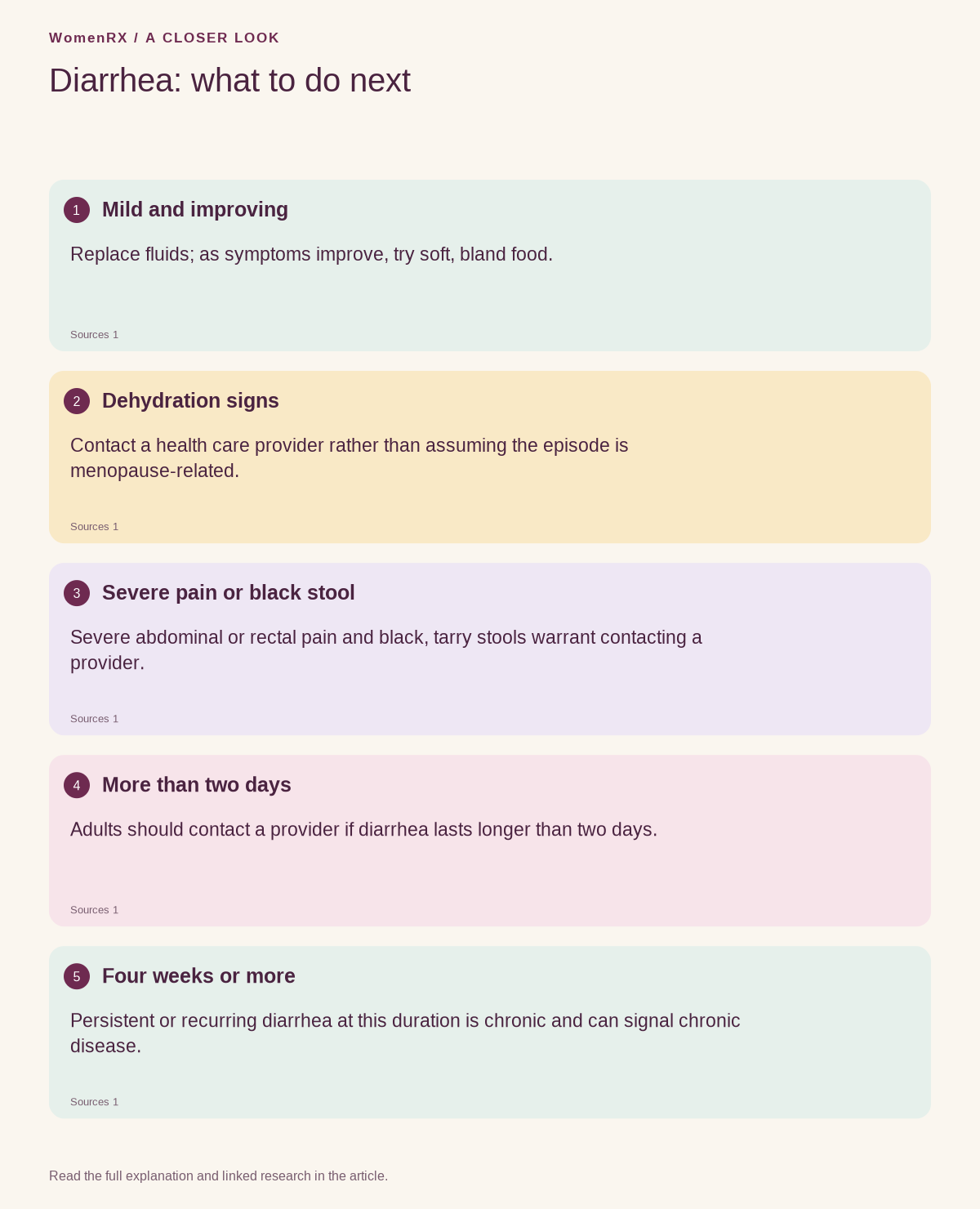
Diarrhea: what to do next
Mild and improving: Replace fluids; as symptoms improve, try soft, bland food.1
Dehydration signs: Contact a health care provider rather than assuming the episode is menopause-related.1
Severe pain or black stool: Severe abdominal or rectal pain and black, tarry stools warrant contacting a provider.1
More than two days: Adults should contact a provider if diarrhea lasts longer than two days.1
Four weeks or more: Persistent or recurring diarrhea at this duration is chronic and can signal chronic disease.1
Read the figure as text
Use duration, severity, and warning signs, not menopause timing alone, to decide whether to monitor a brief episode or seek care.- Mild and improving: Replace fluids; as symptoms improve, try soft, bland food.1
- Dehydration signs: Contact a health care provider rather than assuming the episode is menopause-related.1
- Severe pain or black stool: Severe abdominal or rectal pain and black, tarry stools warrant contacting a provider.1
- More than two days: Adults should contact a provider if diarrhea lasts longer than two days.1
- Four weeks or more: Persistent or recurring diarrhea at this duration is chronic and can signal chronic disease.1
More questions, answered
Does diarrhea mean I’m entering menopause?
No. Diarrhea alone doesn’t establish that you’re in the menopause transition. A midlife study did not find reproductive hormone measures to be significant predictors of diarrhea severity in its multivariable analysis. 3
When does diarrhea count as chronic?
MedlinePlus describes diarrhea lasting at least four weeks as chronic. It may be continuous or come and go, and can be a symptom of a chronic disease. 1
Sources you can check
- Diarrhea | MedlinePlusAccessed 2026-09-25Return to first citation
- Safety of Fezolinetant for Treatment of Moderate to Severe Vasomotor Symptoms Due to Menopause: Pooled Analysis of Three Randomized Phase 3 Studies.Kagan R, Cano A, Nappi RE, English ML, Mancuso S, Wu X, Ottery FD. · Advances in therapy · 2025Return to first citation
- Constipation and diarrhea during the menopause transition and early postmenopause: observations from the Seattle Midlife Women's Health Study.Callan NGL, Mitchell ES, Heitkemper MM, Woods NF. · Menopause (New York, N.Y.) · 2018Return to first citation