Diarrhea During Menopause: Is There a Link?
Diarrhea can happen during the menopause transition, but its timing alone doesn’t show that menopause caused it.
Diarrhea that starts during perimenopause isn’t necessarily caused by hormonal changes. Research cited in a study of bowel symptoms found few differences between women before and after menopause, but that comparison cannot show what happens during the transition or establish a cause. 4 If diarrhea begins or changes, its duration, possible infection, and medicine changes deserve attention too. 1 3
Menopause may be part of the timing, not the explanation
If diarrhea starts during perimenopause, the timing can make a hormone connection seem likely. But timing alone cannot show what caused it. One study examined 193 women who were not yet menopausal and compared gastrointestinal symptoms across menstrual-cycle phases. It found no significant difference by phase. The researchers also cited earlier work reporting few symptom differences between women before and after menopause. Neither finding shows whether diarrhea changes during perimenopause or whether hormones cause it. 4
The practical takeaway is not to dismiss the timing, but not to stop at it either. A new bowel change still deserves attention to its duration and other possible explanations.
Check the pattern and possible causes
Diarrhea generally means loose, watery stools three or more times in a day. A short-lived episode commonly lasts a day or two and goes away, though it can last longer. Viral or bacterial illness can cause diarrhea; infections may also come with fever, chills, or bloody stools. 1 3
Medication history can also matter: when evaluating diarrhea, a clinician may ask what medicines you take. If symptoms began after starting or changing a medicine, make a note of that timing and include it when discussing the change. 1
A clinician may also ask about foods or consider whether avoiding certain foods changes symptoms. That is one way to investigate a possible food-related cause; it does not mean a particular food is a menopause-specific trigger. 1
Let duration and warning signs guide your next step
If symptoms are mild and improving, replacing lost fluid is a useful first step. Diarrhea can cause dehydration. MedlinePlus advises adults with diarrhea to drink fluids; if you feel very thirsty or dizzy, take those symptoms seriously as possible signs of dehydration. 1 2
If diarrhea lasts more than a few days or keeps returning, contact a healthcare provider to discuss the change, even without other warning signs. Diarrhea lasting more than a few days may signal a more serious problem. 1 Contact a healthcare provider if you have a fever of 102°F or higher, blood or pus in the stool, or black, tarry stools. These are reasons to seek medical advice, not symptoms to write off as menopause. 1
Confusion or shock with dehydration calls for medical help right away. 2 Diarrhea lasting at least four weeks is considered chronic; it may come and go and can be a symptom of a chronic disease. 1
A short note about when symptoms started, how long they have lasted, and any recent medicine changes can help you explain the pattern. The key distinction is simple: a possible connection in timing is not the same as an established cause.
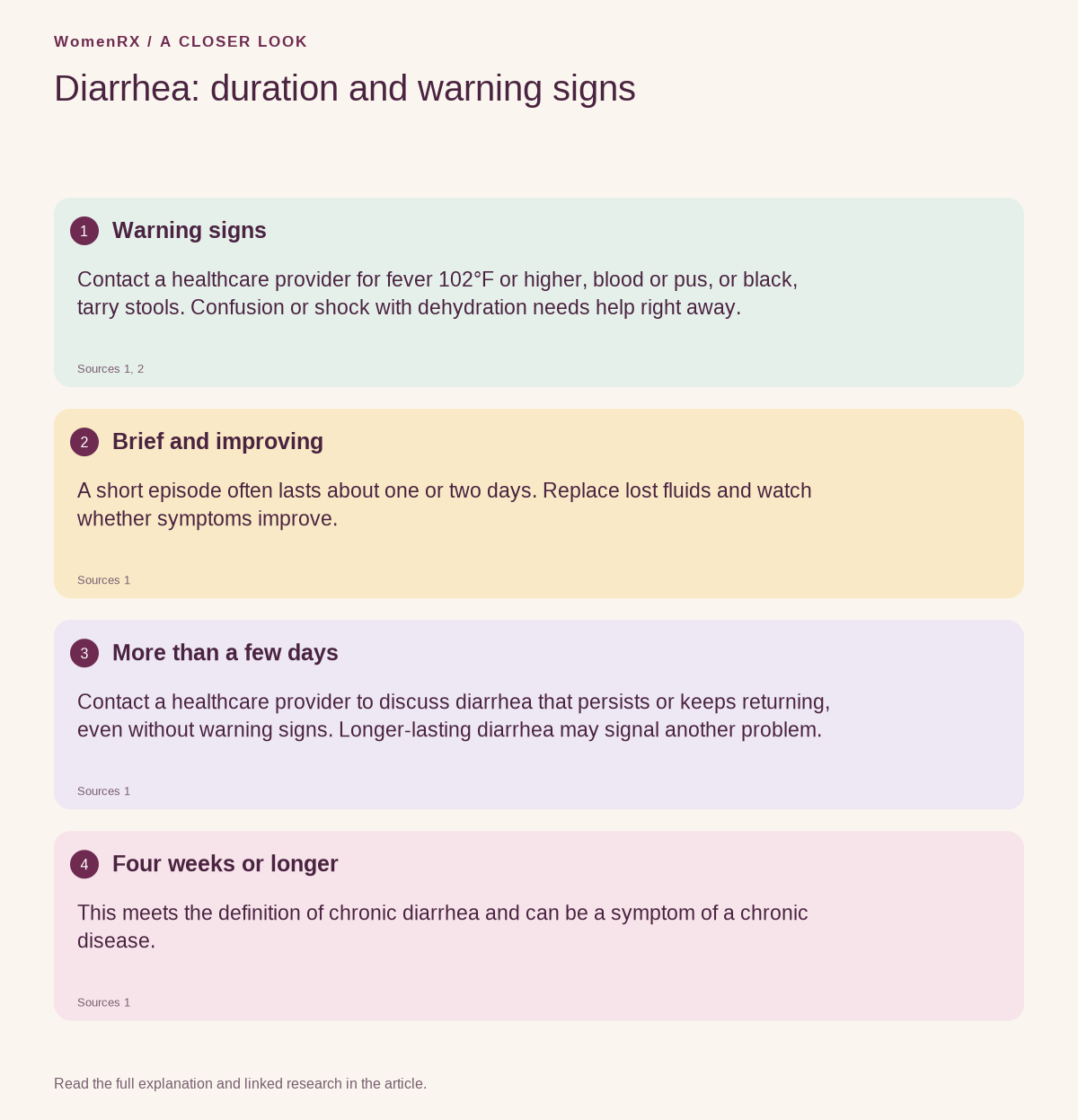
Diarrhea: duration and warning signs
Warning signs: Contact a healthcare provider for fever 102°F or higher, blood or pus, or black, tarry stools. Confusion or shock with dehydration needs help right away.12
Brief and improving: A short episode often lasts about one or two days. Replace lost fluids and watch whether symptoms improve.1
More than a few days: Contact a healthcare provider to discuss diarrhea that persists or keeps returning, even without warning signs. Longer-lasting diarrhea may signal another problem.1
Four weeks or longer: This meets the definition of chronic diarrhea and can be a symptom of a chronic disease.1
Read the figure as text
Use duration and specific warning signs to decide whether to monitor a brief episode or seek medical advice.- Warning signs: Contact a healthcare provider for fever 102°F or higher, blood or pus, or black, tarry stools. Confusion or shock with dehydration needs help right away.12
- Brief and improving: A short episode often lasts about one or two days. Replace lost fluids and watch whether symptoms improve.1
- More than a few days: Contact a healthcare provider to discuss diarrhea that persists or keeps returning, even without warning signs. Longer-lasting diarrhea may signal another problem.1
- Four weeks or longer: This meets the definition of chronic diarrhea and can be a symptom of a chronic disease.1
More questions, answered
When does diarrhea count as chronic?
Diarrhea lasting at least four weeks is considered chronic, whether it is continual or comes and goes. You don’t need to wait four weeks to discuss diarrhea that persists for more than a few days. 1
Which symptoms should I not attribute to menopause?
Seek medical advice for a fever of 102°F or higher, blood or pus in the stool, or black, tarry stools. Diarrhea lasting more than a few days may signal a more serious problem. Confusion or shock with dehydration needs medical help right away. 1 2
Sources you can check
- Diarrhea | MedlinePlusAccessed 2026-09-25Return to first citation
- Dehydration: MedlinePlusAccessed 2026-09-25Return to first citation
- Clinical Management of Infectious Diarrhea.Siciliano V, Nista EC, Rosà T, Brigida M, Franceschi F. · Reviews on recent clinical trials · 2020Return to first citation
- Irritable bowel syndrome is more common in women regardless of the menstrual phase: a Rome II-based survey.Lee SY, Kim JH, Sung IK, Park HS, Jin CJ, Choe WH, Kwon SY, Lee CH, Choi KW. · Journal of Korean medical science · 2007Return to first citation