How to Spread Protein Across Meals on GLP-1s
If smaller meals feel easier, you can spread your personal protein target across meals and snacks instead of leaving most of it for dinner.
Start with the daily protein target set for you, then divide it among the eating occasions you can manage. A worked 80-gram example below shows 22 grams at breakfast, 21 at lunch, 18 in a snack, and 19 at dinner using general food estimates. That’s an illustration, not a recommended target or a complete day of food. 5
Make the target fit the way you eat
GLP-1 medicines can reduce appetite and food intake, so a large meal may not feel realistic. 24 Instead of saving most of your protein for dinner, choose a pattern that spreads your daily target across the times you’re most likely to eat. This is a practical way to plan smaller meals, not a schedule proven to produce better health outcomes.
First, use the target set for you. Protein needs vary with factors including age, sex, health, and physical activity, so there isn’t one daily number that fits every reader. 1 If you haven’t been given a target, ask your care team or a registered dietitian to help set one rather than adopting the number below.
See what one protein day adds up to
Here’s an illustration using 80 grams as a chosen target, not a recommendation. The amounts come from the VA’s general food-portion estimates. Where a portion is doubled or halved, its protein estimate is adjusted by the same arithmetic. 5
| Occasion | Protein foods and portions | Estimated protein |
|---|---|---|
| Breakfast | Two large eggs, 14 g; 1 cup milk, 8 g | 22 g |
| Lunch | 3 ounces lean meat, fish, or skinless poultry | 21 g |
| Snack | ½ cup cottage cheese, 14 g; 1 tablespoon peanut butter, about 4 g | 18 g |
| Dinner | ½ cup cooked dry beans or peas, 7 g; 6 ounces tofu, about 12 g | 19 g |
| Day’s illustrated total | 22 + 21 + 18 + 19 | 80 g |
The VA lists 8 grams for 2 tablespoons of peanut butter and 6 grams for 3 ounces of tofu. The 4- and 12-gram figures above are calculated from those estimates, not separately measured values. 5 These are protein components, not four complete meals or a prescribed daily diet. You could include grains, fruit, vegetables, and fats alongside them; any additional protein from those foods isn’t counted in this illustration. Actual products and portions may differ, so use package information when you work out your own day.
Change the shape without losing the total
If breakfast feels too big, split it: one egg and ½ cup milk at one occasion, then the same amounts later. Each smaller occasion contributes about 11 grams, and together they still contribute the breakfast’s estimated 22 grams. That gives you five eating occasions instead of four without changing the illustrated foods or total. 5
If you prefer a vegetarian lunch, 1 cup cooked beans plus one large egg contributes an estimated 21 grams, the same protein estimate as the 3-ounce meat, fish, or poultry portion. It’s a larger-volume choice, though, so it may not be the easier swap on a low-appetite day. The amounts are an illustration, not a rule that these foods are interchangeable in every respect. 5 For a plant-focused day, eating different types of plant proteins across the day helps supply the amino acids your body needs. 1
Limited cooking time can change the plan, too. For example, you could serve fruit alongside the cottage cheese and peanut butter in the illustrated snack, while prepared beans can go into a soup. The VA guide also suggests hard-cooked eggs in sandwiches and tofu in soups. 5 Choose portions you’ll actually eat, then add their protein amounts rather than assuming every version of a meal matches the table.
Check the day, not just dinner
To make a pattern usable, write your own target at the top of a page. Under each planned meal or snack, note the food, the portion you’re likely to eat, and its protein amount. Add the amounts for the day. If the total is below your target, look for an occasion where another manageable protein food could fit; if a meal feels too large, move part of the plan to a snack. You don’t have to make every portion identical.
In a small cross-sectional survey of 69 adults using GLP-1 medicines for weight reduction, participants’ three-day food records showed that 40% of reported daily protein was eaten at dinner. The survey describes one group’s eating pattern; it didn’t test whether changing that distribution improves health or preserves muscle. 3 It’s a reason to notice where protein lands in your day, not a reason to avoid a dinner that works for you.
When the examples need adjusting
Different targets, appetites, and routines call for different portions. For example, an older woman who prefers smaller breakfasts could split the egg-and-milk breakfast into the two occasions shown above, while still using the protein target set for her. Someone with higher energy needs might prefer three larger meals and include more accompanying foods alongside the protein components. Neither example establishes her daily target or how much energy the whole day supplies. Protein needs vary with age, health, and activity. 1
The illustrated day doesn’t establish a protein target or a suitable menu for someone who is pregnant, breastfeeding, or managing kidney disease. Ask your clinician or a registered dietitian for a protein target and food advice that fit your situation, rather than treating this 80-gram example as a goal.
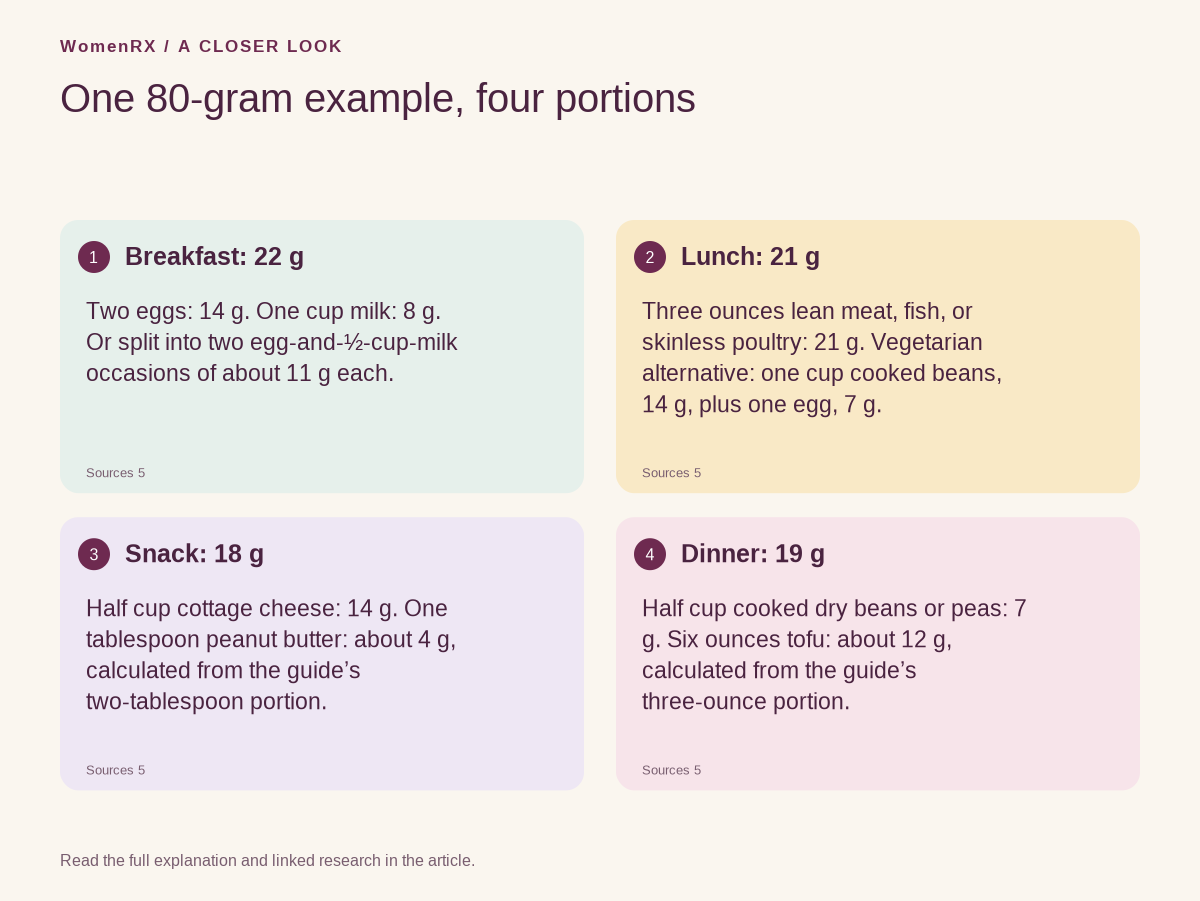
One 80-gram example, four portions
Breakfast: 22 g: Two eggs: 14 g. One cup milk: 8 g. Or split into two egg-and-½-cup-milk occasions of about 11 g each.5
Lunch: 21 g: Three ounces lean meat, fish, or skinless poultry: 21 g. Vegetarian alternative: one cup cooked beans, 14 g, plus one egg, 7 g.5
Snack: 18 g: Half cup cottage cheese: 14 g. One tablespoon peanut butter: about 4 g, calculated from the guide’s two-tablespoon portion.5
Dinner: 19 g: Half cup cooked dry beans or peas: 7 g. Six ounces tofu: about 12 g, calculated from the guide’s three-ounce portion.5
Read the figure as text
Compare the protein contribution of each eating occasion. The 80-gram total is illustrative, not a recommended target; these protein foods alone are not a complete day of food.- Breakfast: 22 g: Two eggs: 14 g. One cup milk: 8 g. Or split into two egg-and-½-cup-milk occasions of about 11 g each.5
- Lunch: 21 g: Three ounces lean meat, fish, or skinless poultry: 21 g. Vegetarian alternative: one cup cooked beans, 14 g, plus one egg, 7 g.5
- Snack: 18 g: Half cup cottage cheese: 14 g. One tablespoon peanut butter: about 4 g, calculated from the guide’s two-tablespoon portion.5
- Dinner: 19 g: Half cup cooked dry beans or peas: 7 g. Six ounces tofu: about 12 g, calculated from the guide’s three-ounce portion.5
More questions, answered
Do meals and snacks have to contain equal amounts of protein?
No. The illustrated day has different amounts at breakfast, lunch, snack, and dinner. You can split a larger occasion, as with the egg-and-milk breakfast, while checking that the portions you eat still add up to your own target. 5
Sources you can check
- Dietary Proteins: MedlinePlusAccessed 2026-09-25Return to first citation
- SAXENDA (LIRAGLUTIDE) INJECTION, SOLUTION [NOVO NORDISK PHARMACEUTICAL INDUSTRIES, LP] | US prescribing information and patient instructionsAccessed 2026-09-25Return to first citation
- Diet quality and nutrient distribution while using glucagon-like-peptide-1 receptor agonist: A secondary cross-sectional analysis.Johnson BVB, Milstead M, Green L, Kreider R, Jones R. · Obesity pillars · 2025Return to first citation
- GLP-1 physiology informs the pharmacotherapy of obesity.Drucker DJ. · Molecular metabolism · 2022Return to first citation
- Healthy Ways to Add Protein, VA Nutrition and Food ServicesAccessed 2026-09-25Return to first citation