Choosing a Protein Snack When GLP-1 Meals Feel Too Big
When your appetite is smaller, the most useful snack is one you can comfortably eat that fills a gap in your day.
If full meals feel difficult, try yogurt, cottage cheese, an egg, edamame, tofu, or a yogurt-based smoothie in an amount you can comfortably eat. These foods can add protein, but a snack isn’t required just because you take a GLP-1 medicine. Choose one if smaller meals are leaving a gap in what you eat across the day. 123
First, decide whether a snack would help
GLP-1 medicines can leave you less hungry or less interested in food. 1 In a review of controlled meal-test trials, people taking these medicines ate less at a test lunch than people taking placebo, but the authors noted that everyday dietary intake remains underreported. Your own appetite and eating pattern matter more than a rule that says everyone needs a protein snack. 7
A snack is useful if smaller meals have left you hungry later, you’ve gone a long stretch without eating, or you’re finding it hard to include protein foods in meals. If you’re eating comfortable, varied meals that meet your needs, you don’t have to add food simply because it’s labeled “high protein.” A four-society GLP-1 nutrition advisory favors flexible food choices and regular, smaller eating occasions when appetite is low. That’s expert guidance, not proof that a particular snack improves outcomes. 1
Pick a food and texture you can manage
Yogurt, cottage cheese, eggs, edamame and tofu are protein-food options; vegetables with hummus are another suggested snack pairing. Soft foods and smoothies may appeal when heavier foods don’t. 123
Start with an amount that feels manageable rather than a prescribed snack portion. The household measures below are author-chosen illustrations to help you picture a small amount. They aren’t recommended GLP-1 snack portions or equivalent protein servings. These examples compare ways to eat a protein food, not grams of protein. The protein you get depends on the food and how much you eat.
| Example snack | Small illustrative portion | Where the protein comes from and what may make it easier to eat |
|---|---|---|
| Plain yogurt with fruit | About ½ cup yogurt, with fruit as desired | Protein comes from the yogurt. It’s soft and spoonable. |
| Cottage cheese | About ¼ cup | A soft, spoonable protein-food option. |
| Egg | One egg | A single-item savory protein option rather than a spoonable food or drink. |
| Edamame | About ¼ cup | A plant-based protein food you can eat a little at a time. |
| Tofu | About ¼ cup | A soft plant-based option. Protein varies by product. |
| Vegetables with hummus | Vegetables with about 2 tablespoons hummus for dipping | The hummus contributes some protein, though the amount depends on how much you eat. |
These portions are examples for choosing an amount, not evidence-based targets. If tofu is a food you like, its package can tell you the protein in a listed serving; compare that serving with the amount you’ll actually eat. 2 The food examples alone don’t establish a protein total for your snack.
You can also make a small smoothie with yogurt and fruit if drinking feels easier than chewing. Its protein depends on what and how much you put in it. A protein drink can be convenient, but foods such as yogurt, eggs, soy foods, beans and fruit help you build a varied eating pattern rather than focusing on protein alone. The advisory includes smoothies and protein drinks as options when heavier foods are unappealing; it doesn’t establish that supplements work better than food. 12
Think about the whole day, not one perfect snack
A protein food at a snack can fill a gap, but it can’t make up for consistently eating too little overall. GLP-1 nutrition guidance calls for attention to fluids, varied foods and whether intake remains adequate as treatment continues. If you’re routinely struggling to eat or drink enough, tell the clinician managing your medicine rather than trying to solve it by adding another protein product. 1
Protein matters for maintaining muscle. The four-society advisory says extra protein alone is likely inadequate without structured strength training. In a small observational study of 28 adults starting semaglutide or tirzepatide, higher protein intake was associated with better preservation of estimated skeletal muscle mass over 24 weeks. That association does not prove that protein snacks caused the difference. 19
If you’re pregnant, choosing a manageable food is only part of the question. The Saxenda label recommends appropriate weight gain based on pre-pregnancy weight, including for people with overweight or obesity. If meals feel difficult, ask your pregnancy-care clinician to assess your overall intake rather than using these snack portions as a protein target. 5 Weight loss offers no benefit during pregnancy and may cause harm, according to the prescribing information for Saxenda (liraglutide); if you learn you’re pregnant while taking it, stop taking Saxenda and contact your prescriber promptly about care during pregnancy. 5 If you’re breastfeeding and taking Saxenda, its prescribing information says there are no human data on whether liraglutide passes into milk or affects a breastfed baby or milk production. Discuss the medicine and your feeding plans with your prescriber rather than treating a snack as a solution to that uncertainty. 5 If you’re breastfeeding, these illustrative portions cannot tell you whether you’re meeting your protein needs; ask your clinician or dietitian to assess your overall eating pattern separately. 4
Protein needs vary with age and activity, too. In older age, maintaining muscle and day-to-day function deserves particular attention, but there still isn’t one snack portion or protein target that fits everyone. 148
Finally, if you’re taking liraglutide, a snack isn’t the answer to severe or persistent abdominal pain, especially if the pain goes toward your back or comes with vomiting. Seek prompt medical care for that symptom. Liraglutide prescribing information identifies it as a possible sign of pancreatitis. 56
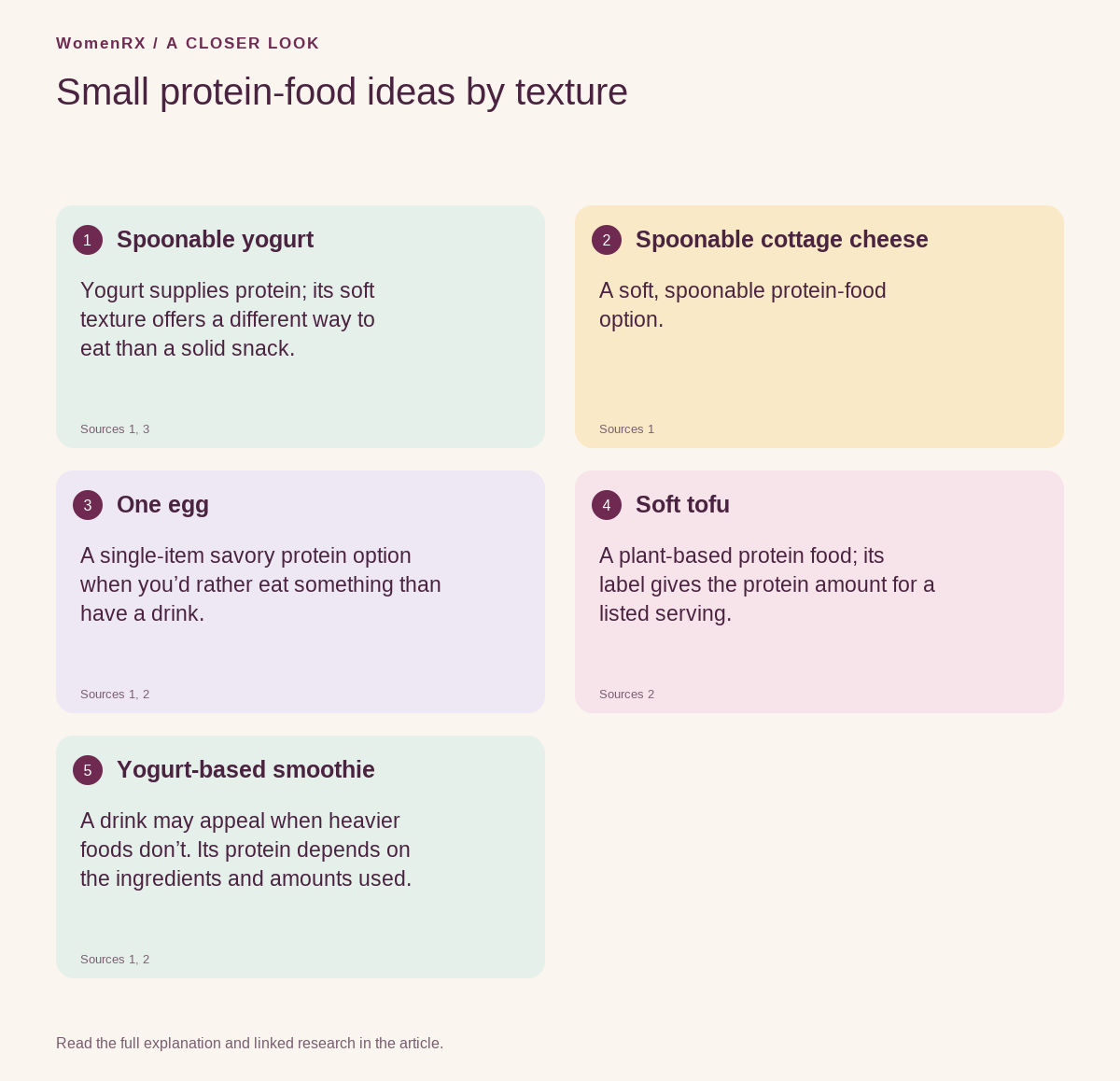
Small protein-food ideas by texture
Spoonable yogurt: Yogurt supplies protein; its soft texture offers a different way to eat than a solid snack.13
Spoonable cottage cheese: A soft, spoonable protein-food option.1
One egg: A single-item savory protein option when you’d rather eat something than have a drink.12
Soft tofu: A plant-based protein food; its label gives the protein amount for a listed serving.2
Yogurt-based smoothie: A drink may appeal when heavier foods don’t. Its protein depends on the ingredients and amounts used.12
Read the figure as text
For illustration only, picture ½ cup yogurt, ¼ cup cottage cheese, one egg, ¼ cup tofu, or a small smoothie. These are author-chosen amounts, not recommended portions or equivalent protein servings.- Spoonable yogurt: Yogurt supplies protein; its soft texture offers a different way to eat than a solid snack.13
- Spoonable cottage cheese: A soft, spoonable protein-food option.1
- One egg: A single-item savory protein option when you’d rather eat something than have a drink.12
- Soft tofu: A plant-based protein food; its label gives the protein amount for a listed serving.2
- Yogurt-based smoothie: A drink may appeal when heavier foods don’t. Its protein depends on the ingredients and amounts used.12
Sources you can check
- Nutritional priorities to support GLP-1 therapy for obesity: four-society joint advisory2025Return to first citation
- MedlinePlus: Protein in diet, including tofu and other plant sourcesAccessed 2026-09-25Return to first citation
- MedlinePlus: Managing weight with healthy eatingAccessed 2026-09-25Return to first citation
- Dietary Proteins: MedlinePlusAccessed 2026-09-25Return to first citation
- SAXENDA (LIRAGLUTIDE) INJECTION, SOLUTION [NOVO NORDISK PHARMACEUTICAL INDUSTRIES, LP] | US prescribing information and patient instructionsAccessed 2026-09-25Return to first citation
- VICTOZA (LIRAGLUTIDE) INJECTION [NOVO NORDISK] | US prescribing information and patient instructionsAccessed 2026-09-25Return to first citation
- Nutritional intake changes during GLP-1 receptor agonist therapy: A systematic review and meta-analysis.Quan AT, Nguyen HL, Nguyen TMT. · Diabetes & metabolic syndrome · 2026Return to first citation
- Dietary Intake as an Undermeasured Potential Mediator: The Ethical Case for Complete and Transparent Dietary Reporting in GLP-1 Receptor Agonist Trials.Strosahl JN, Ziegler TR, Singh RH. · Nutrients · 2026Return to first citation
- Changes in food cravings, dietary quality, body composition, and dietary intake during GLP-1 receptor agonist therapy: The CRAVE study.Babazadeh D, Therrien S, Fitch AK, Steinberg FM. · Obesity pillars · 2026Return to first citation