How to Track Protein on GLP-1 Treatment, Simply
A meal-by-meal check can be enough; detailed calorie or gram tracking isn’t automatically necessary.
You don’t need a detailed protein log just to notice whether protein-containing foods show up in your meals. Protein needs vary with health and activity, so an app’s default target may not fit you. 1 If you want a check, start with a simple meal log or visual reminder; use an app only if its estimates feel helpful. GLP-1 trials offer little guidance on which everyday approach to choose. 3
Start with the question you want answered
If your appetite is smaller on a GLP-1 medicine, you may wonder whether you’re still eating protein regularly. You don’t have to turn every meal into a calculation to check. Protein is found in foods such as meat, dairy, nuts, beans, and some grains, and your needs vary with factors including health and activity. 1
A useful first step is to decide what you want to learn: Am I including protein-containing foods during the day? Or do I need a more detailed estimate to discuss with a dietitian? The first question may not require an app. The second may call for a more structured record.
Three ways to check, with different tradeoffs
Visual reminder: lowest effort, least precise. At meals or snacks, notice whether you included a protein-containing food. This can help you see a pattern without weighing food or counting grams. It won’t tell you how much protein you ate, and a visual impression isn’t a nutritional assessment. Think of it as a prompt, not a score.
Simple meal log: a middle ground. Briefly write down what you ate, without calculating nutrients. This can show whether protein-containing foods appear regularly and give you something concrete to review with a dietitian. It takes more attention than a visual check, and it won’t calculate a reliable protein total on its own.
Digital food tracking: more numbers, more input. An app can estimate protein from the foods and amounts you enter. That can be useful if you genuinely want a rough numerical picture, but the estimate depends on the details entered. Technology-assisted dietary assessment is one approach researchers use. Dietary assessment has measurement error, and its intensity should be balanced against the burden of using it. 2 An app estimate isn’t the same as an individualized nutrition assessment.
A systematic review found a notable limitation in GLP-1 treatment research: only 2 of 41 included randomized trials assessing liraglutide, semaglutide, or tirzepatide reported or assessed dietary intake. That leaves limited trial evidence for choosing one everyday tracking method over another. 3
A no-counting option
If logging feels tiring or stressful, skip the numbers. You could use a simple food-based reminder: when you’re choosing food, consider whether a protein-containing option sounds manageable. Examples include dairy, meat, nuts, or beans. 1 The point is to notice options, not to force a particular food or portion.
You can also stop a tracking approach that makes meals feel more tense or preoccupied. Tracking is a tool you can choose, not a requirement for taking a GLP-1 medicine. If you need a protein target or help interpreting a record, ask a registered dietitian or your care team to personalize that conversation; protein needs vary. 1
When a generic tracker may not fit
If you’re pregnant or breastfeeding, or have a history of an eating disorder, you may prefer to talk through whether food logging feels useful for you rather than starting with a generic app target. Your circumstances and your relationship with tracking matter; an app setting can’t settle that decision for you.
The practical choice is the least demanding method that answers your question without adding distress. For some people, that’s a quick visual check; for others, it’s a short meal log or an app used as a rough estimate. And if none of those helps, not tracking is a reasonable option.
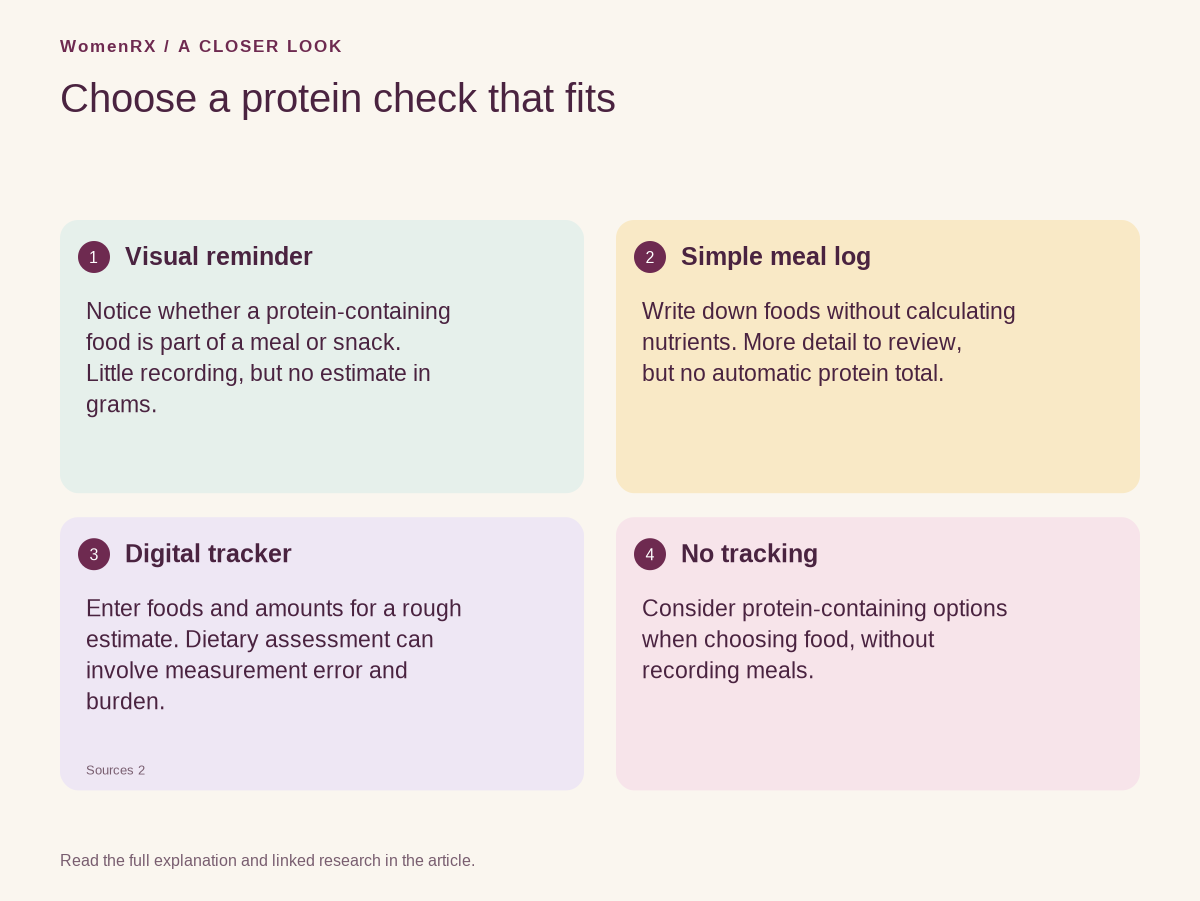
Choose a protein check that fits
Visual reminder: Notice whether a protein-containing food is part of a meal or snack. Little recording, but no estimate in grams.
Simple meal log: Write down foods without calculating nutrients. More detail to review, but no automatic protein total.
Digital tracker: Enter foods and amounts for a rough estimate. Dietary assessment can involve measurement error and burden.2
No tracking: Consider protein-containing options when choosing food, without recording meals.
Read the figure as text
These options trade effort for detail. None is required, and you can stop if logging adds distress.- Visual reminder: Notice whether a protein-containing food is part of a meal or snack. Little recording, but no estimate in grams.
- Simple meal log: Write down foods without calculating nutrients. More detail to review, but no automatic protein total.
- Digital tracker: Enter foods and amounts for a rough estimate. Dietary assessment can involve measurement error and burden.2
- No tracking: Consider protein-containing options when choosing food, without recording meals.
More questions, answered
Do I need to reach the same protein amount every day?
Protein needs vary with factors such as health and activity. If you need a daily target, a dietitian or your care team can help you work out what fits your situation rather than relying on an app’s default. 1
Can an app tell me exactly how much protein I eat?
Treat an app’s result as an estimate based on what you enter, not an exact measurement or individualized nutrition assessment. Dietary assessment methods can involve measurement error. 2
Sources you can check
- Dietary Proteins: MedlinePlusAccessed 2026-09-25Return to first citation
- Dietary Intake as an Undermeasured Potential Mediator: The Ethical Case for Complete and Transparent Dietary Reporting in GLP-1 Receptor Agonist Trials.Strosahl JN, Ziegler TR, Singh RH. · Nutrients · 2026Return to first citation
- A Systematic Review Identifying Critical Evidence Gaps in Reporting Dietary Change in Randomized Controlled Trials Prescribing Liraglutide, Semaglutide, or Tirzepatide.Jansson AK, Gómez-Martín M, Hedin L, Clarke ED, Cross V, Stanford J, Taylor RM, Bogl LH, De Vlieger N, Koochek A, Löf M, Asher RC, Burrows T, Bucher T, Sullivan C, Nowicka P, Colli... · Obesity reviews : an official journal of the International Association for the Study of Obesity · 2026Return to first citation