GLP-1 Nutrition: Which Questions Deserve Your Attention?
If your appetite falls during GLP-1 treatment, focus on whether you’re eating enough, what symptoms affect your meals, and what your own nutrition needs are.
GLP-1 treatment can reduce food intake, making it worth checking whether you’re getting enough protein and other nutrients. Fiber can help prevent constipation, but adding it quickly may cause gas or bloating. Protein needs vary, and a small nutrition-counseling pilot did not test a universal GLP-1 meal plan. Your symptoms, health conditions, and life stage should shape the discussion. 2 3 4 5
Start with what has changed
If you feel full sooner or have less interest in food, the first question isn’t whether you’re following a perfect diet. It’s whether the amount you can comfortably eat is still giving you enough nourishment. Liraglutide’s prescribing information describes weight loss as occurring through decreased calorie intake. A paper about nutrition counseling during GLP-1 treatment raises inadequate protein or micronutrient intake as a concern when appetite falls. Its pilot involved adults who had already lost at least 5% of their weight and were receiving counseling during weight maintenance; it did not test whether participants developed nutritional shortfalls or establish a universal meal plan. 4 5
A practical example: if a usual meal now feels like too much, notice which foods remain manageable and nourishing rather than forcing the same portions you ate before. If your intake is persistently very limited, or you’re concerned you’re not meeting your needs, that’s a useful treatment-plan question for your prescriber or a registered dietitian.
Protein: enough matters more than “high protein”
Protein helps build and maintain muscle, bones, and skin, but individual needs vary with factors such as age, health, and activity. MedlinePlus describes this variation, while the nutrition-counseling pilot does not establish a special protein target for everyone taking a GLP-1 medicine. 3 5
If appetite is low, ask whether your usual eating pattern is still providing enough protein and whether a different mix of foods would be easier to manage. Beans, nuts, dairy, meat, and some grains provide protein; people relying on plant proteins can get the amino acids they need by eating different types of plant protein. 3 This is a question about adequacy and preference, not a reason to assume that more protein is always better.
Fiber and fluids: change one thing at a time
Fiber from plant foods can help digestion and prevent constipation. But increasing it too quickly can cause gas, bloating, or cramps, so a gradual change is more comfortable for many people. 2 If constipation is an issue, consider whether your current meals include foods such as vegetables, fruit, or whole grains, and whether adding them slowly suits you.
Water is part of a healthy eating pattern. 1 If symptoms are making it hard to eat or drink normally, raise that with your care team rather than assuming a food or drink adjustment will be enough. Gastrointestinal reactions to liraglutide can sometimes be severe. 4
Meal size and food triggers aren’t a prescription
You may hear advice to eat smaller meals or avoid rich, spicy, or carbonated foods. A research paper discussing nutrition support mentions avoiding fatty or spicy foods and carbonated beverages as possible measures for tolerability. That passage doesn’t prove one approach works for everyone, or define a required GLP-1 diet. 5
If a certain food seems to make symptoms worse, noting the pattern and trying a manageable alternative can be more useful than cutting out broad food groups automatically. A dietitian or prescriber can help you distinguish a personal trigger from advice that may not fit your experience.
What changes for women?
The nutrition-counseling pilot does not show that women need a different GLP-1 nutrition plan because of sex. It included 58 women among 78 adults who had already lost weight and were receiving maintenance-phase counseling, but it did not report women-specific treatment effects. 5 Nutrition needs can still vary with age, health, and life circumstances, as they do for anyone. 3
Pregnancy is a distinct treatment situation, not simply another nutrition adjustment. A 2025 joint endocrine guideline suggests stopping GLP-1 receptor agonists before conception for people with type 2 diabetes, based on limited pregnancy safety data. This is a medication-planning question to address before trying to conceive, not a reason to change treatment on your own. 6 The maintenance-phase pilot cannot tell us what nutrition plan fits someone who is breastfeeding or going through menopause. 5
When symptoms need more than a food adjustment
For liraglutide, prescribing information warns that severe gastrointestinal reactions can occur. It also says persistent or severe abdominal pain, sometimes spreading to the back and sometimes accompanied by nausea or vomiting, can be a sign of acute pancreatitis and needs prompt medical attention. 4 Don’t try to manage that kind of pain by changing meals alone.
For everyday nutrition questions, keep the discussion specific: What foods are manageable? Has constipation or another symptom changed what you eat? Are you worried that lower intake is leaving gaps? These details can help your care team tailor advice to your medication, health needs, and preferences. A focused meal-planning guide can help with food ideas, but it can’t replace an individualized plan when symptoms or life stage change the picture.
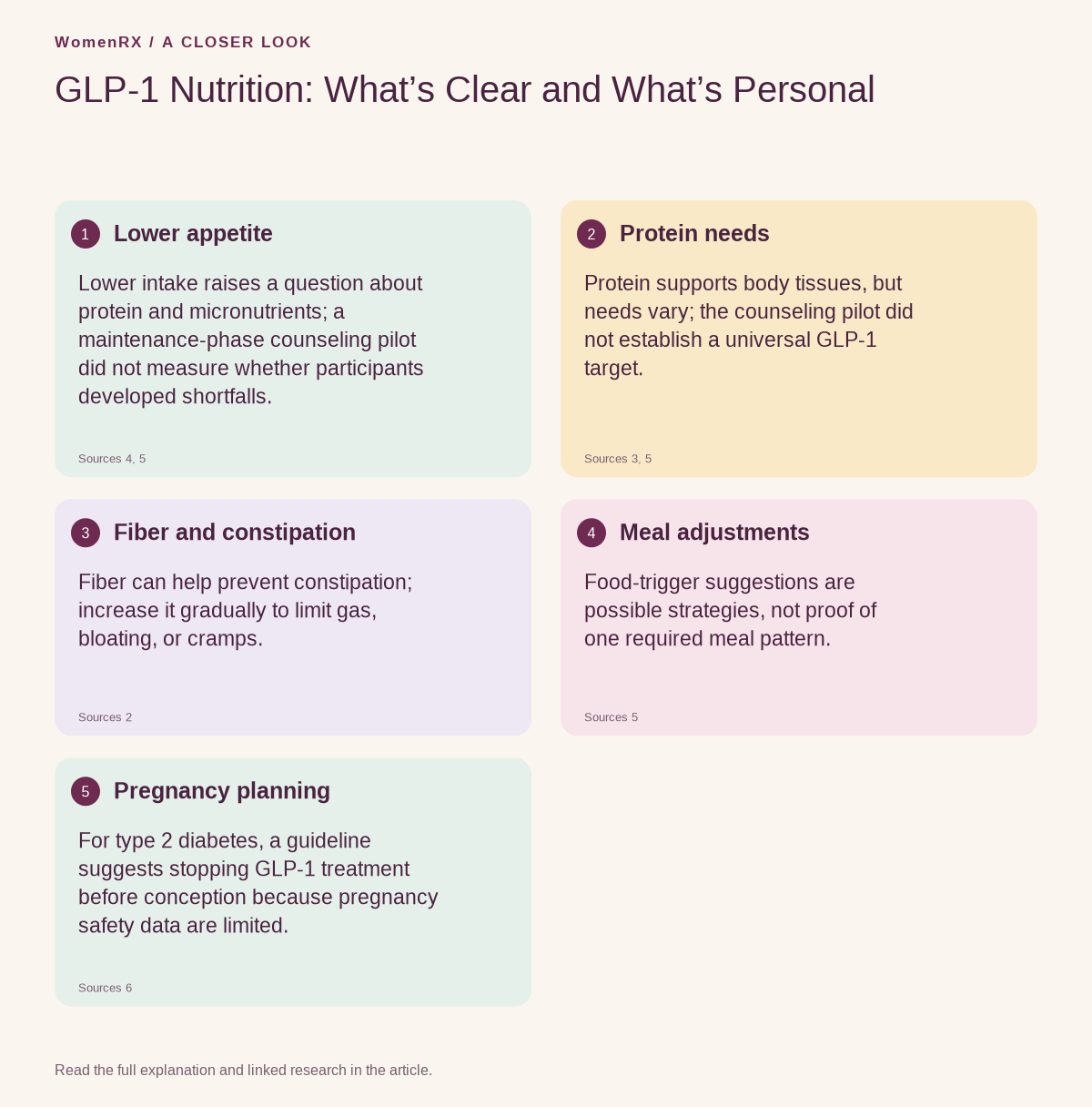
GLP-1 Nutrition: What’s Clear and What’s Personal
Lower appetite: Lower intake raises a question about protein and micronutrients; a maintenance-phase counseling pilot did not measure whether participants developed shortfalls.45
Protein needs: Protein supports body tissues, but needs vary; the counseling pilot did not establish a universal GLP-1 target.35
Fiber and constipation: Fiber can help prevent constipation; increase it gradually to limit gas, bloating, or cramps.2
Meal adjustments: Food-trigger suggestions are possible strategies, not proof of one required meal pattern.5
Pregnancy planning: For type 2 diabetes, a guideline suggests stopping GLP-1 treatment before conception because pregnancy safety data are limited.6
Read the figure as text
Separate general nutrition principles from practical questions that need to be tailored to your symptoms and treatment.- Lower appetite: Lower intake raises a question about protein and micronutrients; a maintenance-phase counseling pilot did not measure whether participants developed shortfalls.45
- Protein needs: Protein supports body tissues, but needs vary; the counseling pilot did not establish a universal GLP-1 target.35
- Fiber and constipation: Fiber can help prevent constipation; increase it gradually to limit gas, bloating, or cramps.2
- Meal adjustments: Food-trigger suggestions are possible strategies, not proof of one required meal pattern.5
- Pregnancy planning: For type 2 diabetes, a guideline suggests stopping GLP-1 treatment before conception because pregnancy safety data are limited.6
More questions, answered
What if I’m planning a pregnancy?
For people with type 2 diabetes, a 2025 joint endocrine guideline suggests stopping GLP-1 receptor agonists before conception; the recommendation reflects limited pregnancy safety data. Discuss medication and nutrition planning before trying to conceive rather than making a treatment change on your own. 6
Is there a proven GLP-1 diet for menopause or breastfeeding?
A small study of adults receiving weight-maintenance counseling after GLP-1-associated weight loss did not test meal plans for menopause or breastfeeding. Your own intake, symptoms, health conditions, and life stage are more useful starting points than treating that pilot as a diet rule. 5
Sources you can check
- Nutrition: MedlinePlusAccessed 2026-09-25Return to first citation
- Dietary Fiber: MedlinePlusAccessed 2026-09-25Return to first citation
- Dietary Proteins: MedlinePlusAccessed 2026-09-25Return to first citation
- SAXENDA (LIRAGLUTIDE) INJECTION, SOLUTION [NOVO NORDISK PHARMACEUTICAL INDUSTRIES, LP] | US prescribing information and patient instructionsAccessed 2026-09-25Return to first citation
- Clinical Decision Support for Digital Dietary Counseling Under GLP-1 Receptor Agonist Therapy: Convergent Mixed Methods Usability and Treatment Satisfaction Pilot Study of the Personalized Nutrition Advisor.Orban F, Journeaux A, Kanehl P, Stoll M, Lehmann M, Schirmann F, Herzig D, Bally L. · JMIR formative research · 2026Return to first citation
- Preexisting Diabetes and Pregnancy: An Endocrine Society and European Society of Endocrinology Joint Clinical Practice Guideline.Wyckoff JA, Lapolla A, Asias-Dinh BD, Barbour LA, Brown FM, Catalano PM, Corcoy R, Di Renzo GC, Drobycki N, Kautzky-Willer A, Murad MH, Stephenson-Gray M, Tabák AG, Weatherup E, Ze... · European journal of endocrinology · 2025Return to first citation