GLP-1 Treatment in Your 40s: What to Weigh
Your health history, treatment goals, and pregnancy plans tell a clinician more than your decade of life does.
Being in your 40s doesn’t, by itself, answer whether a GLP-1 medicine is a fit. The useful discussion is about your weight-related health, medical history, goals, and the specific medicine being considered. If pregnancy is possible or planned, say so before treatment and ask about the particular product. Perimenopause may be part of your context, but a weight-loss medicine shouldn’t be assumed to treat menopause symptoms.
Being in your 40s doesn’t tell you, on its own, whether a GLP-1 medicine is right for you. A more useful conversation starts with what you want treatment to change, how your weight relates to your health, what else is going on medically, and whether pregnancy could be part of your plans.
Age can be a reason to review those details, not a substitute for them. Two women the same age may have very different health histories, goals, and treatment considerations.
Start with the health reason and the goal
A clinician may review your weight history, health conditions, medications, and previous efforts to manage your weight. BMI can be one part of that assessment, but it doesn’t distinguish fat from muscle or bone; waist size and other health information may add context. Some medical conditions and medicines can also affect weight. 1
Be specific about what you hope treatment will help with. For example, your priority might be improving a weight-related health concern, reaching a sustainable weight goal, or finding an approach that works alongside your existing care. Those are different conversations from wanting help with hot flashes or other menopause symptoms.
The medicine itself matters, too. Check the prescribing information for the particular medicine being considered. For example, the US prescribing information for Saxenda, a liraglutide product, warns about sometimes-severe gastrointestinal reactions and says it is not recommended for people with severe gastroparesis. That is a product-specific consideration, not a complete safety summary for every GLP-1 medicine. 2
Include perimenopause without assuming it explains everything
Changes in weight or body shape in midlife can prompt questions about perimenopause, but being in your 40s doesn’t establish your menopausal status or predict how you’ll respond to treatment. Bring up cycle changes or other symptoms if they matter to you; they may call for their own assessment rather than being treated as a weight problem.
It also helps to keep treatment goals distinct. The North American Menopause Society identifies hormone therapy as the most effective treatment for bothersome vasomotor symptoms, such as hot flashes. That is a separate treatment question from whether a medicine is appropriate for weight management. 4 A GLP-1 medicine shouldn’t be assumed to treat hot flashes or other menopause symptoms just because weight and midlife changes overlap.
Talk about pregnancy plans early
If you could become pregnant, are trying to conceive, or are considering fertility treatment, bring that up before selecting or continuing a medicine. Pregnancy safety and recommendations should be discussed for the particular product. For semaglutide, the available reproductive evidence describes pregnancy safety as not definitively established, so don’t assume it is safe during pregnancy. 35
One retrospective study offers a reason not to oversimplify fertility questions. It followed 1,936 women aged 20 to 40 with infertility and found that semaglutide pretreatment was associated with lower pregnancy and live-birth outcomes than in matched controls. Because it was an observational study, it cannot show that semaglutide caused those differences. And women receiving fertility care are not the same population as everyone considering weight treatment in her 40s. The finding deserves discussion, not a prediction about an individual’s chances. 5
If you have PCOS or changes in menstrual cycles, mention those as well. A review of semaglutide studies in PCOS found that reports of improved menstrual regularity came largely from small studies or conference abstracts, so they don’t establish that the medicine improves fertility. 6
Make the appointment about your actual tradeoffs
A focused conversation can cover:
- Reason for treatment: What health concern or goal are you addressing, and how will you know whether the plan is helping?
- Health history: Which conditions, past treatments, and current medicines could affect the choice? Weight treatment planning may depend on overall health, and some medicines or conditions can influence weight. 1
- Product-specific safety: What side effects and medical cautions apply to the particular medicine being considered? For Saxenda, for example, severe gastrointestinal reactions and severe gastroparesis are noted in the prescribing information. 2
- Reproductive plans: Could pregnancy be possible during treatment, or are you planning conception or fertility care? Agree on a medicine-specific plan before starting or changing treatment. 35
- Midlife symptoms: Are cycle changes, hot flashes, or other symptoms also affecting your well-being? They may need a separate plan; menopause treatment and weight management are not interchangeable goals. 4
The most useful next step is to bring your priorities and relevant history into the discussion, rather than letting the number 40 stand in for either. The answer should be specific to your health, your plans, and the medicine under consideration.
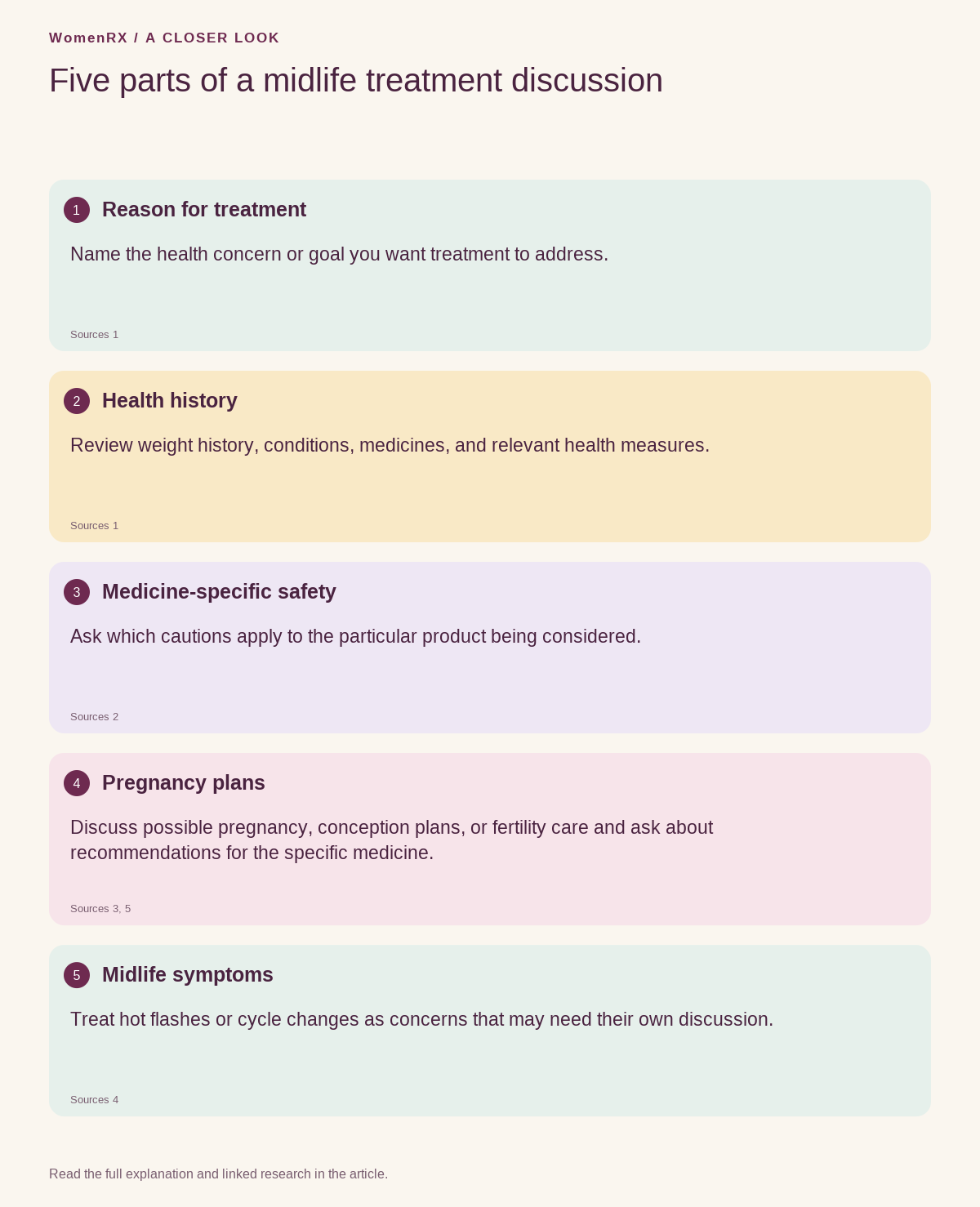
Five parts of a midlife treatment discussion
Reason for treatment: Name the health concern or goal you want treatment to address.1
Health history: Review weight history, conditions, medicines, and relevant health measures.1
Medicine-specific safety: Ask which cautions apply to the particular product being considered.2
Pregnancy plans: Discuss possible pregnancy, conception plans, or fertility care and ask about recommendations for the specific medicine.35
Midlife symptoms: Treat hot flashes or cycle changes as concerns that may need their own discussion.4
Read the figure as text
Use these prompts to keep the conversation focused on your health and plans, rather than age alone.- Reason for treatment: Name the health concern or goal you want treatment to address.1
- Health history: Review weight history, conditions, medicines, and relevant health measures.1
- Medicine-specific safety: Ask which cautions apply to the particular product being considered.2
- Pregnancy plans: Discuss possible pregnancy, conception plans, or fertility care and ask about recommendations for the specific medicine.35
- Midlife symptoms: Treat hot flashes or cycle changes as concerns that may need their own discussion.4
Sources you can check
- Obesity: MedlinePlusAccessed 2026-09-25Return to first citation
- SAXENDA (LIRAGLUTIDE) INJECTION, SOLUTION [NOVO NORDISK PHARMACEUTICAL INDUSTRIES, LP] | US prescribing information and patient instructionsAccessed 2026-09-25Return to first citation
- Pregnancy and Medicines | MedlinePlusAccessed 2026-09-25Return to first citation
- The 2022 hormone therapy position statement of The North American Menopause Society.“The 2022 Hormone Therapy Position Statement of The North American Menopause Society” Advisory Panel. · Menopause (New York, N.Y.) · 2022Return to first citation
- Impact of semaglutide pretreatment on reproductive outcomes in women with overweight and obesity with infertility: a real-world multicenter cohort study.Wu YC, Hsu JC, Su EC, Chen CH, Chang TH. · Reproductive biology and endocrinology : RB&E · 2026Return to first citation
- Efficacy and Safety of Semaglutide in Patients with Polycystic Ovary Syndrome: A Scoping Review.La Vignera S, Condorelli RA. · Biomedicines · 2026Return to first citation