A GLP-1 Medicine During Perimenopause: What to Weigh
The decision is about treating weight-related health needs, not treating perimenopause itself.
Obesity care may include weight-loss medicines, but a BMI category or being in perimenopause alone doesn’t establish eligibility for a specific GLP-1 medicine. Menopause-specific evidence remains limited. Guidance identifies treatments for hot flashes and other menopause symptoms but doesn’t identify GLP-1 medicines for those purposes. Clarify your treatment goal, reproductive plans, symptom priorities, and how nutrition and muscle health will be followed. 1 3 4 5
Start with the reason for treatment
Perimenopause alone isn’t enough to determine whether a weight-management medicine is appropriate. The first question is whether you have a health reason to treat excess weight and whether medication fits your overall care. MedlinePlus defines obesity in adults as a body mass index (BMI) of 30 or more, and describes weight-loss medicines as one possible part of obesity treatment. That broad information does not establish eligibility for a specific GLP-1 medicine. A BMI category is a starting point for assessment, not a decision about which medicine is right for you. 1
Ask what the treatment is intended to change in your case. The goal might involve weight, a related health condition, or both. That’s different from choosing a medicine because body changes have begun during the menopause transition. Treatment plans for obesity can depend on overall weight and other health conditions. 1
Keep weight goals separate from menopause symptoms
If hot flashes, night sweats, or vaginal and urinary symptoms are a priority, discuss them as their own treatment questions. Menopause guidance identifies hormone therapy as the most effective treatment for vasomotor symptoms and describes options for genitourinary symptoms. Separate guidance lists evidence-supported nonhormonal options for vasomotor symptoms. Neither identifies GLP-1 medicines as a treatment option for these symptoms. A weight-management medicine and menopause symptom treatment address different goals, though both could be part of an individual care plan. 3 4
That distinction can help if several concerns are happening at once. For example, you might want help with weight and also be waking at night with hot flashes. Name both concerns, then discuss them as separate treatment questions rather than assuming one medicine will address both.
What menopause-specific research can tell you
The evidence for GLP-1 and related medicines specifically in peri- and postmenopausal women is still limited and largely observational, according to a 2026 position statement from the Spanish Menopause Society. The statement says semaglutide has the largest amount of direct menopause-specific evidence among these medicines, while menopause-specific evaluation is still needed for tirzepatide and other dual incretin therapies. That does not show that one is best for a particular woman in perimenopause. 5
One study compared women described as postmenopausal with premenopausal women after four months of semaglutide. Average weight loss and lean-mass changes were similar between the groups, but the study did not report a separate perimenopause group. It therefore offers only limited help in predicting what to expect during the transition. 6
Make muscle and nutrition part of the plan
Weight loss can involve changes in lean mass as well as fat mass. The menopause society statement recommends considering muscle and skeletal health alongside cardiometabolic goals, with attention to resistance exercise, adequate protein intake, and structured monitoring of functional and metabolic outcomes. It does not provide a universal nutrition target or a single monitoring schedule for every woman. 5
Ask what you and your care team will use to judge whether the plan is working beyond the number on the scale. Depending on your circumstances, that discussion might include how you’re eating, strength or physical function, and relevant health measures. If appetite or side effects make it hard to eat well, raise that early; the Saxenda prescribing information, for example, warns that gastrointestinal reactions can sometimes be severe. That warning is specific to liraglutide marketed as Saxenda, not a precise estimate of risk for every medicine in the class. 2
Include reproductive status and current symptoms
If pregnancy is possible, or you’re trying to conceive, say so and ask how it affects the specific medicine being considered. Age or changing periods shouldn’t substitute for that medicine-specific conversation.
Bring your current symptoms into the conversation too. For example, nausea or other digestive symptoms may affect how manageable a treatment feels, while hot flashes or sleep disruption may need a separate plan. The goal is to choose treatment around your health priorities and circumstances, not to treat every midlife change as a weight problem.
Questions that make the decision more specific
- What health concern are we treating, and how will we know whether treatment is helping?
- What are the current US eligibility criteria for this specific medicine, and how does my health history fit them?
- How should pregnancy possibility or plans affect the choice?
- What will we monitor for nutrition, strength, function, and relevant health measures?
- Which symptoms need a separate menopause treatment plan?
- What side effects should prompt me to contact you or seek prompt care? For Saxenda, its prescribing information identifies persistent or severe abdominal pain, sometimes radiating to the back, as a possible sign of pancreatitis. 2
A useful decision isn’t simply “yes” or “no” based on being in perimenopause. It connects a clear weight-related health goal with your reproductive circumstances, symptom priorities, and a plan to protect day-to-day function while treatment is assessed.
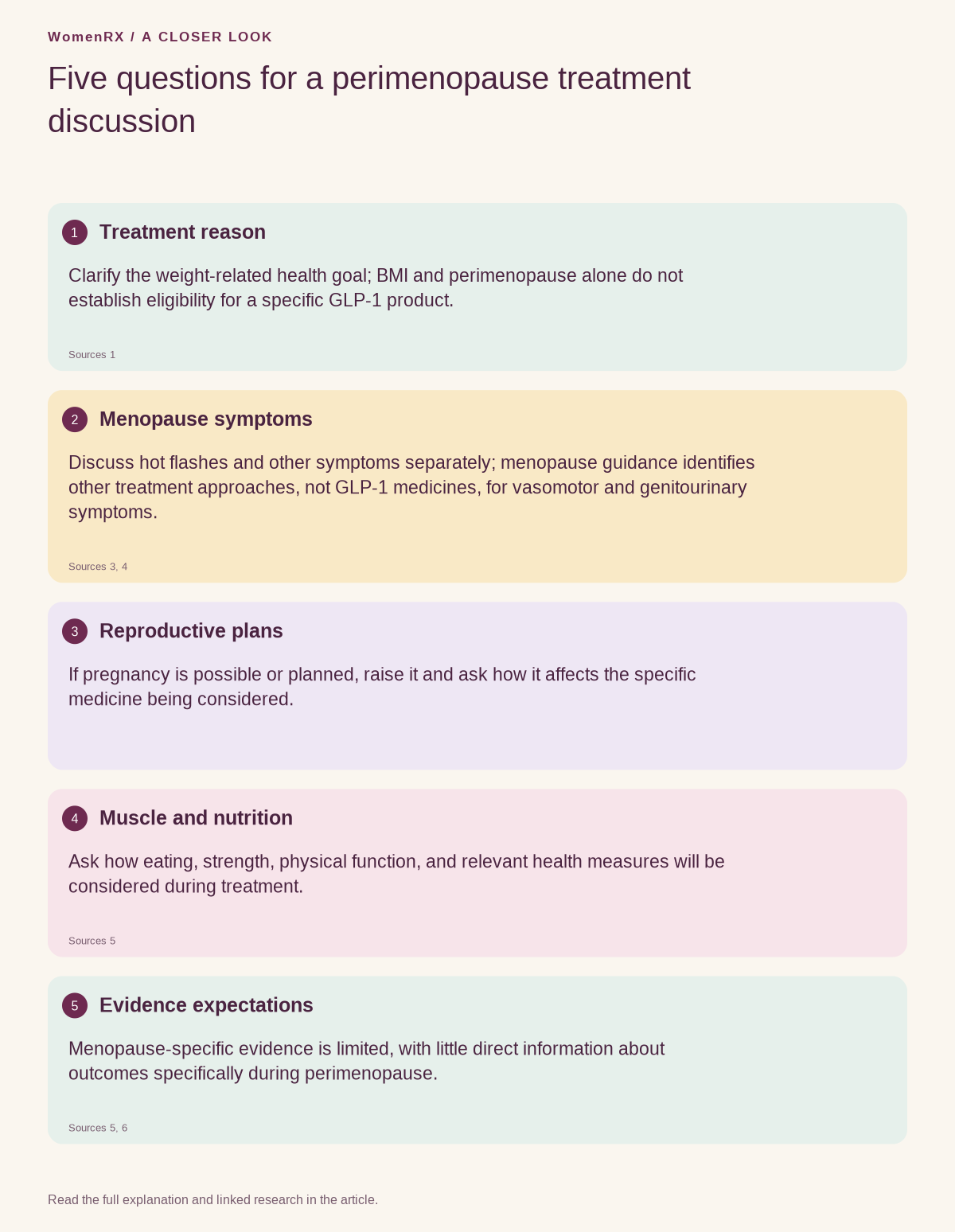
Five questions for a perimenopause treatment discussion
Treatment reason: Clarify the weight-related health goal; BMI and perimenopause alone do not establish eligibility for a specific GLP-1 product.1
Menopause symptoms: Discuss hot flashes and other symptoms separately; menopause guidance identifies other treatment approaches, not GLP-1 medicines, for vasomotor and genitourinary symptoms.34
Reproductive plans: If pregnancy is possible or planned, raise it and ask how it affects the specific medicine being considered.
Muscle and nutrition: Ask how eating, strength, physical function, and relevant health measures will be considered during treatment.5
Evidence expectations: Menopause-specific evidence is limited, with little direct information about outcomes specifically during perimenopause.56
Read the figure as text
Use these prompts to keep weight-management goals distinct from menopause symptom care and include product-specific eligibility, reproductive plans, and day-to-day function.- Treatment reason: Clarify the weight-related health goal; BMI and perimenopause alone do not establish eligibility for a specific GLP-1 product.1
- Menopause symptoms: Discuss hot flashes and other symptoms separately; menopause guidance identifies other treatment approaches, not GLP-1 medicines, for vasomotor and genitourinary symptoms.34
- Reproductive plans: If pregnancy is possible or planned, raise it and ask how it affects the specific medicine being considered.
- Muscle and nutrition: Ask how eating, strength, physical function, and relevant health measures will be considered during treatment.5
- Evidence expectations: Menopause-specific evidence is limited, with little direct information about outcomes specifically during perimenopause.56
More questions, answered
Does being in perimenopause make me eligible for a GLP-1 medicine?
Perimenopause alone doesn’t establish eligibility. MedlinePlus describes weight-loss medicines as one possible part of obesity care, but that broad guidance doesn’t set eligibility criteria for a specific GLP-1 product. The specific medicine’s current US criteria and your health circumstances need to be considered. 1
Can a GLP-1 medicine treat hot flashes?
Menopause guidance doesn’t identify GLP-1 medicines as a hot-flash treatment. It identifies hormone therapy as the most effective treatment for vasomotor symptoms and lists evidence-supported nonhormonal options. 3 4
Sources you can check
- Obesity: MedlinePlusAccessed 2026-09-25Return to first citation
- SAXENDA (LIRAGLUTIDE) INJECTION, SOLUTION [NOVO NORDISK PHARMACEUTICAL INDUSTRIES, LP] | US prescribing information and patient instructionsAccessed 2026-09-25Return to first citation
- The 2022 hormone therapy position statement of The North American Menopause Society.“The 2022 Hormone Therapy Position Statement of The North American Menopause Society” Advisory Panel. · Menopause (New York, N.Y.) · 2022Return to first citation
- The 2023 nonhormone therapy position statement of The North American Menopause Society.Menopause (New York, N.Y.) · 2023Return to first citation
- Incretin-based therapies in peri- and postmenopausal women with obesity: an expert position statement from the Spanish Menopause Society.Sánchez-Prieto M, Romero-Domínguez M, Orozco R, Lilue M, Lubián-López DM, González SP, Nieto A, Coronado P, Sánchez-Borrego R, Cano A, Castelo-Branco C, Palacios S, Young Investiga... · Maturitas · 2026Return to first citation
- Effectiveness of Low Doses of Semaglutide on Weight Loss and Body Composition Among Women in Their Menopause.Nicolau J, Blanco-Anesto J, Bonet A, Félix-Jaume JJ, Gil-Palmer A. · Metabolic syndrome and related disorders · 2025Return to first citation