Thyroid Symptoms or Perimenopause? What Can Help Tell Them Apart
Because fatigue, sleep changes, mood shifts, and menstrual changes can overlap, symptoms alone usually can’t tell you which explanation fits.
A changing period, fatigue, low mood, or disrupted sleep can happen for more than one reason, so none of these symptoms alone identifies perimenopause or thyroid disease. Menstrual history helps place changes in context, while thyroid blood tests can check thyroid function. Ask how your symptoms, cycle pattern, and test results fit together rather than trying to diagnose yourself from a symptom list. 1 2 3 4
Why the overlap can be confusing
During perimenopause, periods may become irregular, and hot flashes or night sweats can occur. Mood changes may also arise during this transition. An underactive thyroid can involve tiredness, weight gain, and low mood, while thyroid dysfunction can be associated with menstrual irregularity. These patterns overlap, so one symptom, or even a cluster, can’t reliably tell you what’s causing your changes. 1 4
Temperature symptoms need context, too. Hot flashes and night sweats can occur during the menopausal transition. Excessive sweating, insomnia, and anxiety are also described with an overactive thyroid. Those symptoms are not proof of either cause, and they don’t establish hypothyroidism. 4
What your cycle can, and can’t, tell you
The timing and pattern of your periods are useful clues to discuss. Progressive menstrual irregularity can accompany the menopausal transition, but thyroid dysfunction can also be associated with menstrual changes. A period change by itself therefore doesn’t confirm either condition. 3 4
Menopause is identified retrospectively after 12 consecutive months without a period. Before that point, a changing cycle may fit the transition, but it doesn’t rule out another explanation for fatigue, mood changes, or other symptoms. 3
Rather than asking only, “Are my periods irregular?”, consider sharing what has changed: whether your cycle intervals are shifting, whether you’ve skipped periods, and when sleep, mood, or temperature symptoms began. This gives a clinician a clearer picture of whether the changes track with your cycle, seem persistent across it, or deserve a separate thyroid check.
What thyroid blood tests add
Symptoms can raise a question about thyroid function, but blood tests provide information symptoms can’t. TSH is used in thyroid screening, and thyroid hormone measurements such as T4 may also be relevant depending on the situation and results. The interpretation belongs with the clinician who knows your health history; don’t treat a single symptom or a single lab result as a self-diagnosis. 2 4
In one study, blood tests found subclinical hypothyroidism in 22 of 148 apparently healthy women aged 46 to 55 in India (14.9%) and overt hypothyroidism in 8 (5.4%). This was a small study in a specific setting, and it doesn’t establish how common thyroid disease is among all US women in perimenopause or show that routine testing is right for everyone. The reported findings don’t show whether symptoms distinguish thyroid dysfunction from perimenopause; separately, the authors discuss how thyroid and menopausal features can overlap. 4
If you already take levothyroxine, mention that and ask whether your recent thyroid tests and dose follow-up fit your current symptoms. Blood tests are used to assess thyroid replacement, and an unsuitable dose can cause side effects, including trouble sleeping. Don’t change your medication based on symptoms alone. 1 2
A focused way to bring it up
You might say: “My periods have changed, and I’m also having fatigue and sleep or temperature changes. Could these fit the menopausal transition, thyroid dysfunction, or more than one thing? Would thyroid testing help clarify it?” If you have recent thyroid results or take thyroid medication, include that information in the conversation.
The useful distinction isn’t a perfect symptom match. It’s that cycle history helps describe the transition, while thyroid testing can assess thyroid function. Both can be considered without assuming that irregular periods prove menopause or that perimenopause caused a thyroid problem. 2 3 4
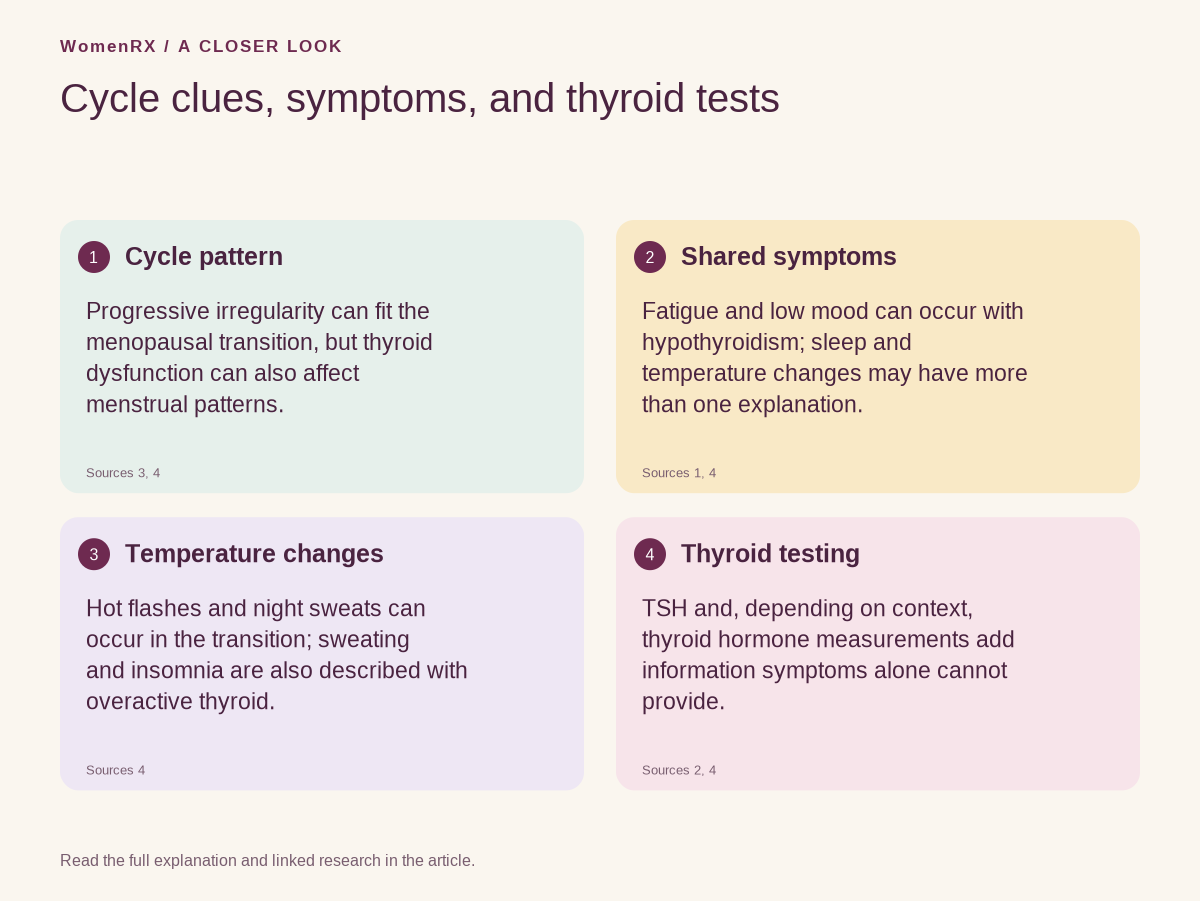
Cycle clues, symptoms, and thyroid tests
Cycle pattern: Progressive irregularity can fit the menopausal transition, but thyroid dysfunction can also affect menstrual patterns.34
Shared symptoms: Fatigue and low mood can occur with hypothyroidism; sleep and temperature changes may have more than one explanation.14
Temperature changes: Hot flashes and night sweats can occur in the transition; sweating and insomnia are also described with overactive thyroid.4
Thyroid testing: TSH and, depending on context, thyroid hormone measurements add information symptoms alone cannot provide.24
Read the figure as text
These clues help organize a conversation; none of the symptoms on its own diagnoses perimenopause or thyroid disease.- Cycle pattern: Progressive irregularity can fit the menopausal transition, but thyroid dysfunction can also affect menstrual patterns.34
- Shared symptoms: Fatigue and low mood can occur with hypothyroidism; sleep and temperature changes may have more than one explanation.14
- Temperature changes: Hot flashes and night sweats can occur in the transition; sweating and insomnia are also described with overactive thyroid.4
- Thyroid testing: TSH and, depending on context, thyroid hormone measurements add information symptoms alone cannot provide.24
More questions, answered
Do irregular periods mean I have a thyroid problem?
No. Menstrual irregularity can occur during the menopausal transition and can also be associated with thyroid dysfunction. The pattern is useful context, but it doesn’t diagnose either one. 3 4
Can symptoms alone show whether I have hypothyroidism?
No. Tiredness, weight gain, and low mood can occur with an underactive thyroid, but symptoms overlap with other changes. Thyroid blood tests provide information a symptom list can’t. 1 2
Sources you can check
- Levothyroxine: a medicine for an underactive thyroid (hypothyroidism) - NHSAccessed 2026-09-25Return to first citation
- LEVOTHYROXINE SODIUM TABLET [CARDINAL HEALTH 107, LLC] | US prescribing information and patient instructionsAccessed 2026-09-25Return to first citation
- Perimenopause as an obesogenic sensitive period: Contributions to elevated cardiovascular risk.Manning ME, Stockman SL, Zanni MV. · American journal of preventive cardiology · 2026Return to first citation
- Thyroid Dysfunction: An Alternate Plausibility in Perimenopausal Women!Usha SMR, Bindu CM, Chandrika N. · Journal of mid-life health · 2022Return to first citation