Vaginal Atrophy or GSM? What the Terms Mean
“Vaginal atrophy” describes tissue changes, while GSM also includes related vulvar, sexual, and urinary symptoms.
Genitourinary syndrome of menopause (GSM) is the broader term for genital, sexual, and urinary changes linked to low estrogen; “vaginal atrophy” is an older, narrower name. Dryness, irritation, pain with sex, or urinary symptoms can fit GSM, but they can have other causes too. Evaluation helps distinguish them. Options include lubricants or moisturizers and, for some people, local vaginal estrogen. 3 4 5
Why the name changed
“Vaginal atrophy” can sound as if the problem is limited to the vagina. GSM is a broader term: it describes changes that can affect the vulva, vagina, and lower urinary tract, as well as sexual comfort. Experts adopted GSM to better reflect this wider range of symptoms. The older term may still come up, but it doesn’t capture the whole picture. 3 5
Lower estrogen after menopause can change the tissues’ structure, lubrication, and elasticity. These changes help explain why symptoms may show up in more than one way. Menopause is a common setting, but low-estrogen states can occur at other ages too, including during lactation, with hypothalamic amenorrhea, or with antiestrogen treatment. 3
Symptoms can overlap with other conditions
Possible GSM symptoms include vaginal dryness, itching, burning, irritation, and pain with sex. Urinary symptoms can include discomfort with urination, urgency, frequency, or recurrent urinary infections. You might have one symptom or several. 4 5
The overlap matters: GSM symptoms can resemble urinary or vaginal infections and other genitourinary problems. Having dryness or irritation doesn’t by itself establish the cause, and urinary discomfort shouldn’t automatically be attributed to menopause. 3
What evaluation can clarify
A clinician can start with your symptoms and health history, then consider an examination. Depending on what you describe and what the exam shows, additional checks such as vaginal pH or a cell-based assessment may be considered; they aren’t described as necessary for every person. The point is to assess whether GSM fits and whether another cause needs attention. 4
It can help to describe which symptom is bothering you most and when it occurs, such as dryness, pain with sex, or urinary urgency. This gives evaluation and treatment discussions a concrete starting point. If symptoms suggest infection or don’t fit the expected pattern, that can change what should be evaluated before choosing treatment. 3 4
Treatment depends on the symptom you want to relieve
Lubricants and moisturizers are nonhormonal options that may help vaginal symptoms. The available guidance identifies both as options, but doesn’t establish that they work equally well for everyone or which is best for a particular person. 2
Local vaginal estrogen is another option when menopause-related dryness or irritation is the concern. It comes in forms such as a vaginal tablet, cream, gel, or ring. It targets vaginal symptoms rather than symptoms such as hot flashes, and it may take time to reach its full effect; the cited guidance says this can take up to three months. Form and treatment choice can be discussed in light of your symptoms and preferences. 1 2
Broader menopause symptoms call for a separate discussion. Local vaginal estrogen is not intended to treat symptoms such as hot flashes or sleep problems. If you have those too, say so: treatment aimed at vaginal symptoms and treatment aimed at symptoms throughout the body are not interchangeable. 1
The most useful starting point is the symptom you want to change, not the label alone. Ask whether GSM fits your symptoms, what else has been considered, and which treatment option best matches your main concern.
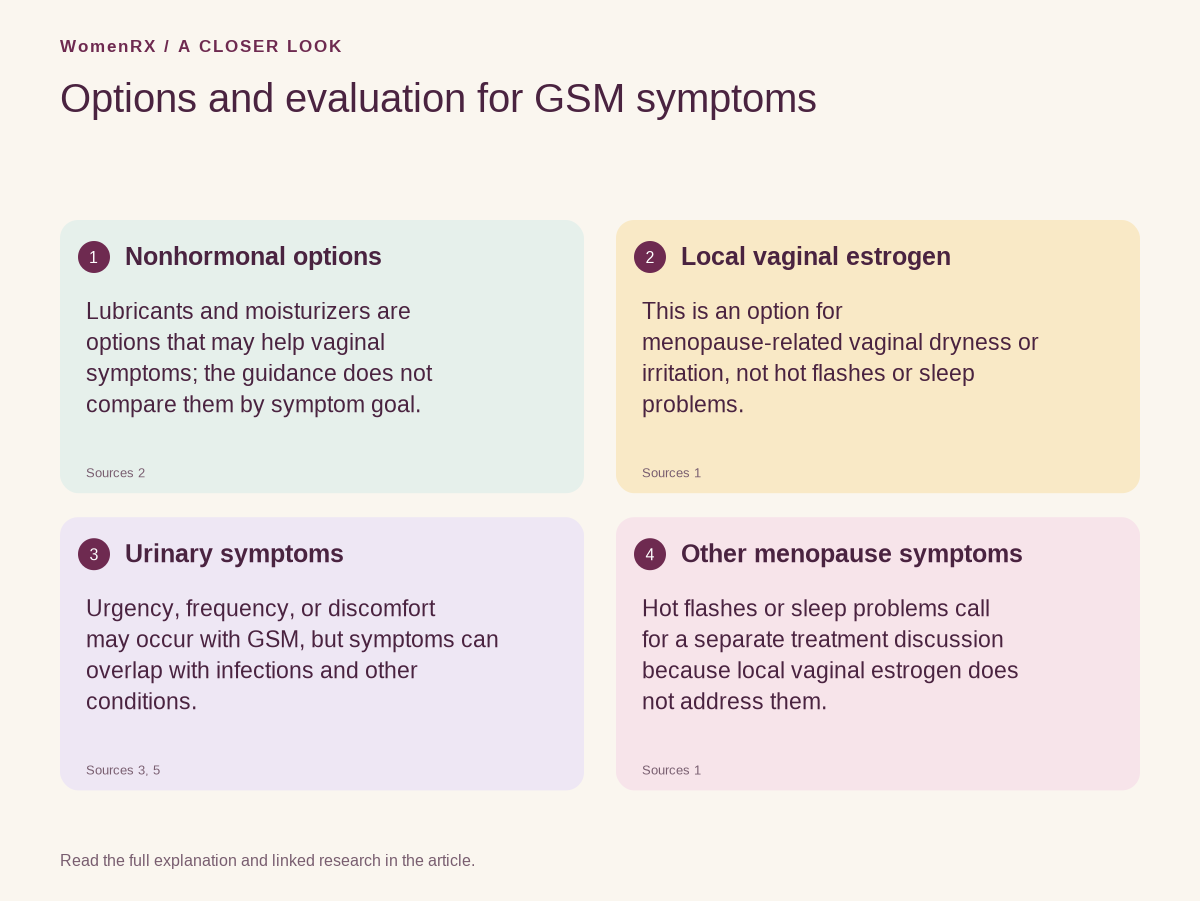
Options and evaluation for GSM symptoms
Nonhormonal options: Lubricants and moisturizers are options that may help vaginal symptoms; the guidance does not compare them by symptom goal.2
Local vaginal estrogen: This is an option for menopause-related vaginal dryness or irritation, not hot flashes or sleep problems.1
Urinary symptoms: Urgency, frequency, or discomfort may occur with GSM, but symptoms can overlap with infections and other conditions.35
Other menopause symptoms: Hot flashes or sleep problems call for a separate treatment discussion because local vaginal estrogen does not address them.1
Read the figure as text
These distinctions show how broad treatment categories relate to symptoms, while keeping evaluation for other causes in view.- Nonhormonal options: Lubricants and moisturizers are options that may help vaginal symptoms; the guidance does not compare them by symptom goal.2
- Local vaginal estrogen: This is an option for menopause-related vaginal dryness or irritation, not hot flashes or sleep problems.1
- Urinary symptoms: Urgency, frequency, or discomfort may occur with GSM, but symptoms can overlap with infections and other conditions.35
- Other menopause symptoms: Hot flashes or sleep problems call for a separate treatment discussion because local vaginal estrogen does not address them.1
More questions, answered
Can GSM happen before menopause?
Yes. GSM is associated with low estrogen, which can occur in other situations too, including lactation, hypothalamic amenorrhea, or antiestrogen treatment. 3
Does vaginal estrogen treat hot flashes?
No. Local vaginal estrogen is used for vaginal symptoms such as dryness and irritation; it doesn’t treat hot flashes or sleep problems. 1
Sources you can check
- About vaginal oestrogen - NHSAccessed 2026-09-25Return to first citation
- Common questions about vaginal oestrogen - NHSAccessed 2026-09-25Return to first citation
- Genitourinary Syndrome of MenopauseCarlson K, Vadakekut ES. · 2026Return to first citation
- A Randomized Controlled Pilot Trial Evaluating the Efficacy of Intravaginal and Extravaginal K-Laser Therapy as a Personalized Non-Hormonal Treatment for Genitourinary Syndrome of Menopause.Martín-Valero R, Ruiz-Moreno AM, Gallardo-García PJ, Martínez Colmena MD, Muñoz Pagan C, González-Rojas P, Ortega Quiñonero P. · Journal of personalized medicine · 2026Return to first citation
- Urinary manifestations of genitourinary syndrome of menopause: a review of the pathophysiology, clinical presentation, and management.Saad JC, Brandon CA. · Gynecology and pelvic medicine · 2026Return to first citation