Clitoral or Vulvar Changes: What Can You Try at Home?
Gentle care may ease irritated vulvar skin, but a new clitoral change needs a closer look.
If the discomfort feels like vaginal dryness, an over-the-counter vaginal moisturizer or water-based lubricant may help; avoiding perfumed washes and douches is also reasonable. 3 For irritated skin on the outside, gentle washing and a thin layer of white petrolatum may offer comfort. 4 Those steps don’t identify the cause of vulvar itching or a perceived clitoral change. 15
First, locate what has changed
The vulva is the external skin and tissue around the vaginal opening, including the clitoris. The vagina is internal. That distinction matters when choosing a comfort measure: a skin protectant suggested for the outside isn’t the same thing as a product made for vaginal dryness. 34
For example, if the skin stings where a scented wipe or pad touches it, irritation from contact is one possibility. Contact dermatitis can cause burning, itching, redness, swelling, or skin that feels raw. It can also develop gradually, so a product you’ve used for a while may still be worth considering. But itching is a symptom, not a diagnosis; an examination may be needed to find its cause. 15
Dryness has a different set of possible contributors. Hormone changes around menopause, pregnancy, or breastfeeding can affect vaginal moisture. Certain medicines and cancer treatments can also play a part. That doesn’t mean a new symptom in any of those circumstances is automatically hormonal. 3
A gentler approach for the outside
If the main problem is mild external irritation, try removing likely sources of friction and contact irritation rather than adding several remedies at once. Wash the vulva gently with warm water, without scrubbing, and pat it dry. Skip perfumed soaps, wipes, sprays, douches, and scented bath products. Loose clothing and changing out of damp clothes may also reduce rubbing and moisture against the skin. 45
A thin layer of white petrolatum on the external vulvar skin is one skin-protectant option in University of Iowa Health Care’s vulvar-care guidance. Its purpose is to protect irritated skin, not to reverse a change in clitoral tissue or treat an infection. Don’t put it inside the vagina as a substitute for a vaginal moisturizer. 43
If dryness during sex is the concern, a water-based lubricant can reduce friction; a product made as a vaginal moisturizer is another option for vaginal dryness. These are different from applying a skin protectant to the outside. If you use condoms, avoid oil-based lubricant because it can damage them. 32
When comfort care isn’t enough
Arrange an examination if you’ve noticed a new or persistent change in the clitoris or surrounding skin, such as a lump, swelling, or an area that looks different. A clinician can look at the area and ask about symptoms and products that have touched the skin. Neither dryness products nor a layer of petrolatum can establish what caused a visible change. Vulvar itching likewise calls for assessment if it persists rather than repeated trials of home remedies. 15
Seek care for unusual vaginal discharge, bleeding after sex, bleeding between periods, or any bleeding after menopause. If dryness has lasted a few weeks despite measures you’ve tried, or is affecting daily life, it also deserves a visit. These signs can point to a question that comfort measures alone won’t answer. 3
You don’t need to figure out whether the word atrophy fits before asking for help. Describe what you’ve actually noticed: where the discomfort is, whether the skin looks different, and whether the concern is external irritation, vaginal dryness, or both. That gives the examination a better starting point than trying to treat every vulvar or clitoral change as dryness. 135
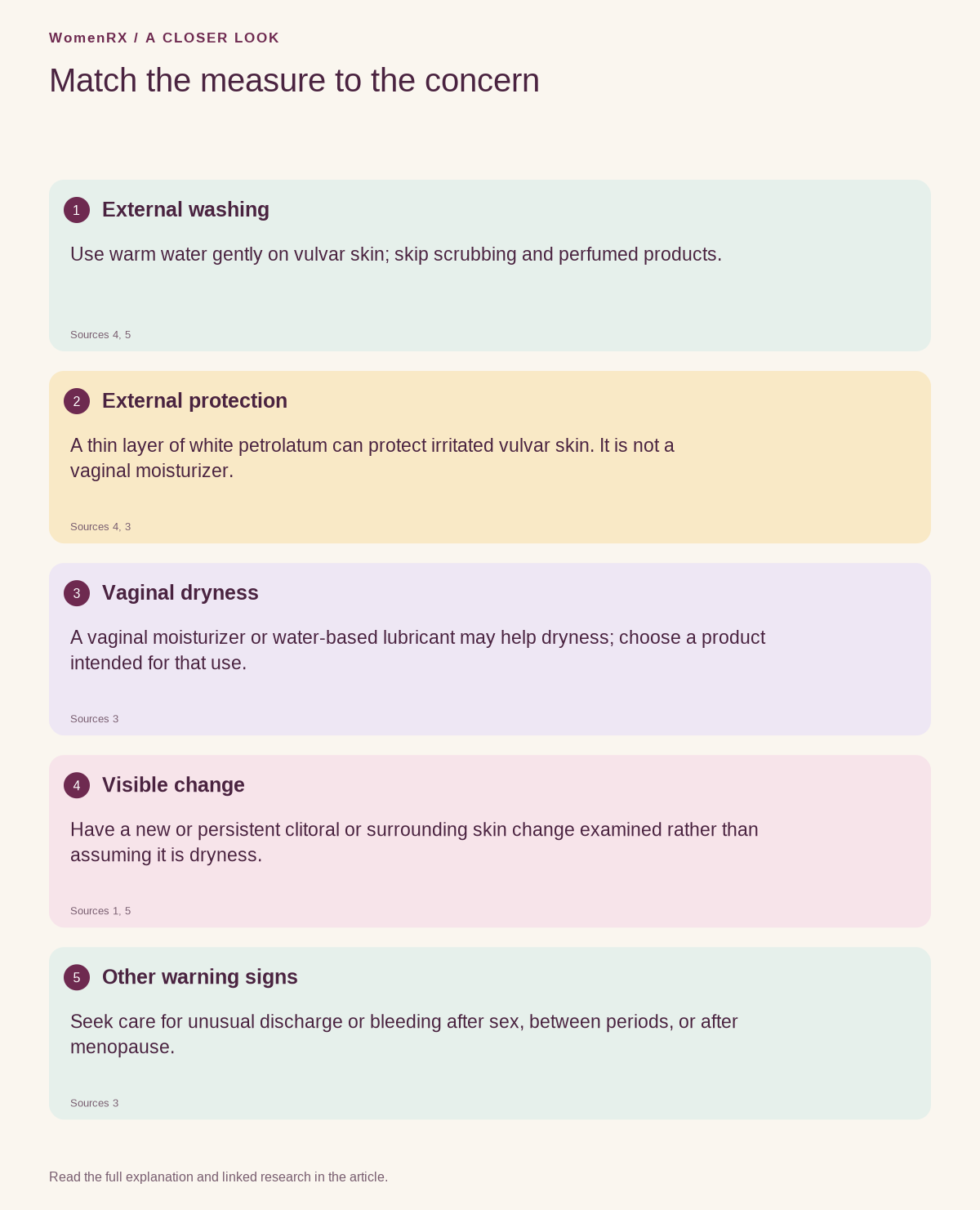
Match the measure to the concern
External washing: Use warm water gently on vulvar skin; skip scrubbing and perfumed products.45
External protection: A thin layer of white petrolatum can protect irritated vulvar skin. It is not a vaginal moisturizer.43
Vaginal dryness: A vaginal moisturizer or water-based lubricant may help dryness; choose a product intended for that use.3
Visible change: Have a new or persistent clitoral or surrounding skin change examined rather than assuming it is dryness.15
Other warning signs: Seek care for unusual discharge or bleeding after sex, between periods, or after menopause.3
Read the figure as text
These options serve different purposes; none identifies the cause of a new clitoral change.- External washing: Use warm water gently on vulvar skin; skip scrubbing and perfumed products.45
- External protection: A thin layer of white petrolatum can protect irritated vulvar skin. It is not a vaginal moisturizer.43
- Vaginal dryness: A vaginal moisturizer or water-based lubricant may help dryness; choose a product intended for that use.3
- Visible change: Have a new or persistent clitoral or surrounding skin change examined rather than assuming it is dryness.15
- Other warning signs: Seek care for unusual discharge or bleeding after sex, between periods, or after menopause.3
Sources you can check
- Clinical care of vulvar pruritus, with emphasis on one common cause, lichen simplex chronicus.Stewart KM. · Dermatologic clinics · 2010Return to first citation
- Things you can do to help menopause and perimenopause symptoms - NHSAccessed 2026-09-25Return to first citation
- Vaginal dryness - NHSAccessed 2026-09-25Return to first citation
- Vulvar skin care guidelines | University of Iowa Health CareAccessed 2026-09-26Return to first citation
- Contact dermatitis of the vulva | University of Iowa Health CareAccessed 2026-09-26Return to first citation