Rheumatoid Arthritis: Signs, Testing, and Treatment Decisions
Persistent joint swelling, especially with stiffness after rest, deserves evaluation even if an antibody blood test is negative.
Rheumatoid arthritis (RA) often causes swollen, tender joints and stiffness that is worse in the morning or after inactivity, commonly affecting joints on both sides of the body. These patterns can raise suspicion, but they don’t confirm RA. Assessment combines your symptoms, a joint examination, blood tests, and sometimes imaging. If RA is diagnosed, treatment aims to control inflammation and protect joint function, with the plan adjusted over time. 1245
The pattern matters more than one symptom
RA is an autoimmune disease in which the immune system inflames the lining of joints. It often affects the hands, feet, and wrists. Swelling, warmth, tenderness, and stiffness after sleep or sitting still can be clues. Symptoms often affect matching joints on both sides, but not always. Fatigue or other general symptoms can occur too. 234
That pattern is different from a diagnosis. Osteoarthritis, among other conditions, can also cause joint pain and stiffness. As one helpful comparison, morning stiffness from osteoarthritis often eases within about 30 minutes, while RA stiffness often lasts longer. That distinction can guide an evaluation, but it can’t diagnose either condition on its own. 4
If you have persistent joint swelling or stiffness that keeps returning, arrange an evaluation rather than trying to settle the question with an at-home symptom checklist. Mention which joints are affected, whether symptoms occur on both sides, and how stiffness changes after rest. A clinician can examine your joints and decide whether a rheumatology evaluation is appropriate. 12
How clinicians put the pieces together
There isn’t a single blood test that proves or rules out RA. A clinician considers your history and joint examination along with blood tests and, when useful, imaging. The overall pattern is what matters. 12
Rheumatoid factor and anti-CCP are antibody tests that can support an RA diagnosis. A positive result, especially anti-CCP, can make RA more likely, but a positive result alone doesn’t settle the diagnosis. Some people with RA don’t have these antibodies, so a negative result doesn’t rule it out either. Other blood tests may help assess general health or look for other explanations. X-rays and other scans can help show inflammation or joint damage and may be used to monitor change. 1
This is why the examination and test results need to be interpreted together. If symptoms and examination suggest inflammatory arthritis, a negative antibody test shouldn’t be treated as the final word. 12
What a care plan is meant to achieve
If RA is diagnosed, ask how the plan will reduce inflammation, protect joints, and support the activities that matter to you. Disease-modifying antirheumatic drugs, or DMARDs, are a central part of treatment; other care can include support such as physical or occupational therapy. Early treatment can help reduce symptoms and the risk of joint damage. 23
A useful treatment conversation is about both the medicine and the target. In an international study of rheumatologists treating people with new-onset RA, the treatment recommendations examined included starting a DMARD as soon as possible after diagnosis and using methotrexate as part of the first treatment strategy for active RA. The same study described a treat-to-target approach: assess disease activity regularly and adjust treatment with the aim of reaching remission or low disease activity. It documented how often participating clinicians followed those recommendations; it wasn’t a trial comparing which medicine works best for an individual. 5
There are different DMARD categories, including conventional medicines and biologic or targeted synthetic medicines. Research comparing specific options doesn’t establish one best choice for everyone. An older comparative review found important limits in the evidence for choosing among many drug strategies. A newer review of biologic and targeted synthetic medicines found few consistent differences between classes across several patient-reported outcomes, with variation among the included studies. These findings don’t replace an individualized treatment decision. 67
After diagnosis, useful questions include: What are we aiming for, and how will we measure progress? Which treatment category fits my disease and health circumstances? How will we decide whether to adjust the plan? How could treatment affect pain, fatigue, and daily activities? If a medicine isn’t suitable or isn’t helping enough, what alternatives would we discuss? 57
Make pregnancy plans part of medication review
If you’re planning a pregnancy, are pregnant, or are postpartum, bring that up when discussing your RA care plan. Ask your rheumatologist to review medication choices in light of your circumstances, and coordinate with your obstetric clinician when relevant.
Treatment decisions are also a chance to talk about your priorities, such as hand function, energy, or being able to manage daily tasks. RA care may change over time as symptoms and treatment response are assessed, so the plan should include how progress will be reviewed, not just which medicine to start. 25
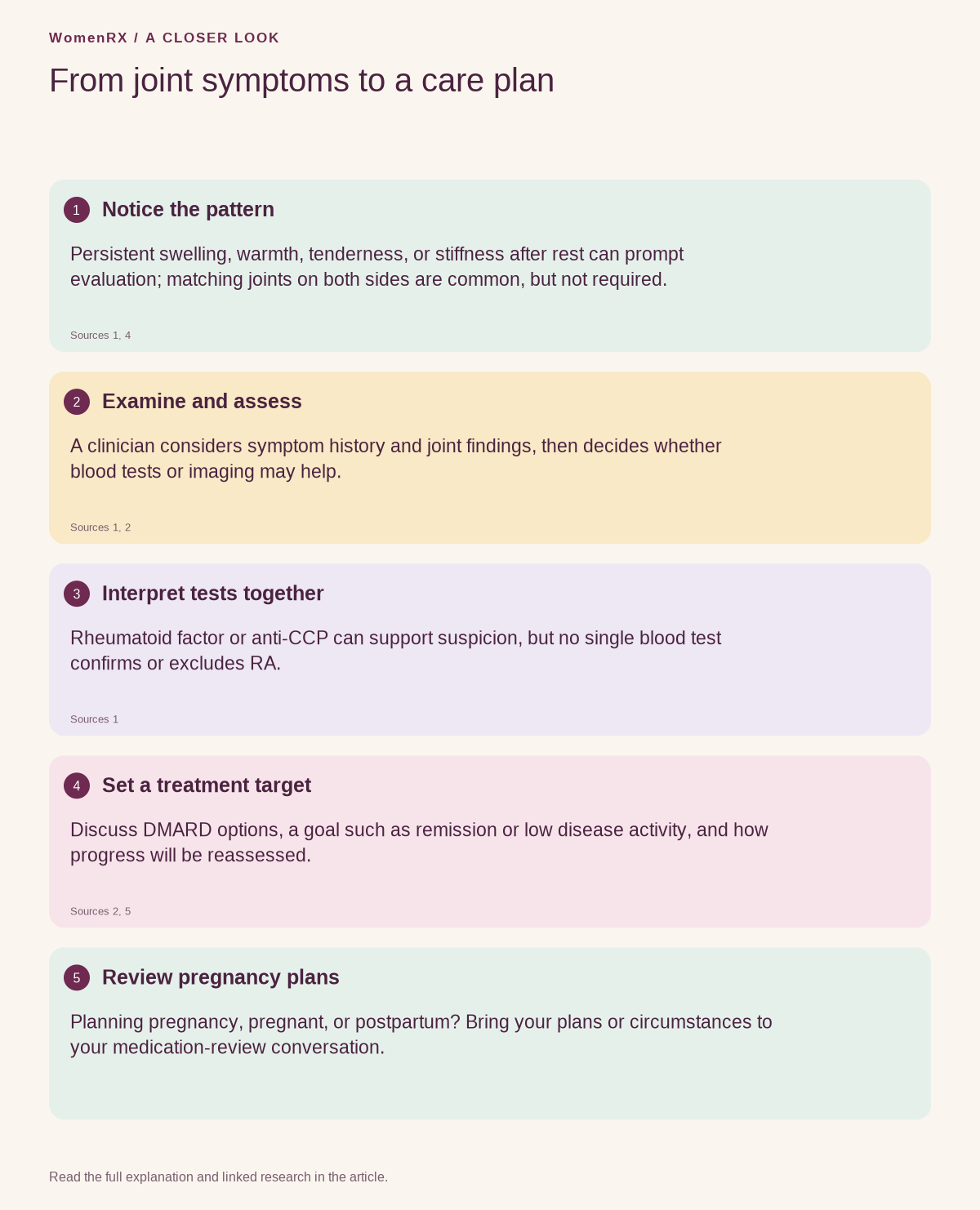
From joint symptoms to a care plan
Notice the pattern: Persistent swelling, warmth, tenderness, or stiffness after rest can prompt evaluation; matching joints on both sides are common, but not required.14
Examine and assess: A clinician considers symptom history and joint findings, then decides whether blood tests or imaging may help.12
Interpret tests together: Rheumatoid factor or anti-CCP can support suspicion, but no single blood test confirms or excludes RA.1
Set a treatment target: Discuss DMARD options, a goal such as remission or low disease activity, and how progress will be reassessed.25
Review pregnancy plans: Planning pregnancy, pregnant, or postpartum? Bring your plans or circumstances to your medication-review conversation.
Read the figure as text
A simple path shows how persistent symptoms lead to assessment, interpretation, and a treatment discussion, with pregnancy plans included as a separate medication-review prompt.- Notice the pattern: Persistent swelling, warmth, tenderness, or stiffness after rest can prompt evaluation; matching joints on both sides are common, but not required.14
- Examine and assess: A clinician considers symptom history and joint findings, then decides whether blood tests or imaging may help.12
- Interpret tests together: Rheumatoid factor or anti-CCP can support suspicion, but no single blood test confirms or excludes RA.1
- Set a treatment target: Discuss DMARD options, a goal such as remission or low disease activity, and how progress will be reassessed.25
- Review pregnancy plans: Planning pregnancy, pregnant, or postpartum? Bring your plans or circumstances to your medication-review conversation.
More questions, answered
Can a negative rheumatoid factor test rule out RA?
No. Rheumatoid factor and anti-CCP can support the diagnosis, but neither a negative antibody result nor any single blood test rules out RA. Clinicians consider symptoms, joint findings, and other tests together. 1
Sources you can check
- Rheumatoid arthritis - Diagnosis - NHSAccessed 2026-09-25Return to first citation
- Rheumatoid Arthritis | RA | MedlinePlusAccessed 2026-09-25Return to first citation
- Rheumatoid arthritis - NHSAccessed 2026-09-25Return to first citation
- Rheumatoid arthritis - Symptoms - NHSAccessed 2026-09-25Return to first citation
- When rheumatologists report that they agree with a guideline, does this mean that they practise the guideline in clinical practice? Results of the International Recommendation Implementation Study (IRIS).Gvozdenović E, Allaart CF, van der Heijde D, Ferraccioli G, Smolen JS, Huizinga TW, Landewé R. · RMD open · 2016Return to first citation
- Summary of AHRQ's comparative effectiveness review of drug therapy for rheumatoid arthritis (RA) in adults--an update.Singh JA, Cameron DR. · Journal of managed care pharmacy : JMCP · 2012Return to first citation
- Effects of biologic and targeted synthetic disease modifying antirheumatic drugs (b/tsDMARDs) on patient-reported outcome domains in rheumatoid arthritis: a systematic review and network meta-analyses.van Esveld L, Dikkenberg MVD, Luurssen-Masurel N, de Jong P, Kok MR, Bosch T, Hackert MQN, Weel-Koenders A, Lopes Barreto D, Kuijper TM. · RMD open · 2026Return to first citation