Could Your Symptoms Be Lupus? What to Look For
Recurring joint pain, rashes, and fatigue can raise the question of lupus, but the pattern and test results matter more than any one symptom.
Lupus can cause joint pain, skin rashes, and fatigue, but those symptoms can also have other causes. A clinician considers your symptoms alongside blood test results and may use urine tests to check for kidney problems. No single test diagnoses lupus. Tell a clinician about new swelling or visible blood in your urine, and seek emergency care for severe breathing difficulty or a heavy, tight chest.3652
Notice the pattern, not just the symptom
A spell of exhaustion can make you wonder about lupus. So can aching joints or a rash that keeps returning. Lupus is an autoimmune condition that can affect the skin, joints, and internal organs, and its symptoms can worsen during flares. But these symptoms overlap with other conditions. Describing what happens together and what keeps coming back gives a clinician useful context; it doesn't turn a symptom pattern into a diagnosis.36
For example, you might describe when joint pain began, whether a rash appeared during the same period, and whether both improved and returned. If you have a photo of a rash that has faded, it may help you show what you mean. These details help tell the story of your symptoms without asking you to decide for yourself whether they're lupus.
What testing can, and can't, answer
There is no single test for lupus. An assessment brings together your symptoms and test results because other illnesses can look similar.36
Blood tests may include antibody testing and a complete blood count. Antibody results are considered alongside symptoms rather than treated as a stand-alone answer. A blood count measures red cells, white cells, and platelets; it can help identify problems such as anemia, but it does not diagnose lupus on its own.361
Urine testing has a different job: checking for possible kidney problems. Lupus can affect the kidneys, and a review of research in people with established lupus found that even relatively low levels of protein in the urine or blood in the urine can accompany active kidney disease. An abnormal urine result needs interpretation, not an assumption that lupus is the cause. If kidney involvement is suspected, a specialist may consider further evaluation, including a kidney biopsy.364
This is why an antibody result isn't a diagnosis by itself. It needs to be considered alongside your symptoms and other findings.36
Which changes need faster attention?
Make an appointment if joint pain, rashes, or fatigue persist or recur, especially if you're concerned by how they are changing. Early assessment matters because lupus is easier to manage when it is found and treated early.3
Other changes are worth reporting to a clinician. Kidney involvement in lupus can be associated with blood or protein in the urine, swelling, and high blood pressure. Tell a clinician about new swelling or visible blood in your urine, whether or not you think you have lupus.5
Severe difficulty breathing, or a chest that feels tight or heavy, calls for emergency care. These symptoms have many possible causes; the urgent decision is to get help, not to work out whether lupus is responsible.2
If you're planning a pregnancy
Lupus symptoms aren't unique to women, though more women than men develop the condition. If you already have lupus and are thinking about pregnancy, discuss pregnancy-related concerns with the clinician who manages your lupus. Lupus can cause pregnancy complications.3
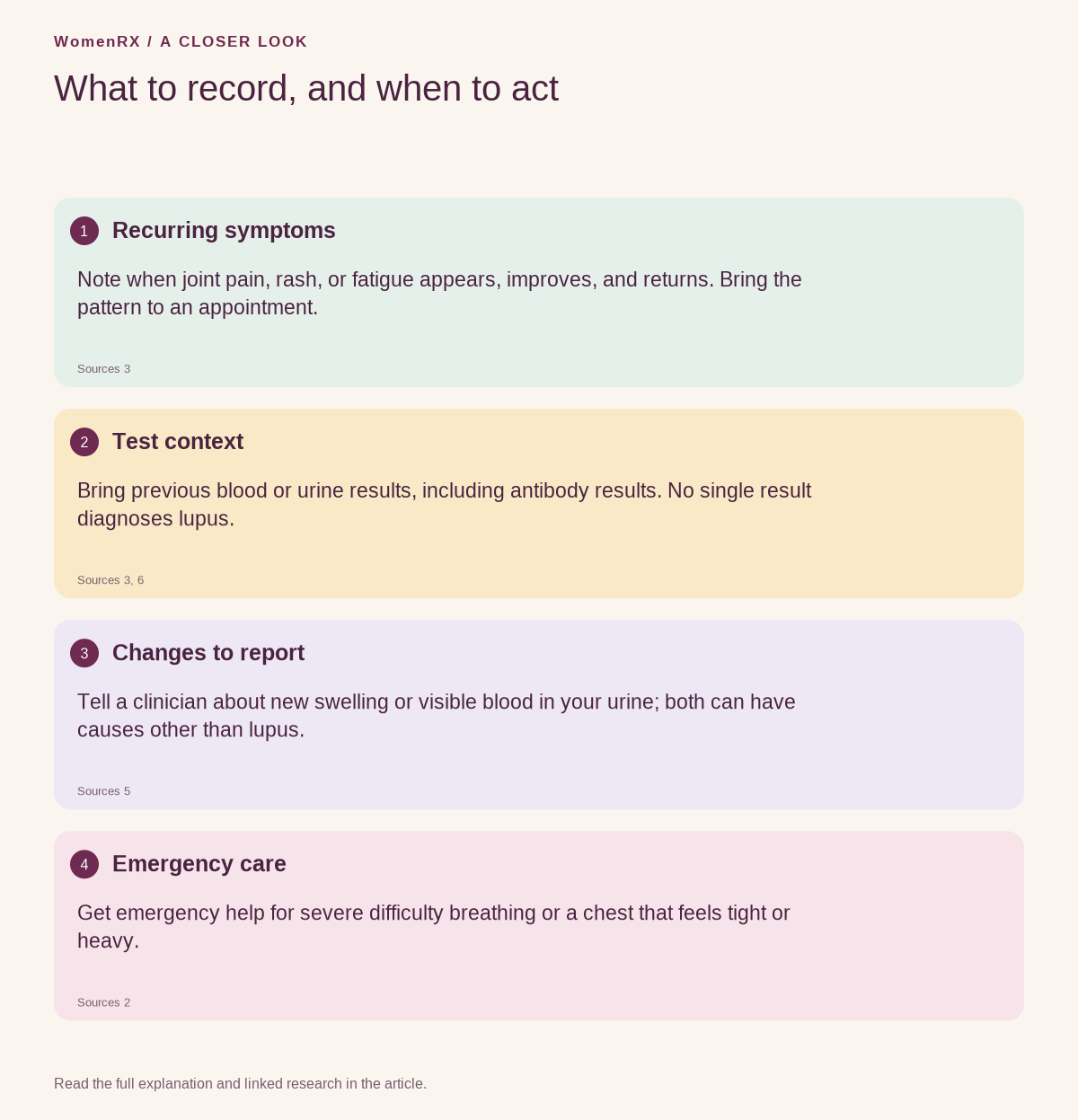
What to record, and when to act
Recurring symptoms: Note when joint pain, rash, or fatigue appears, improves, and returns. Bring the pattern to an appointment.3
Test context: Bring previous blood or urine results, including antibody results. No single result diagnoses lupus.36
Changes to report: Tell a clinician about new swelling or visible blood in your urine; both can have causes other than lupus.5
Emergency care: Get emergency help for severe difficulty breathing or a chest that feels tight or heavy.2
Read the figure as text
These are prompts for describing symptoms and recognizing changes that need care, not a lupus test or diagnostic score.- Recurring symptoms: Note when joint pain, rash, or fatigue appears, improves, and returns. Bring the pattern to an appointment.3
- Test context: Bring previous blood or urine results, including antibody results. No single result diagnoses lupus.36
- Changes to report: Tell a clinician about new swelling or visible blood in your urine; both can have causes other than lupus.5
- Emergency care: Get emergency help for severe difficulty breathing or a chest that feels tight or heavy.2
More questions, answered
Does a positive antibody result mean I have lupus?
No. Lupus has no single diagnostic test. A clinician interprets an antibody result alongside your symptoms and other findings, including evidence that another condition may explain them.36
Sources you can check
- Blood Count Tests: MedlinePlusAccessed 2026-09-25Return to first citation
- Shortness of breath - NHSAccessed 2026-09-25Return to first citation
- Lupus - NHSAccessed 2026-09-25Return to first citation
- Management of systemic lupus erythematosus with kidney involvement: systematic literature review to inform the 2025 update of EULAR recommendations.Kostopoulou M, Bertsias G, Scire CA, Boumpas DT, Fanouriakis A. · EULAR rheumatology open · 2025Return to first citation
- [Recommendations for the diagnosis and management of lupus nephritis in China].Zhang H, Yang NS, Lu J, Cao H, Du R, Zhang W, Zhao Y. · Zhonghua nei ke za zhi · 2021Return to first citation
- Lupus | Lupus Symptoms | SLE | MedlinePlusAccessed 2026-09-25Return to first citation