Folate Deficiency: Symptoms, Testing, and B12
Fatigue can have many causes, so symptoms alone can’t tell you whether folate is low or whether another problem, including vitamin B12 deficiency, needs attention.
Folate deficiency can cause tiredness, weakness, shortness of breath, a sore tongue, or changes in memory, but these symptoms overlap with vitamin B12 deficiency and other conditions. Testing usually brings together symptoms, a blood count, and folate and B12 blood levels. If deficiency is being considered, B12 matters too: folate treatment may improve blood measurements while B12-related nerve problems continue. 1 3 4 6
Symptoms can raise a question, not settle it
Low energy, weakness, headaches, shortness of breath, palpitations, a sore or red tongue, and changes in memory or judgment can occur with folate or vitamin B12 deficiency anemia. Some people have symptoms without anemia, and many of these symptoms can have other causes. That makes fatigue, by itself, a poor way to identify low folate. 3 4
Folate and B12 deficiency can both affect the production of red blood cells. In either case, those cells may be larger than usual and may not function properly. But a blood-cell pattern is a clue, not a diagnosis of which vitamin is low: the blood tests also need to assess folate and B12 levels and be interpreted alongside symptoms. 1 2 3
What makes testing worth discussing
Testing may be useful when symptoms fit, when a blood count has shown anemia or unusually large red blood cells, or when there are reasons you might not be getting or absorbing enough of these vitamins. Examples include a restrictive diet with few folate-rich foods, regular heavy alcohol use, or a condition affecting absorption. Some medicines can affect vitamin levels, too, so it’s useful to mention what you take rather than stopping anything on your own. 1 2 3
These factors don’t prove that you have a deficiency. They help explain why a clinician might look beyond symptoms and consider blood tests. Diet is only one possible cause; the reason for a low result can affect what happens next. 1 2
How blood tests help separate folate from B12
An evaluation may include a blood count to check hemoglobin and the size of red blood cells, along with measurements of folate and vitamin B12 in the blood. Symptoms and results are considered together: some people have symptoms despite apparently normal vitamin levels, while others have low levels without symptoms. If results suggest a deficiency, further testing may be used to look for its cause. 1
B12 deserves attention even when folate is part of the question. The two deficiencies can look similar in a blood count, but B12 deficiency can also affect the nervous system. Numbness is one symptom associated with B12 deficiency. Folate given without recognizing B12 deficiency may improve blood measurements while neurological problems continue, which is why finding the right deficiency matters. 3 4 6
neural tube defect prevention is different from deficiency treatment
If you could become pregnant, folic acid has a preventive role: a pregnancy guideline recommends a low daily amount before conception and during pregnancy and breastfeeding. That routine prevention guidance is not a way to diagnose or treat a deficiency. Higher-dose supplementation is described for particular risk situations, not as a general response to tiredness or a suspected low level. 5
If you’re pregnant, planning a pregnancy, or have a history of a pregnancy affected by a neural tube defect, bring that context into the conversation about testing and supplementation. Don’t assume that taking folic acid answers whether your B12 status also needs assessment. 5 6
The useful next step is to describe the symptoms and relevant diet, health, and medication history, then ask whether a blood count and folate and B12 testing make sense. If you have numbness as well as fatigue or weakness, mention it specifically because it can point to a B12-related nerve concern. 1 4
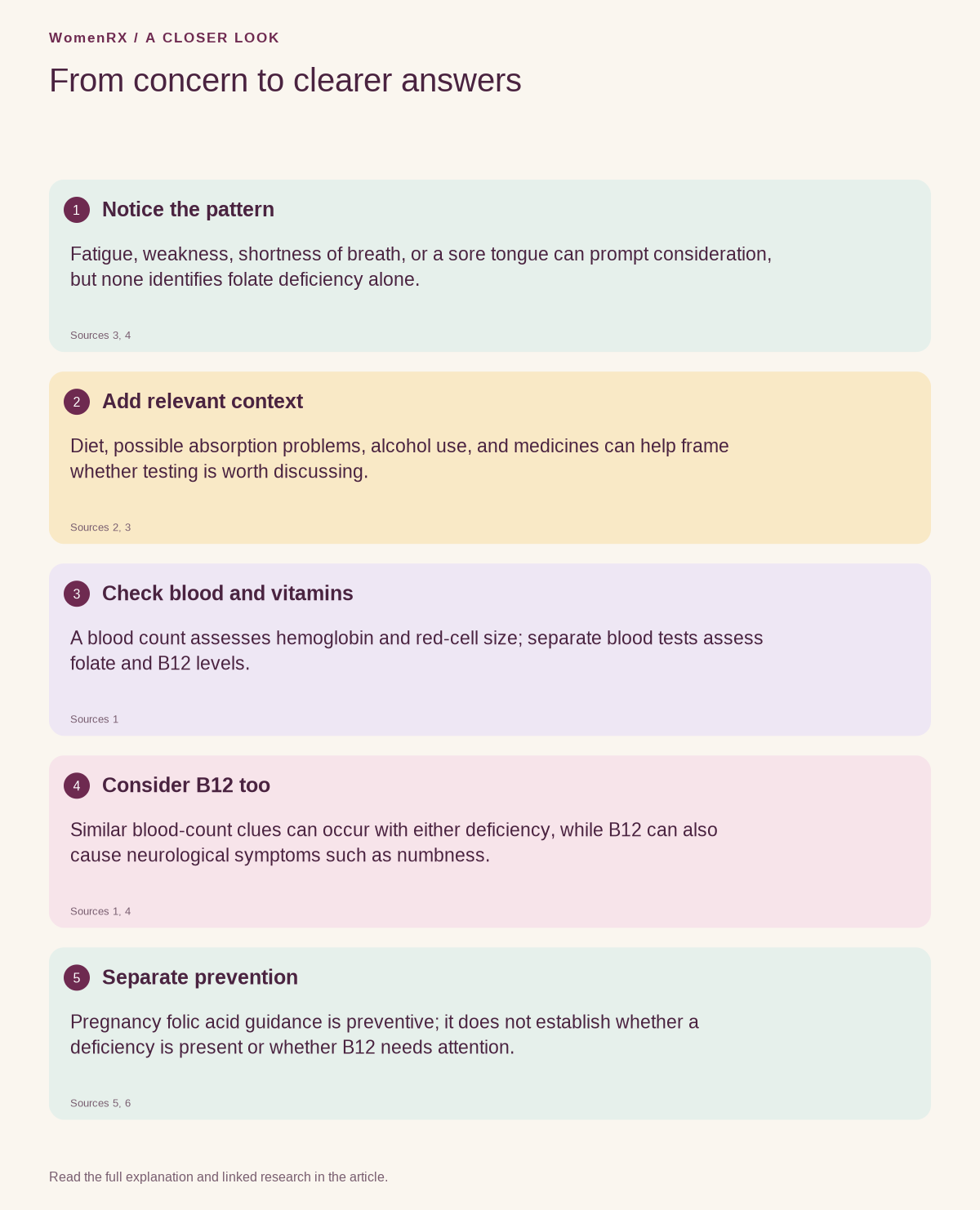
From concern to clearer answers
Notice the pattern: Fatigue, weakness, shortness of breath, or a sore tongue can prompt consideration, but none identifies folate deficiency alone.34
Add relevant context: Diet, possible absorption problems, alcohol use, and medicines can help frame whether testing is worth discussing.23
Check blood and vitamins: A blood count assesses hemoglobin and red-cell size; separate blood tests assess folate and B12 levels.1
Consider B12 too: Similar blood-count clues can occur with either deficiency, while B12 can also cause neurological symptoms such as numbness.14
Separate prevention: Pregnancy folic acid guidance is preventive; it does not establish whether a deficiency is present or whether B12 needs attention.56
Read the figure as text
Symptoms and risk factors can lead to testing, but the blood count and vitamin measurements answer different parts of the question.- Notice the pattern: Fatigue, weakness, shortness of breath, or a sore tongue can prompt consideration, but none identifies folate deficiency alone.34
- Add relevant context: Diet, possible absorption problems, alcohol use, and medicines can help frame whether testing is worth discussing.23
- Check blood and vitamins: A blood count assesses hemoglobin and red-cell size; separate blood tests assess folate and B12 levels.1
- Consider B12 too: Similar blood-count clues can occur with either deficiency, while B12 can also cause neurological symptoms such as numbness.14
- Separate prevention: Pregnancy folic acid guidance is preventive; it does not establish whether a deficiency is present or whether B12 needs attention.56
More questions, answered
Can I tell from a blood count alone whether folate is low?
No. A blood count can show anemia or larger-than-usual red blood cells, but testing folate and vitamin B12 levels helps distinguish the possible causes. Results also need to be considered with symptoms, since symptoms and vitamin levels don’t always line up neatly. 1
Does taking folic acid prevent a deficiency diagnosis from mattering?
No. Folic acid is recommended for neural tube defect prevention, but that recommendation is separate from diagnosing a deficiency. B12 status may still matter because folate can improve blood measurements while B12-related neurological problems continue. 5 6
Sources you can check
- Vitamin B12 or folate deficiency anaemia - Diagnosis - NHSAccessed 2026-09-25Return to first citation
- Vitamin B12 or folate deficiency anaemia - Causes - NHSAccessed 2026-09-25Return to first citation
- Vitamin B12 or folate deficiency anaemia - NHSAccessed 2026-09-25Return to first citation
- Vitamin B12 or folate deficiency anaemia - Symptoms - NHSAccessed 2026-09-25Return to first citation
- Guideline No. 427: Folic Acid and Multivitamin Supplementation for Prevention of Folic Acid-Sensitive Congenital Anomalies.Wilson RD, O'Connor DL. · Journal of obstetrics and gynaecology Canada : JOGC = Journal d'obstetrique et gynecologie du Canada : JOGC · 2022Return to first citation
- Micronutrient Networks in Nutritional Anemia: A Narrative Review Beyond Pathophysiology, Diagnosis, and Management of Iron Deficiency.Chougule S, T M, Mohite A, Choudhary V, Thangvelu S, Datkhile K, Pawar J. · Cureus · 2026Return to first citation