Anxiety in Your 40s: Could Perimenopause Be a Factor?
A change in your periods alongside hot flashes, sleep problems, or anxiety is worth looking at as a pattern, not as proof of one cause.
Yes, perimenopause could be one factor if anxiety begins or changes around the same time as less predictable periods or other menopause symptoms. But being in your 40s, or having anxiety alongside hot flashes, can’t establish a hormonal cause. Stress and other health problems deserve consideration too. Anxiety that persists, worsens, or disrupts daily life merits assessment regardless of your cycle. 1 4 5
Look at what changed together
If anxiety feels different lately, start with the pattern rather than your age. Are your periods becoming less predictable? Have hot flashes or sleep problems appeared around the same time? Irregular or variable-length cycles are a clinical feature of the menopause transition, and anxiety can occur during it. Hormonal changes may contribute for some women, but many don’t have menopause-related mental health problems. 4
Periods aren’t the only clue. In a prospective study of women aged 35 to 47 who had regular cycles when they enrolled, some reported hot flashes before noticeable menstrual irregularity. That makes hot flashes worth mentioning even if your periods still seem regular. It doesn’t mean a hot flash, or anxiety that happens with one, identifies the cause. 6
Sleep problems and anxiety are also commonly reported together. In an international app survey, women aged 35 and older frequently reported both. Because symptoms and perimenopause status were self-reported, the survey can’t show that the transition caused anyone’s anxiety. 3
Give the other explanations equal room
A menopause link becomes more plausible when several changes arrive together, but life circumstances don’t pause during perimenopause. In an online survey of midlife women, more bothersome anxiety and vigilance symptoms were associated with health and work stress and difficulty paying for basic needs. Those associations don’t identify a cause for any one person. They do offer a reason to take pressures in your life seriously alongside changes in your cycle. 5
A health assessment can look beyond reproductive stage, too. It may include questions about when symptoms began, your medical history, and whether another health problem could be contributing; an exam or lab tests may be part of that assessment. If your health or medications changed around the same time, mention the change rather than assuming it explains the anxiety. 1
A useful way to sort the picture is to ask two separate questions: What makes perimenopause worth considering? Changing cycles or hot flashes alongside a new anxiety pattern can. What tells me anxiety needs attention? Whether it persists, worsens, or interferes with your life can, even if your periods haven’t changed. Neither question requires you to settle the cause yourself. 1 4 6
Treat anxiety as a concern in its own right
Anxiety may show up as hard-to-control worry, restlessness, or tension. It can also come with a pounding heartbeat, dizziness, or shortness of breath. Anxiety disorders can worsen or interfere with work, relationships, and other daily activities, which is why persistent or disruptive symptoms are worth assessing rather than waiting for a clear hormonal explanation. 1
There are approaches directed at anxiety itself, including psychotherapy such as cognitive behavioral therapy and, for some people, medication. If hot flashes are also bothersome, say so: menopause treatments have their own evidence and goals. Hormone therapy is an effective treatment for hot flashes, but its effectiveness for that symptom shouldn’t be taken as proof that it will treat anxiety. You can discuss both concerns without having to choose a single explanation for everything you’re feeling. 1 2
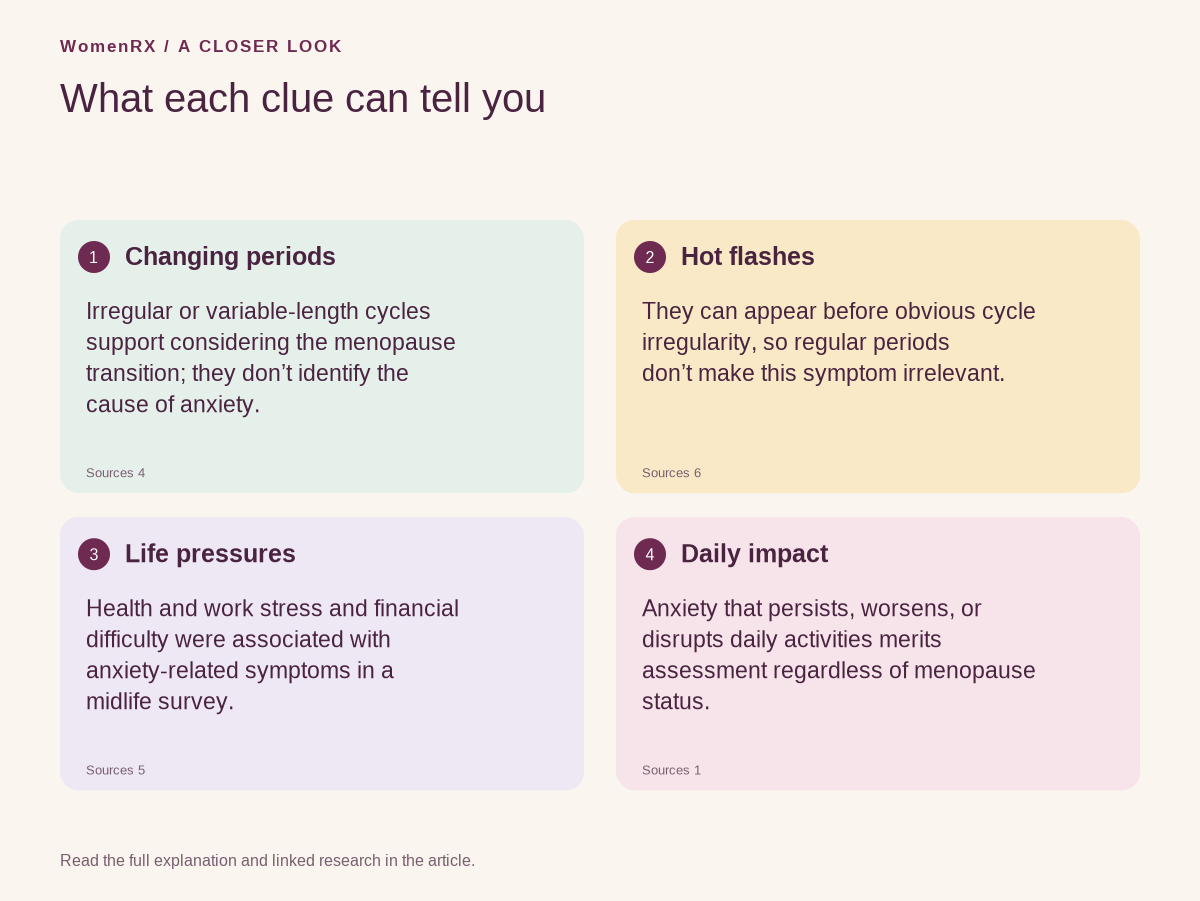
What each clue can tell you
Changing periods: Irregular or variable-length cycles support considering the menopause transition; they don’t identify the cause of anxiety.4
Hot flashes: They can appear before obvious cycle irregularity, so regular periods don’t make this symptom irrelevant.6
Life pressures: Health and work stress and financial difficulty were associated with anxiety-related symptoms in a midlife survey.5
Daily impact: Anxiety that persists, worsens, or disrupts daily activities merits assessment regardless of menopause status.1
Read the figure as text
These distinctions help separate a possible perimenopause connection from reasons to assess anxiety on its own.- Changing periods: Irregular or variable-length cycles support considering the menopause transition; they don’t identify the cause of anxiety.4
- Hot flashes: They can appear before obvious cycle irregularity, so regular periods don’t make this symptom irrelevant.6
- Life pressures: Health and work stress and financial difficulty were associated with anxiety-related symptoms in a midlife survey.5
- Daily impact: Anxiety that persists, worsens, or disrupts daily activities merits assessment regardless of menopause status.1
Sources you can check
- Anxiety: MedlinePlusAccessed 2026-09-25Return to first citation
- The 2022 hormone therapy position statement of The North American Menopause Society.“The 2022 Hormone Therapy Position Statement of The North American Menopause Society” Advisory Panel. · Menopause (New York, N.Y.) · 2022Return to first citation
- Global perspectives on perimenopause: a digital survey of knowledge and symptoms using the Flo application.Hedges MS, Hewings-Martin Y, Karam J, Castaneda R, Cunningham AC, Xu Y, Zhaunova L, Faubion SS, Shufelt CL. · Menopause (New York, N.Y.) · 2026Return to first citation
- Hormonal Agents for the Treatment of Depression Associated with the Menopause.Herson M, Kulkarni J. · Drugs & aging · 2022Return to first citation
- Perimenopause meets life: observations from the Women Living Better Survey.Woods NF, Coslov N, Richardson MK. · Menopause (New York, N.Y.) · 2022Return to first citation
- Hot flashes in the late reproductive years: risk factors for Africa American and Caucasian women.Freeman EW, Sammel MD, Grisso JA, Battistini M, Garcia-Espagna B, Hollander L. · Journal of women's health & gender-based medicine · 2001Return to first citation