Bloating in Your 40s: Could Hormones Be Involved?
A pattern around your period can be a clue, but age and bloating alone can’t identify the cause.
Hormones may be part of the picture: bloating can happen around a period, and one longitudinal study found an association between menopause-transition stages and greater bloating severity. That doesn’t prove hormones caused any one person’s symptoms. Gas, foods and bowel changes can also matter. Notice the pattern and duration, and get recurring or persistent bloating assessed rather than assuming it’s perimenopause. 1 2
Look for a pattern, not just an age
Bloating can happen around the time of a period. In a longitudinal analysis of 291 women, early and late stages of the menopause transition were associated with increased bloating severity. Tension was also associated with greater severity. These are associations, not proof that hormonal changes caused bloating in an individual or a way to diagnose perimenopause from this symptom alone. 1 2
Notice whether bloating repeatedly appears around a similar point in your cycle and then eases. That pattern may suggest a menstrual connection, but it doesn’t establish that perimenopause is responsible. Changes in bleeding can be useful context, too, although a cross-sectional study found that changed menstrual flow alone was not a clear indicator of the start of the menopause transition. 3
Check what else is changing
Gas is the most common reason for bloating. Some foods and fizzy drinks can contribute, as can swallowing air while eating. Note whether constipation or another bowel-pattern change happens at the same time. 1
If symptoms are mild, keep a simple record of when bloating starts and settles, where it falls in relation to bleeding, and whether bowel changes or particular foods and drinks seem to coincide with it. Note any recent medicine changes as context for a care conversation; that alone doesn’t show a medicine is the cause.
If a food or drink seems connected, notice whether the pattern repeats rather than making broad diet changes based on one episode. Regular movement and chewing with your mouth closed are practical steps that may help reduce bloating. 1
When to get it checked
Arrange a care conversation if bloating keeps returning, feels very uncomfortable, or does not go away, especially if simple changes have not helped. Bloating with unintentional weight loss or blood in your stool also warrants assessment. Persistent bloating can sometimes signal a more serious condition, including ovarian cancer. That possibility is a reason not to dismiss ongoing symptoms, not a reason to assume the worst. 1
A swollen abdomen together with sudden, severe abdominal pain needs emergency care. 1
For a care conversation, a useful summary is when the bloating happens, how long it lasts, whether it tracks with your period, what your bowel pattern is doing, and any relevant medicine changes. Those details can help consider a possible menopause connection alongside other explanations.
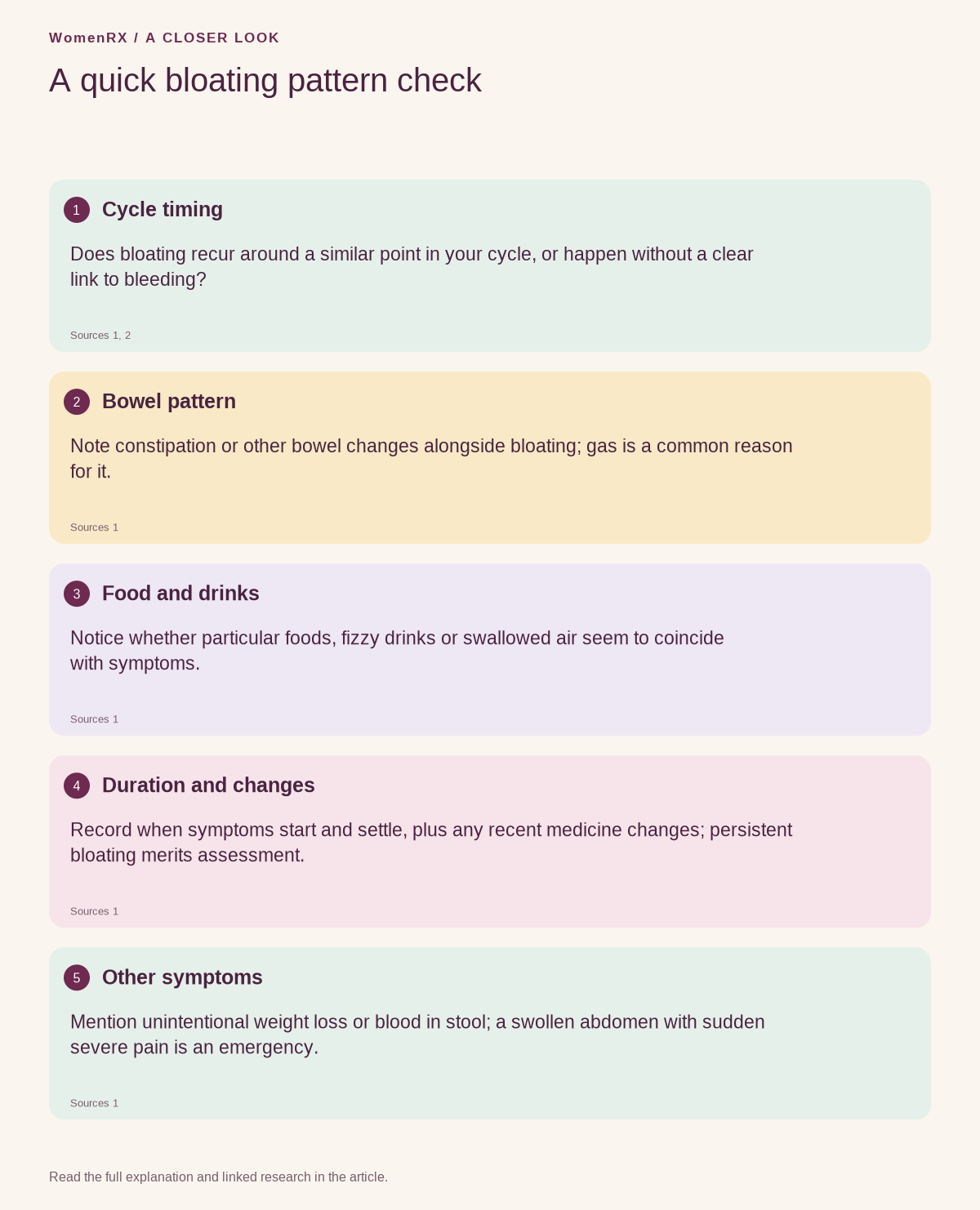
A quick bloating pattern check
Cycle timing: Does bloating recur around a similar point in your cycle, or happen without a clear link to bleeding?12
Bowel pattern: Note constipation or other bowel changes alongside bloating; gas is a common reason for it.1
Food and drinks: Notice whether particular foods, fizzy drinks or swallowed air seem to coincide with symptoms.1
Duration and changes: Record when symptoms start and settle, plus any recent medicine changes; persistent bloating merits assessment.1
Other symptoms: Mention unintentional weight loss or blood in stool; a swollen abdomen with sudden severe pain is an emergency.1
Read the figure as text
Use these prompts to describe what is happening; they are not a diagnostic score.- Cycle timing: Does bloating recur around a similar point in your cycle, or happen without a clear link to bleeding?12
- Bowel pattern: Note constipation or other bowel changes alongside bloating; gas is a common reason for it.1
- Food and drinks: Notice whether particular foods, fizzy drinks or swallowed air seem to coincide with symptoms.1
- Duration and changes: Record when symptoms start and settle, plus any recent medicine changes; persistent bloating merits assessment.1
- Other symptoms: Mention unintentional weight loss or blood in stool; a swollen abdomen with sudden severe pain is an emergency.1
More questions, answered
Can bloating by itself tell me I’m in perimenopause?
No. Bloating has several possible explanations, and the available menopause-transition findings show an association, not a symptom test that can identify perimenopause. Consider it alongside your menstrual pattern and other changes. 2 3
Sources you can check
- Bloating - NHSAccessed 2026-09-25Return to first citation
- Bloating During the Menopause Transition: Observations from the Seattle Midlife Women's Health Study.Kamp KJ, Callan NGL, Mitchell ES, Heitkemper MM, Woods NF. · Journal of women's health (2002) · 2026Return to first citation
- Symptom profiles in the late reproductive stage, earlier premenopause and early perimenopause in the absence of vasomotor symptoms: a cross-sectional study.Bresolin S, Islam RM, Bond M, Davis SR. · BMJ sexual & reproductive health · 2026Return to first citation