Can Acne Clues Tell You If Hormones Are Involved?
A period-related flare can be hormone-sensitive, but acne patterns alone can’t diagnose a hormone disorder.
Acne that flares around your period may be hormone-sensitive, but its location, severity, or timing can’t tell you whether you have a hormone disorder. The more useful clue is acne alongside other changes, such as irregular periods or new unwanted facial or body hair. Those symptoms are worth mentioning together; they still aren’t a diagnosis. 2 1 6
What a breakout can, and can’t, tell you
Hormones can influence acne. Some women notice breakouts around their period, and hormonal changes during pregnancy can also contribute to acne episodes. But a flare that follows your cycle doesn’t show that your hormone levels are abnormal or point to a particular condition. 2
Adult acne can occur without other signs of androgen excess. A small original study enrolled 38 women with acne who had no other features of hyperandrogenism. Its background also discusses adult acne without hormonal abnormalities, but the study’s selected participants cannot establish how often that occurs. 7
Location is not a reliable shortcut, either. Acne on the lower face or jawline may be a pattern people notice, but acne’s appearance by itself can’t establish a hormone diagnosis. In a retrospective study of 133 patients who already had PCOS, acne severity wasn’t associated with measured androgen levels or menstrual irregularity. That study can’t tell us how every woman with acne will fare, but it does caution against reading hormone status from acne severity. 5 7
When the combination deserves a conversation
It’s useful to look at what’s happening beyond your skin. Tell a clinician if acne occurs alongside periods that have become irregular or changed from your usual pattern, or new unwanted hair growth on your face or body. Irregular periods have many possible explanations and aren’t usually a sign of a problem on their own. When they occur with other symptoms, though, the whole pattern is worth discussing. 1
Unwanted coarse hair growth, often called hirsutism, is one clinical sign associated with androgen excess; acne can be another. Neither symptom on its own proves that androgen levels are high. A clinician considers the combination and your history rather than diagnosing from a breakout or a single symptom. 6
Life stage matters when interpreting cycle changes. Irregular periods are more common when periods first begin and near menopause. For adolescents, evaluating possible PCOS is especially careful because normal puberty overlaps with some features used in adult diagnosis. 1 4
What an evaluation may involve
A useful starting point is a clear account of what changed: when the acne began, whether it repeatedly flares around your period, how your cycles have changed, and when unwanted hair growth appeared. These details help put the skin symptoms in context; they aren’t a self-test.
If the combination of symptoms warrants it, a clinician may consider blood tests related to androgens. Which tests make sense depends on the person; a review of adult female acne and hyperandrogenism notes that not every test is needed for every patient. The review describes tests such as total testosterone and DHEAS among possible parts of an evaluation. 6
The goal is to understand whether there’s a broader pattern, not to order a hormone panel because acne happens to be on the jawline. Acne can also be treated as acne while its possible contributors are being considered. Hormonal treatments, including combined oral contraceptives, can help some women with acne, especially when it flares around periods or is associated with PCOS. 3
A simple way to decide what to do next
If acne is your only clue, focus on getting suitable acne care rather than trying to diagnose a hormone problem from your skin. Mild acne may be discussed with a pharmacist; moderate or severe acne, nodules or cysts, or acne that makes you very unhappy warrants a clinician discussion. 2 If you also notice irregular periods or new unwanted hair growth, bring the symptoms up together. That combination gives a clinician more useful context, while still leaving room for several possible explanations. 1 6
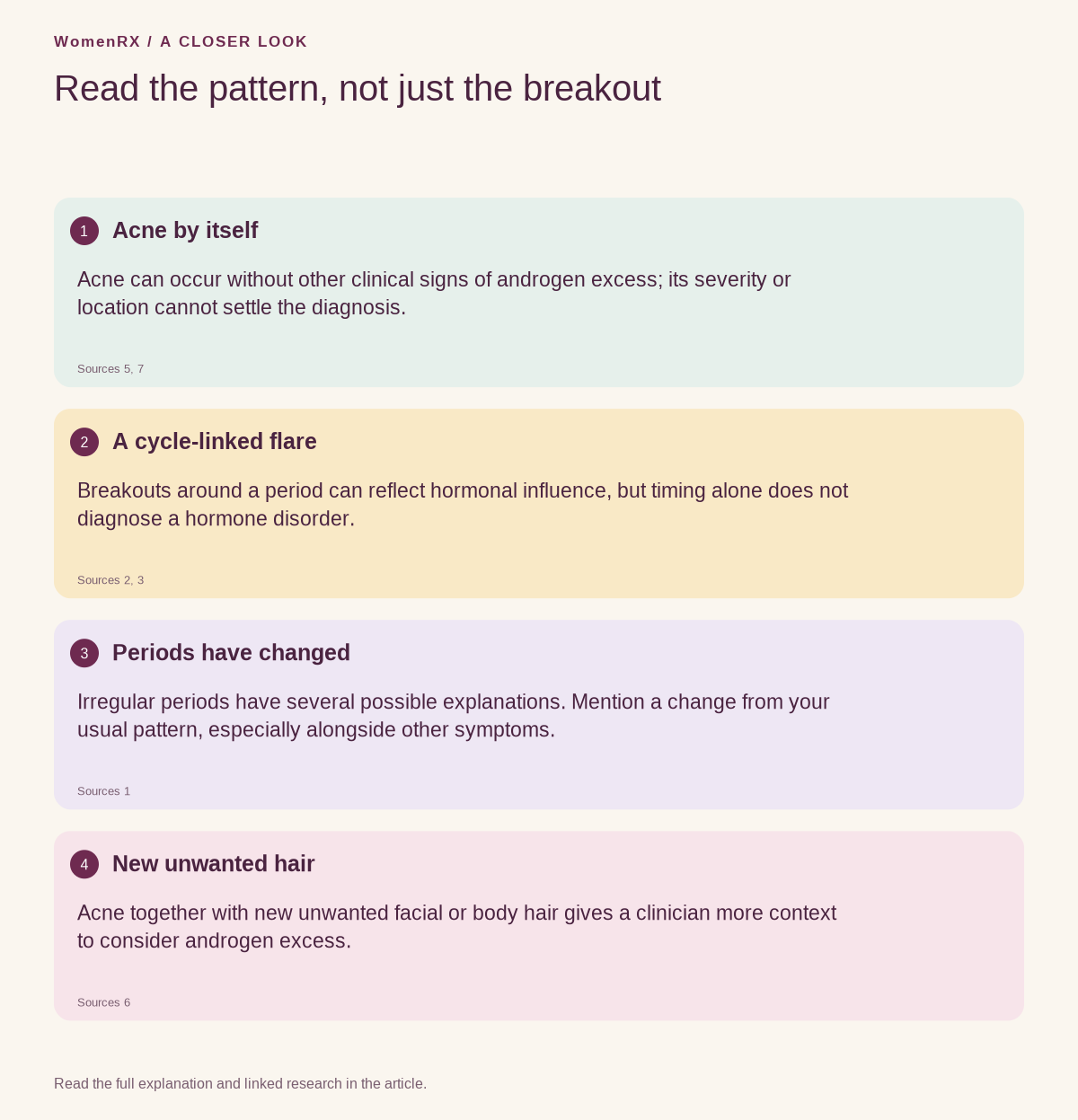
Read the pattern, not just the breakout
Acne by itself: Acne can occur without other clinical signs of androgen excess; its severity or location cannot settle the diagnosis.57
A cycle-linked flare: Breakouts around a period can reflect hormonal influence, but timing alone does not diagnose a hormone disorder.23
Periods have changed: Irregular periods have several possible explanations. Mention a change from your usual pattern, especially alongside other symptoms.1
New unwanted hair: Acne together with new unwanted facial or body hair gives a clinician more context to consider androgen excess.6
Read the figure as text
Acne can be hormone-sensitive without proving a hormone disorder. These distinctions help show when the wider symptom picture is worth discussing.- Acne by itself: Acne can occur without other clinical signs of androgen excess; its severity or location cannot settle the diagnosis.57
- A cycle-linked flare: Breakouts around a period can reflect hormonal influence, but timing alone does not diagnose a hormone disorder.23
- Periods have changed: Irregular periods have several possible explanations. Mention a change from your usual pattern, especially alongside other symptoms.1
- New unwanted hair: Acne together with new unwanted facial or body hair gives a clinician more context to consider androgen excess.6
More questions, answered
Does acne before my period mean I have PCOS?
No. Acne can flare around periods, and hormonal therapies may help some women with acne, but a cycle-related flare alone doesn’t diagnose PCOS or show that androgen levels are abnormal. 2 3
Should acne alone lead to hormone testing?
Acne can occur without other clinical signs of androgen excess. Whether testing is useful depends on the wider history and symptoms; not every person needs the same tests. 7 6
Sources you can check
- Irregular periods - NHSAccessed 2026-09-25Return to first citation
- Acne - NHSAccessed 2026-09-25Return to first citation
- Acne - Treatment - NHSAccessed 2026-09-25Return to first citation
- Adolescent polycystic ovary syndrome according to the international evidence-based guideline.Peña AS, Witchel SF, Hoeger KM, Oberfield SE, Vogiatzi MG, Misso M, Garad R, Dabadghao P, Teede H. · BMC medicine · 2020Return to first citation
- Acne severity and the Global Acne Grading System in polycystic ovary syndrome.Hacivelioglu S, Gungor AN, Gencer M, Uysal A, Hizli D, Koc E, Cosar E. · International journal of gynaecology and obstetrics: the official organ of the International Federation of Gynaecology and Obstetrics · 2013Return to first citation
- An updated clinico-investigative approach to diagnosis of cutaneous hyperandrogenism in relation to adult female acne, female pattern alopecia & hirsutism a primer for dermatologists.Sardana K, Muddebihal A, Sehrawat M, Bansal P, Khurana A. · Expert review of endocrinology & metabolism · 2024Return to first citation
- ADT-G as a promising biomarker for peripheral hyperandrogenism in adult female acne.Rocha M, Cardozo KHM, Carvalho VM, Bagatin E. · Dermato-endocrinology · 2017Return to first citation