How Endometriosis Is Diagnosed: Scans, Symptoms, and Surgery
A normal ultrasound or MRI can miss some endometriosis, so diagnosis depends on how your symptoms, examination, and imaging fit together.
Endometriosis is assessed through your symptoms and medical history, an examination when appropriate, and often ultrasound or MRI. Imaging can identify ovarian endometriomas and many forms of deep endometriosis, but a normal scan does not rule out smaller superficial lesions. Laparoscopy can directly confirm visible disease, but surgery is not automatically required for everyone being evaluated. 1 4 6
Diagnosis is a process, not one yes-or-no test
Painful periods, pelvic pain, pain during sex, or difficulty getting pregnant can prompt an evaluation for endometriosis. Symptoms vary, and pelvic pain can also come from bowel, bladder, or other pelvic conditions. A clinician typically starts by asking what the pain feels like, when it happens, how it affects daily life, and whether there are related symptoms or a family history. An examination may be offered, but the symptoms and examination alone cannot show exactly where endometriosis is or whether it is present. 1 2
You don’t need to have every familiar symptom to raise the possibility. Pain can be cyclical or occur at other times, and symptoms can affect people differently. In adolescents, period pain may be dismissed as an ordinary part of menstruation, which can contribute to delayed recognition. 1 3 7
The assessment also needs to leave room for other explanations or overlapping conditions. One review notes that chronic pelvic pain may involve conditions such as adenomyosis, pelvic-floor problems, irritable bowel syndrome, or bladder pain syndrome. So persistent pain with a normal scan deserves thoughtful evaluation, not an automatic assumption that endometriosis is either present or absent. 4
What ultrasound and MRI can show
An ultrasound, including one performed through the vagina when appropriate, can look for ovarian endometriomas and signs of deeper disease. MRI may also be used as part of further evaluation. These scans can help identify disease that changes pelvic anatomy and can help clinicians understand where it is. A specialist, structured ultrasound assessment may look beyond the ovaries to features such as organ movement, tenderness in specific areas, and nodules in different pelvic compartments. 1 5 6
A scan’s usefulness depends partly on what kind of disease is being considered and how the examination is performed. In a multicenter study of people referred to tertiary gynecology services with symptoms or signs suggestive of endometriosis, a structured transvaginal ultrasound protocol was assessed against visual findings at laparoscopy. The study supports comprehensive assessment for deep endometriosis in that setting; its results should not be treated as a guarantee that an ultrasound will detect every type of endometriosis in every person. 5
The key limitation is superficial disease. Small lesions on the pelvic lining may not be visible on conventional imaging. That means a normal ultrasound or MRI can make some forms of endometriosis less apparent, but it does not settle the question for all forms. It also doesn’t mean that every person with pelvic pain and normal imaging has endometriosis. 4 6
When laparoscopy enters the conversation
Laparoscopy is an operation in which a camera is passed through a small cut in the abdomen. It lets a surgeon look directly inside the pelvis; visible areas may sometimes be treated during the procedure. It can confirm disease that imaging has not shown, particularly when superficial lesions are suspected. 1 4
But “the most direct way to see it” does not mean “the necessary next step for everyone.” The decision depends on the full clinical picture and what the result would change. Laparoscopy may be discussed when symptoms continue despite other approaches, imaging raises concern for more complex disease, fertility concerns affect the decision, or a direct diagnosis would help guide treatment. Surgery has its own burdens and risks, so it’s reasonable to ask what the operation is expected to answer and whether treatment could happen at the same time. 1 4
A visible amount of disease also doesn’t neatly explain how much pain someone feels. The relationship between lesion burden and pain severity is inconsistent, and persistent pelvic pain can have more than one contributor. A scan or operation is therefore only part of understanding what you’re experiencing. 4
What to take from a normal scan
A normal result is useful information, but it is not a universal rule-out. Ask what the scan was designed to assess: for example, whether it evaluated the ovaries and looked for deep disease, or whether the question includes superficial lesions that are harder to see. If symptoms continue to affect your life, the next discussion can focus on whether another cause should be considered, whether specialist imaging could clarify the picture, or whether a different diagnostic or treatment approach makes sense. 4 5
A response to hormonal treatment may be part of clinical reasoning, but improvement does not prove endometriosis. Similar improvement can happen with other hormone-sensitive conditions or menstrual pain, so treatment response is not a specific diagnostic test. 4
For a useful conversation, describe the pattern rather than just the pain rating: whether it follows your cycle, happens with sex or bowel or bladder symptoms, and interferes with school, work, sleep, or daily activities. These details help connect symptoms to the next step without requiring you to decide the diagnosis yourself. 1 2
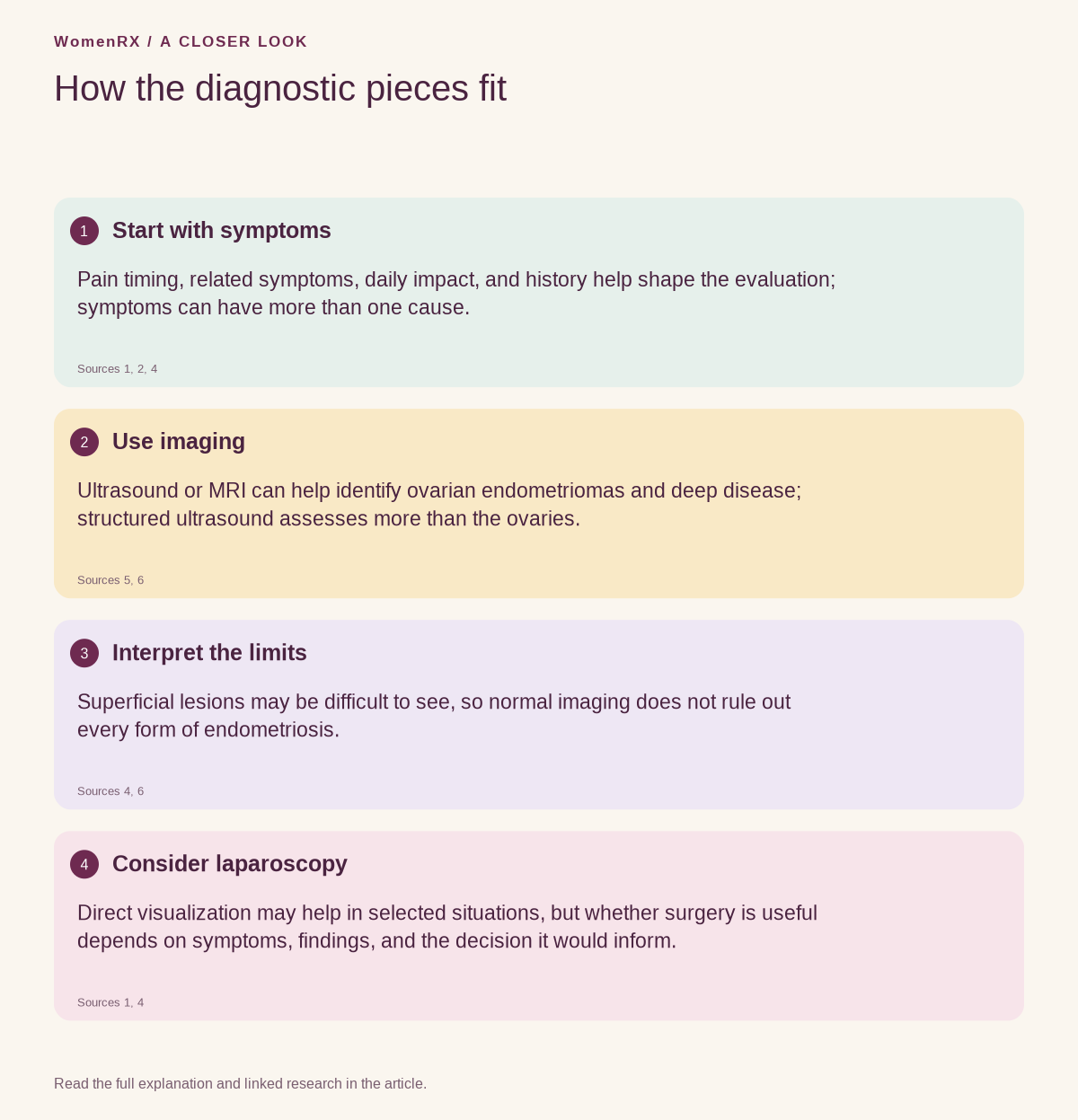
How the diagnostic pieces fit
Start with symptoms: Pain timing, related symptoms, daily impact, and history help shape the evaluation; symptoms can have more than one cause.124
Use imaging: Ultrasound or MRI can help identify ovarian endometriomas and deep disease; structured ultrasound assesses more than the ovaries.56
Interpret the limits: Superficial lesions may be difficult to see, so normal imaging does not rule out every form of endometriosis.46
Consider laparoscopy: Direct visualization may help in selected situations, but whether surgery is useful depends on symptoms, findings, and the decision it would inform.14
Read the figure as text
Symptoms, imaging, and sometimes surgery contribute different kinds of information; a normal scan does not answer every question.- Start with symptoms: Pain timing, related symptoms, daily impact, and history help shape the evaluation; symptoms can have more than one cause.124
- Use imaging: Ultrasound or MRI can help identify ovarian endometriomas and deep disease; structured ultrasound assesses more than the ovaries.56
- Interpret the limits: Superficial lesions may be difficult to see, so normal imaging does not rule out every form of endometriosis.46
- Consider laparoscopy: Direct visualization may help in selected situations, but whether surgery is useful depends on symptoms, findings, and the decision it would inform.14
More questions, answered
Does responding to hormone treatment confirm endometriosis?
No. Symptom improvement can support a treatment decision, but it is not specific to endometriosis because other conditions and menstrual pain may also improve. 4
Can endometriosis be diagnosed in a teenager?
Yes. Endometriosis can affect adolescents, and significant period pain should not be dismissed simply because it occurs during menstruation. Assessment may include symptoms and imaging; laparoscopy may be considered in some situations, such as when treatment has not helped. 3 7
Sources you can check
- Endometriosis - NHSAccessed 2026-09-25Return to first citation
- Pelvic pain - NHSAccessed 2026-09-25Return to first citation
- Period pain - NHSAccessed 2026-09-25Return to first citation
- Superficial Peritoneal Endometriosis Beyond Surgical Diagnosis: A Narrative Review of Emerging Functional and Molecular Perspectives.Palumbo M, D'Angelo G, Colacurci D, Baldini GM, La Verde M, Watrowski R, Carone V, Bifulco G, Giampaolino P, Della Corte L. · Medicina (Kaunas, Lithuania) · 2026Return to first citation
- Diagnostic test accuracy of each of the four IDEA ultrasound steps in predicting presence of deep endometriosis.McClenahan P, Mak J, Uzuner C, Espada Vaquero M, Reid S, Eathorne A, Condous G, IDEA Group Collaborators. · Ultrasound in obstetrics & gynecology : the official journal of the International Society of Ultrasound in Obstetrics and Gynecology · 2026Return to first citation
- Global trends in the uptake of specialist diagnostic ultrasound and MRI scans for endometriosis: An international cross-sectional survey.Avery JC, Fragkoudi A, Deslandes A, Nelson SM, Henry L, Bhardwaj A, Topcu EG, Tulandi T, Malhotra J, Feldberg D, Barnea E, Purandare N, Mocanu E, Leonardi M, Hull ML, FIGO Committe... · International journal of gynaecology and obstetrics: the official organ of the International Federation of Gynaecology and Obstetrics · 2026Return to first citation
- Endometriosis in adolescents: A literature review.Cauchin C, Jamard E, Bendifallah S, Fauvet R. · Journal of gynecology obstetrics and human reproduction · 2026Return to first citation