Hormones in Your 50s: The Transition and What Follows
Your age alone can’t tell you whether you’re in the menopause transition or postmenopause; the clearest dividing line is 12 months without a period.
In your 50s, menstrual history matters more than age for understanding your stage. Menopause is identified retrospectively, after 12 months without a period; the years leading up to that point are the transition. Ovarian hormone levels change across this time, but they may fluctuate rather than decline in a straight line. Bleeding after those 12 months is postmenopausal bleeding and needs medical assessment. 1 2 3
The calendar matters more than the birthday
Turning 50 doesn’t, by itself, mean you’ve reached menopause. The transition is the period leading up to your final menstrual period. Menopause is identified after 12 months have passed without a period; the years after that are postmenopause. Because the 12-month mark is known only in hindsight, you may not be able to name your exact stage while your periods are still changing. 3
Hormones shift during this transition, but not necessarily in a steady, predictable slide. Ovarian hormones including estradiol and progesterone decline across the transition, while measurements can still vary. 1 2 For example, in a selected group of 406 participants in the Study of Women’s Health Across the Nation who had repeated anti-Müllerian hormone measurements, 220 later had a detectable reading after an earlier one had been below the test’s detection limit. Of those 220, 107 also had a concurrent rise in estradiol. That study doesn’t establish what any one person’s hormone levels will do; it does show why a single hormone reading may not tell the whole story of a changing menstrual history. 1
So, if your periods are changing in your 50s, age alone can’t settle whether you’re in the transition or have reached menopause. The 12-month mark is the key distinction, not a particular birthday or one hormone result.
Why bleeding after menopause is different
Bleeding patterns can change before the final period, but a new or concerning change shouldn’t automatically be written off as menopause. Abnormal uterine bleeding can involve changes in how often bleeding occurs, how regular it is, how long it lasts, or how heavy it is. Clinical guidance recommends systematic evaluation of abnormal bleeding to check for significant causes. 3
After 12 months without periods, any uterine bleeding is considered postmenopausal bleeding, even if it’s light or happens only once. It’s a different clinical situation from bleeding during the transition, and it warrants assessment rather than watchful normalization. The evaluation is meant to check for causes that need attention, including changes in the uterine lining. 3
Assessment doesn’t always mean one particular test. A joint society guideline finds that hysteroscopy, with or without a visually directed biopsy, can be more accurate than blind endometrial sampling for identifying several kinds of uterine pathology. The guideline especially notes its value when imaging or sampling is inconclusive or a focal problem is suspected. Your clinician can explain which evaluation fits your history and findings. 3
When symptoms deserve attention
The calendar isn’t the only useful clue. If symptoms such as hot flashes are persistent or bothersome, you don’t have to assume you should simply put up with them. The North American Menopause Society identifies hormone therapy as the most effective treatment for vasomotor symptoms, and its position statements also describe evidence-based nonhormonal options. Which approach fits depends on your health history and preferences. 4 5
A practical way to describe what’s happening is to note when your last period began, whether bleeding has recurred, and which symptoms are affecting daily life. Most of all, mention any bleeding that occurs after a full 12 months without periods. That detail changes the question from “Could this be part of the transition?” to “What evaluation is appropriate for postmenopausal bleeding?” 3
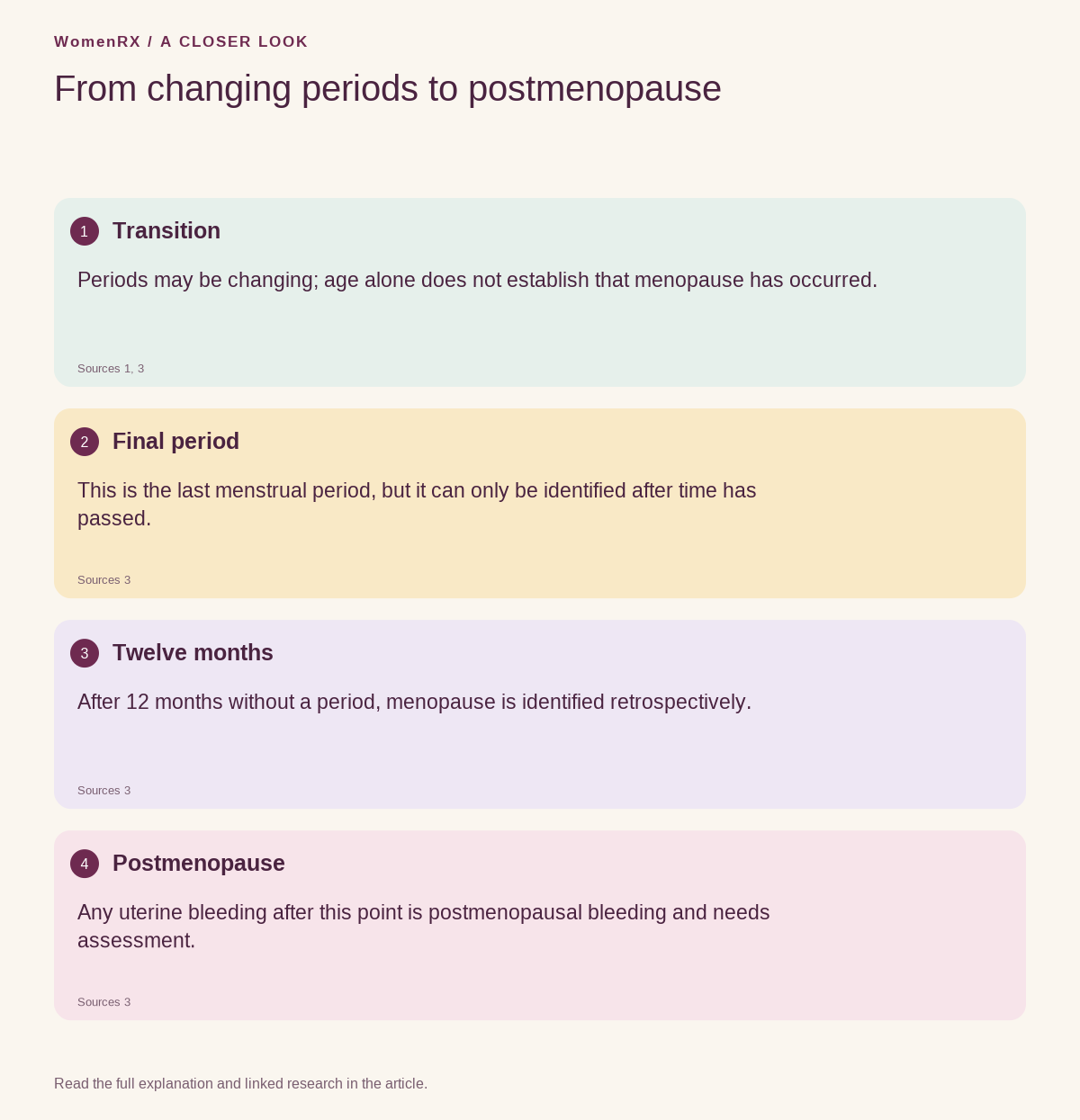
From changing periods to postmenopause
Transition: Periods may be changing; age alone does not establish that menopause has occurred.13
Final period: This is the last menstrual period, but it can only be identified after time has passed.3
Twelve months: After 12 months without a period, menopause is identified retrospectively.3
Postmenopause: Any uterine bleeding after this point is postmenopausal bleeding and needs assessment.3
Read the figure as text
The 12-month interval separates the menopause transition from postmenopause; bleeding after that point is a different clinical issue.- Transition: Periods may be changing; age alone does not establish that menopause has occurred.13
- Final period: This is the last menstrual period, but it can only be identified after time has passed.3
- Twelve months: After 12 months without a period, menopause is identified retrospectively.3
- Postmenopause: Any uterine bleeding after this point is postmenopausal bleeding and needs assessment.3
More questions, answered
Can hormone levels fluctuate after they become very low?
They can. In a selected SWAN group with repeated measurements, some participants had anti-Müllerian hormone become detectable again after an earlier undetectable result; some of those also had a concurrent estradiol rise. This finding describes that study group, not a prediction for every person. 1
Does light bleeding count after menopause?
Yes. Uterine bleeding 12 months or more after periods have stopped is classified as postmenopausal bleeding and needs assessment, even if it is light or happens once. 3
Sources you can check
- Antimüllerian hormone rebound and estradiol changes in the study of women's health across the nation.Bozzuto LM, Acharya K, Shiferaw B, Kaizer LK, Finkelstein JS, Neal-Perry G, Karlamangla A, Morrison A, Santoro N, Sammel MD. · Fertility and sterility · 2026Return to first citation
- Menopause and "leaky gut": implications for midlife women's health.Peters BA. · The Journal of clinical investigation · 2026Return to first citation
- Visually directed hysteroscopic biopsy in the evaluation of abnormal uterine bleeding and postmenopausal bleeding: a Joint Society Practice Guideline. Joint Society Practice Guideline from AAGL-ESGE-GCH. · Facts, views & vision in ObGyn · 2026Return to first citation
- The 2022 hormone therapy position statement of The North American Menopause Society.“The 2022 Hormone Therapy Position Statement of The North American Menopause Society” Advisory Panel. · Menopause (New York, N.Y.) · 2022Return to first citation
- The 2023 nonhormone therapy position statement of The North American Menopause Society.Menopause (New York, N.Y.) · 2023Return to first citation