Early Signs of the Menopause Transition: What to Notice
Cycle changes can be an early clue, but no single period pattern or symptom proves that perimenopause has begun.
Your periods may start coming closer together or farther apart, or change in length or flow. Hot flashes and vaginal dryness can also occur, but symptoms vary and can have other causes. Notice how your cycle and symptoms change over time rather than treating one sign as proof. Age and medical history matter, especially if periods become irregular before age 40. 1 3
Look for a change from your usual cycle
The first noticeable change may be that your periods no longer follow their familiar pattern. They might come with more or less time between them, last longer or less long, or become heavier or lighter. These changes can vary; there isn’t one sequence everyone follows. 1
A shift in flow alone isn’t a clear signal that the transition has started. In a cross-sectional study of women without hot flashes or other vasomotor symptoms, those with regular periods but changed flow differed little on most measured symptoms from those whose flow hadn’t changed. That makes the overall pattern more useful than one change in bleeding by itself. 2
Hot flashes and vaginal dryness can also occur. In a large Australian cross-sectional study, hot flashes showed a clearer increase from premenopause to late perimenopause than most of the other symptoms measured. This finding describes a group pattern, not a way to diagnose an individual. Mood changes may happen too, but symptoms such as low mood or tiredness can have other contributors. 1 3
Keep a simple record, not a score
For a few cycles, note when bleeding starts, how long it lasts, and whether the amount seems different from your usual. Separately jot down symptoms that recur, such as hot flashes, vaginal dryness, or mood changes, and whether they seem to coincide with cycle changes. The goal is to describe your pattern clearly, not to calculate a score or diagnose yourself.
Menopause itself is defined as 12 months without a period. Before that point, cycle changes may be part of the transition, but they cannot tell you exactly when your final period will happen. 1
Age and medical history change the picture
The transition usually begins in a person’s 40s, though it can start earlier. “Early menopause” means menopause before age 45, and “premature menopause” means it happens before age 40. Those labels describe when menopause occurs; they don’t mean every irregular period before those ages is menopause. 1
Before age 40, irregular or absent periods are worth discussing with a clinician because primary ovarian insufficiency (POI) is one possible explanation. POI is different from early menopause: periods may continue irregularly, and pregnancy may still be possible. 1
Some medical histories also make bleeding patterns harder to interpret. Removing the uterus stops periods, but doesn’t cause menopause if the ovaries remain. Chemotherapy and some hormone treatments for breast cancer may bring menopause on earlier than usual. Mention these histories when discussing new symptoms or cycle changes. 1
When to seek an evaluation
Consider arranging an evaluation if periods become irregular before age 40, particularly if they become infrequent or stop, rather than assuming the change is routine perimenopause. At any age, you can also seek advice if symptoms are affecting your day-to-day life or a change in bleeding concerns you. Your notes can help explain what has changed, but a symptom or cycle tracker can’t identify the cause on its own. 1
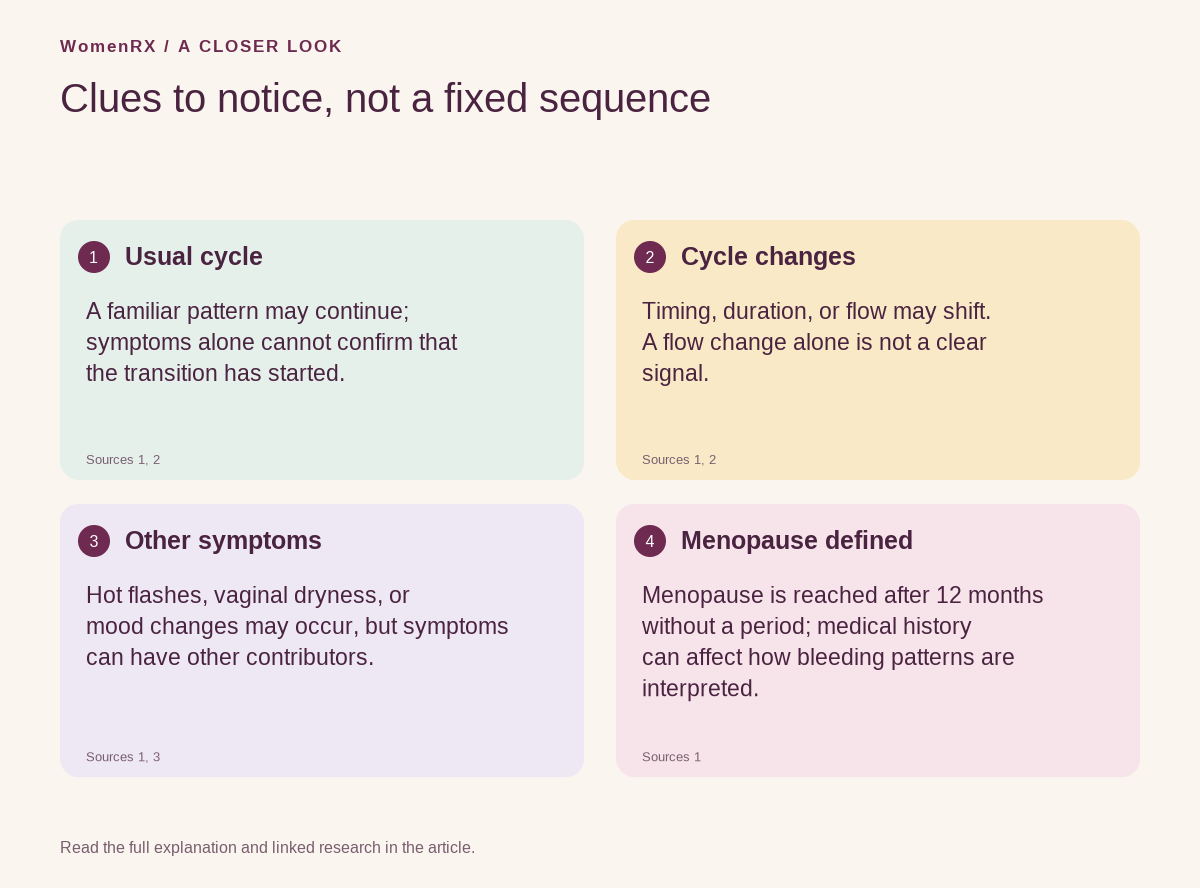
Clues to notice, not a fixed sequence
Usual cycle: A familiar pattern may continue; symptoms alone cannot confirm that the transition has started.12
Cycle changes: Timing, duration, or flow may shift. A flow change alone is not a clear signal.12
Other symptoms: Hot flashes, vaginal dryness, or mood changes may occur, but symptoms can have other contributors.13
Menopause defined: Menopause is reached after 12 months without a period; medical history can affect how bleeding patterns are interpreted.1
Read the figure as text
These patterns can occur in different combinations. The guide separates possible changes from what they can and cannot tell you.- Usual cycle: A familiar pattern may continue; symptoms alone cannot confirm that the transition has started.12
- Cycle changes: Timing, duration, or flow may shift. A flow change alone is not a clear signal.12
- Other symptoms: Hot flashes, vaginal dryness, or mood changes may occur, but symptoms can have other contributors.13
- Menopause defined: Menopause is reached after 12 months without a period; medical history can affect how bleeding patterns are interpreted.1
More questions, answered
Does one irregular period mean I’m in perimenopause?
No. Periods can change during the transition, but one change, especially a change in flow alone, doesn’t clearly establish that it has begun. Consider your pattern over time along with your age and medical history. 1 2
Can pregnancy still be possible with irregular periods?
Yes. With primary ovarian insufficiency, periods may continue irregularly and pregnancy may still be possible. 1
Sources you can check
- Menopause | Menopause Symptoms | MedlinePlusAccessed 2026-09-25Return to first citation
- Symptom profiles in the late reproductive stage, earlier premenopause and early perimenopause in the absence of vasomotor symptoms: a cross-sectional study.Bresolin S, Islam RM, Bond M, Davis SR. · BMJ sexual & reproductive health · 2026Return to first citation
- Prevalence and severity of symptoms across the menopause transition: cross-sectional findings from the Australian Women's Midlife Years (AMY) Study.Islam RM, Bond M, Ghalebeigi A, Wang Y, Walker-Bone K, Davis SR. · The lancet. Diabetes & endocrinology · 2025Return to first citation