Perimenopause Symptoms: What Can Change and When to Get Help
Periods may become less predictable during perimenopause, and sleep, heat, mood, or vaginal and urinary changes may be part of the picture too.
Perimenopause can bring changes in menstrual timing and flow, hot flashes, disturbed sleep, and vaginal or urinary changes. Mood changes may overlap with poor sleep, but none of these symptoms proves perimenopause is the cause. Bleeding deserves assessment when it affects daily life, happens between periods or after sex, or comes with severe period pain. 2 4 6 7
What can change during the transition?
Perimenopause is the transition before menopause, when periods may continue but ovarian function becomes less predictable. Symptoms don’t arrive as one fixed package, and a change can have more than one possible cause. 4
Cycle: timing, flow, and pain
Periods can change in how often they come, how regular they are, how long they last, or how heavy the flow is. Hormonal fluctuation is one possible reason for abnormal bleeding during perimenopause, but it isn’t the only one. Fibroids and polyps, among other conditions, can also contribute. 4 5
A change in flow is worth assessing if it disrupts daily life, if you have severe period pain, or if you bleed between periods or after sex. One practical sign of heavy bleeding is needing to change a pad or tampon every one to two hours. The NHS also lists feeling tired or short of breath a lot among signs to mention when describing heavy periods; those symptoms don’t establish the cause on their own. 2
Bleeding after sex or between periods isn’t something to automatically write off as a transition symptom. A clinician may consider several possible causes, including pregnancy when possible, infection, or changes in the uterus or cervix. 4
Heat and sleep
Hot flashes can occur during the menopause transition. Sleep changes may look like waking during the night, waking early, or feeling that sleep isn’t restorative. A nighttime hot flash may disrupt sleep, but sleep problems can also occur without hot flashes. Research on how common and disruptive these sleep problems are focuses largely on postmenopausal women, so it doesn’t tell you exactly how likely they are at your stage of perimenopause. 6 7
Mood and vaginal or urinary changes
If anxiety or low mood shows up alongside poor sleep, it’s worth noticing both rather than assuming one explains the other. Research links disturbed sleep with anxiety and depression, primarily in postmenopausal women; that association doesn’t establish that perimenopause caused a mood change. 6
Hormonal changes during perimenopause can also affect vaginal tissue and pH and are associated with a greater risk of urinary tract infections. A new urinary problem isn’t automatically a menopause symptom or an infection, but it shouldn’t be lost in a conversation focused only on periods and hot flashes. 7
When bleeding needs assessment
Arrange an evaluation if heavy bleeding affects your life, you have severe period pain, or you bleed between periods or after sex. If you have heavy bleeding along with tiredness or shortness of breath, mention that too. These patterns can have treatable causes, and assessment helps distinguish hormonal changes from other conditions. 2 4
For women over 45, bleeding after more than a year without a period needs medical evaluation. It should not be treated as an ordinary change in a still-active menstrual cycle. 1
If pregnancy is possible, irregular periods don’t rule it out; pregnancy may need to be excluded when evaluating abnormal bleeding. 4
A useful way to keep track
For a short time, note when bleeding starts and stops, whether it’s unusually heavy, and whether it happens between periods or after sex. You can also jot down hot flashes, sleep or mood changes, and vaginal or urinary concerns, including which ones interfere with daily activities. This isn’t a diagnostic test; it helps describe the pattern clearly. The pattern matters because abnormal bleeding can have hormonal, structural, or other causes. 3 4 6 7
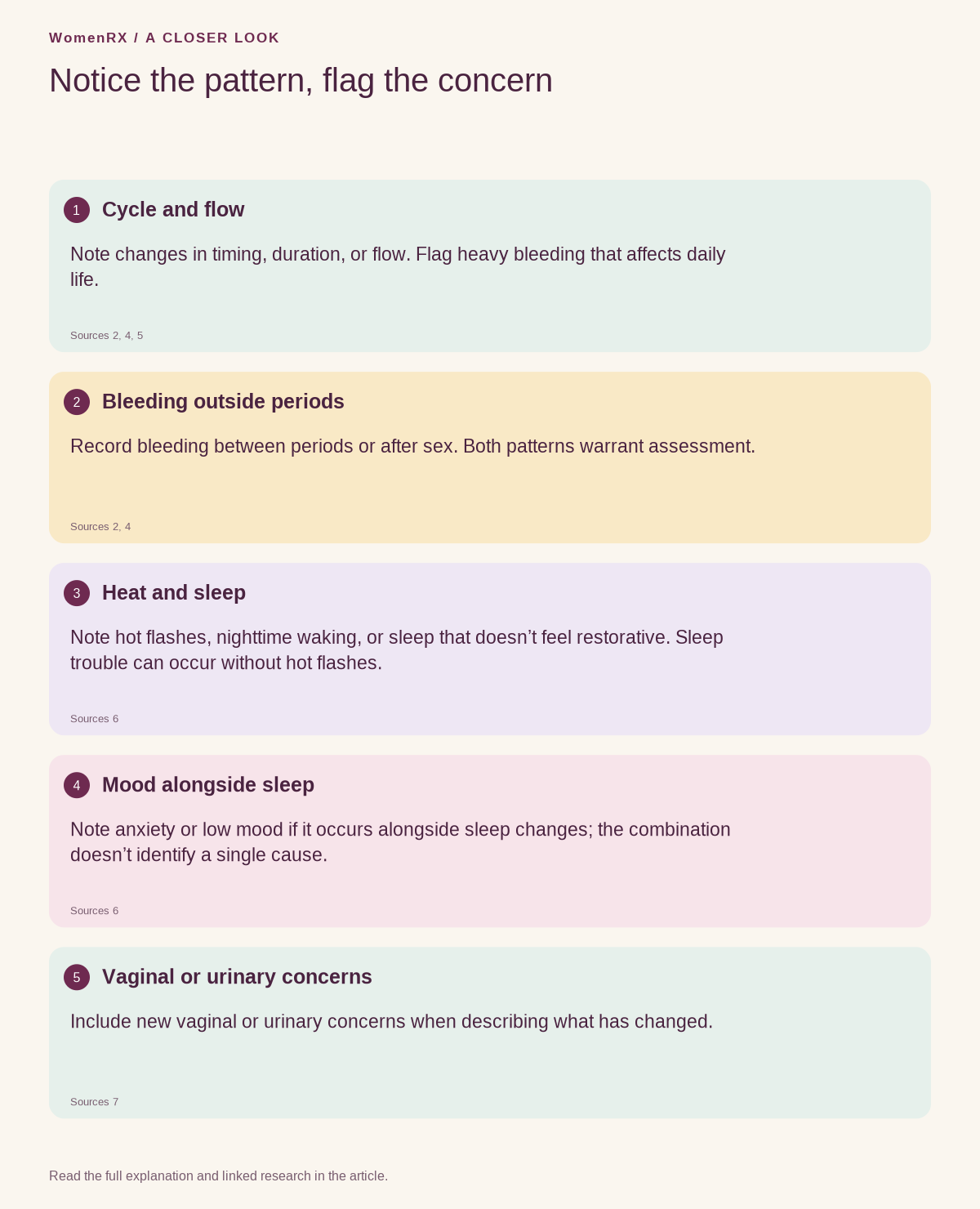
Notice the pattern, flag the concern
Cycle and flow: Note changes in timing, duration, or flow. Flag heavy bleeding that affects daily life.245
Bleeding outside periods: Record bleeding between periods or after sex. Both patterns warrant assessment.24
Heat and sleep: Note hot flashes, nighttime waking, or sleep that doesn’t feel restorative. Sleep trouble can occur without hot flashes.6
Mood alongside sleep: Note anxiety or low mood if it occurs alongside sleep changes; the combination doesn’t identify a single cause.6
Vaginal or urinary concerns: Include new vaginal or urinary concerns when describing what has changed.7
Read the figure as text
Use these prompts to describe what’s changing. This is a memory aid, not a diagnostic checklist.- Cycle and flow: Note changes in timing, duration, or flow. Flag heavy bleeding that affects daily life.245
- Bleeding outside periods: Record bleeding between periods or after sex. Both patterns warrant assessment.24
- Heat and sleep: Note hot flashes, nighttime waking, or sleep that doesn’t feel restorative. Sleep trouble can occur without hot flashes.6
- Mood alongside sleep: Note anxiety or low mood if it occurs alongside sleep changes; the combination doesn’t identify a single cause.6
- Vaginal or urinary concerns: Include new vaginal or urinary concerns when describing what has changed.7
More questions, answered
Can irregular bleeding be part of perimenopause?
Yes. Changing ovarian function can contribute to irregular bleeding during perimenopause. But fibroids, polyps, pregnancy, and other causes may also need consideration, so bleeding between periods, after sex, or heavy enough to affect daily life warrants assessment. 2 4
Does sleep trouble mean I’m having hot flashes at night?
Not necessarily. Sleep disturbance can occur without hot flashes, and sleep problems can have other contributors. A sleep change by itself doesn’t identify its cause. 6
Sources you can check
- Postmenopausal bleeding - NHSAccessed 2026-09-25Return to first citation
- Heavy periods - NHSAccessed 2026-09-25Return to first citation
- Complex benign gynecology in perimenopause: current evidence and future directions.Goren R, Shats M, Ciesielski K, Siedhoff M, Meyer R. · Current opinion in obstetrics & gynecology · 2026Return to first citation
- Perimenopausal abnormal uterine bleeding.Dreisler E, Frandsen CS, Ulrich L. · Maturitas · 2024Return to first citation
- Abnormal Uterine BleedingMikes BA, Vadakekut ES, Sparzak PB. · 2025Return to first citation
- Impact of sleep disturbances on health-related quality of life in postmenopausal women: a systematic review.Soares CN, Bajbouj M, Schoof N, Kishore A, Caetano C. · Menopause (New York, N.Y.) · 2026Return to first citation
- [Preventive measures against urinary tract infections in women during perimenopause and postmenopause].Ricart-Barreiro L, Alonso-Calvete A, López-Pais M, Tomé-Lage D, Mollinedo-Cardalda I. · Revista espanola de salud publica · 2026Return to first citation