Hair Thinning Around Menopause: Causes and Care Options
A widening part can fit female pattern hair loss, but timing alone can’t tell you why your hair is thinning.
Hair thinning during perimenopause or after menopause doesn’t automatically mean menopause caused it. Thinning over the crown or a widening part can fit female pattern hair loss; noticeable shedding or a different pattern calls for a closer look. An assessment can help match care to the cause. 1 3 Menopausal hormone therapy is a separate decision, based on symptoms and individual benefits and risks. 2 4
Start with the pattern, not the calendar
Hair changes during perimenopause or after menopause can feel like one more thing to explain. But the timing doesn’t identify the cause. Female pattern hair loss can happen without elevated androgen levels, and other conditions can resemble it. 3
A widening part or thinning across the crown, often with the frontal hairline largely preserved, fits a common pattern of female pattern hair loss. Some women have more noticeable thinning at the front of the scalp. These are clues, not a diagnosis. 3
If what you notice is hair coming out rather than a widening part, describe the shedding when you seek an assessment. Illness can be associated with temporary hair loss. A review of female pattern hair loss also lists chronic telogen effluvium, alopecia areata incognita, and frontal fibrosing alopecia among conditions to distinguish from it. The distinction matters because they aren’t all treated the same way. 1 3
What an assessment can clarify
A clinician can often begin by looking at your hair and scalp. Tell them where you see thinning, whether you’re noticing shedding, and when you first saw the change. Mention a recent illness if there was one. That gives the assessment a more useful starting point than your menopause timing alone: does the distribution fit female pattern hair loss, or should another cause be considered? The NHS advises getting the cause assessed before turning to a commercial hair clinic. 1 3
If you’re in perimenopause, a hair change alongside changes in your cycle doesn’t establish why it’s happening. If you’re postmenopausal, a widening part still needs the same attention to pattern and possible alternatives. 3
If the change is worrying you, it’s reasonable to ask for an assessment rather than assume it is a menopause effect. Hair loss can be upsetting, and that impact is part of the reason to seek help. 1
Match care to the diagnosis
For confirmed female pattern hair loss, topical minoxidil is one treatment option to discuss. A clinical review describes temporary increased shedding during the first months of use, possible scalp irritation or contact dermatitis, and unwanted facial hair. It describes waiting at least 12 months before judging whether treatment is working and continuing it if it helps. That makes the length of a trial and the prospect of ongoing use worth discussing before you start. 3
If the assessment points to another cause, the next step may be different. For example, hair loss related to an illness may stop or grow back after recovery. That’s why identifying the pattern and likely cause matters before choosing a product or treatment. 1
Keep the hormone decision separate
Menopausal hormone therapy and hair-loss treatment answer different questions. Guidance frames hormone therapy around menopausal symptoms, personal health history, and an individual balance of benefits and risks. The balance can also depend on factors such as when treatment begins relative to menopause. 2 4 Hair thinning still needs its own assessment to identify the likely cause. 1 3
If you’re considering hormone therapy for menopause symptoms, its benefits and risks are considered individually, with timing among the factors that may matter. For hair thinning, a useful next question is: “Does this look like female pattern hair loss, or should we check for another cause before discussing treatment?”
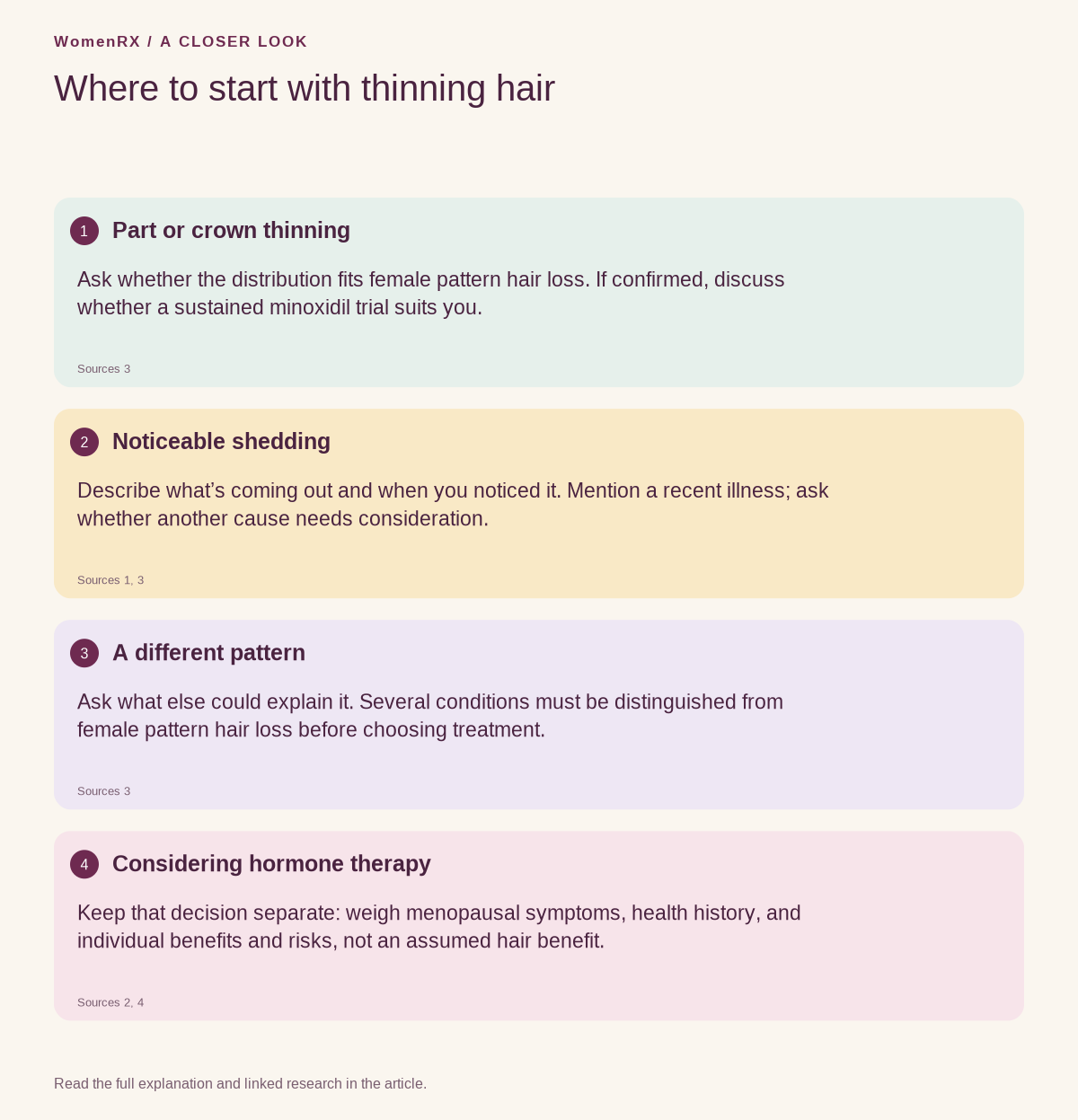
Where to start with thinning hair
Part or crown thinning: Ask whether the distribution fits female pattern hair loss. If confirmed, discuss whether a sustained minoxidil trial suits you.3
Noticeable shedding: Describe what’s coming out and when you noticed it. Mention a recent illness; ask whether another cause needs consideration.13
A different pattern: Ask what else could explain it. Several conditions must be distinguished from female pattern hair loss before choosing treatment.3
Considering hormone therapy: Keep that decision separate: weigh menopausal symptoms, health history, and individual benefits and risks, not an assumed hair benefit.24
Read the figure as text
Start with what you can observe, then use that description to guide an assessment. These branches are questions, not diagnoses.- Part or crown thinning: Ask whether the distribution fits female pattern hair loss. If confirmed, discuss whether a sustained minoxidil trial suits you.3
- Noticeable shedding: Describe what’s coming out and when you noticed it. Mention a recent illness; ask whether another cause needs consideration.13
- A different pattern: Ask what else could explain it. Several conditions must be distinguished from female pattern hair loss before choosing treatment.3
- Considering hormone therapy: Keep that decision separate: weigh menopausal symptoms, health history, and individual benefits and risks, not an assumed hair benefit.24
More questions, answered
Does normal testosterone rule out female pattern hair loss?
No. A review reports that testosterone levels are normal in most women with female pattern hair loss, so a normal result doesn’t rule it out. The hair pattern and assessment matter too. 3
Sources you can check
- Hair loss - NHSAccessed 2026-09-25Return to first citation
- Counseling in menopausal women: How to address the benefits and risks of menopause hormone therapy. A FIGO position paper.Genazzani AR, Divakar H, Khadilkar SS, Monteleone P, Evangelisti B, Galal AF, Priego PIR, Simoncini T, Giannini A, Goba G, Benedetto C. · International journal of gynaecology and obstetrics: the official organ of the International Federation of Gynaecology and Obstetrics · 2024Return to first citation
- Female pattern hair loss.Herskovitz I, Tosti A. · International journal of endocrinology and metabolism · 2013Return to first citation
- The 2022 hormone therapy position statement of The North American Menopause Society.“The 2022 Hormone Therapy Position Statement of The North American Menopause Society” Advisory Panel. · Menopause (New York, N.Y.) · 2022Return to first citation