Hair Thinning Around Menopause: Identify the Pattern First
A widening part, sudden shedding, and an inflamed scalp call for different next steps, even when they appear around menopause.
A gradually widening part can suggest female-pattern hair loss, while a sudden increase in shedding or a changing, uncomfortable scalp deserves a closer look before treatment. Hair thinning around menopause doesn’t establish its cause. If female-pattern loss is the diagnosis, topical minoxidil may help, but it takes months and its benefit depends on continued use. 245
Start with what changed
Perhaps your part looks wider in photos, or perhaps the shower drain suddenly seems full of hair. Those changes can feel alike, but they point toward different questions. Female-pattern hair loss often first shows up as overall thinning or a widening part. In this type of loss, susceptible follicles gradually shrink and produce less substantial hair. It can become noticeable in midlife, but timing alone doesn’t mean menopause caused it. 25
A sudden increase in hairs coming out is different from slowly seeing more scalp through your hair. Excess shedding can follow childbirth, an illness, surgery, or another major stressor. Weight loss and iron deficiency are also possible contributors. Shedding after a trigger may improve, though gradual pattern loss can be present at the same time. If you’re postpartum, don’t assume new shedding is menopausal hair loss. 145
Patches or scalp changes call for another look. A scaly or inflamed area may signal a scalp condition rather than ordinary pattern thinning. Inflammatory conditions can damage follicles, so don’t simply cover a painful or visibly changing scalp and wait for a hair-growth product to work. A receding frontal hairline with eyebrow loss also deserves assessment: frontal fibrosing alopecia is a scarring condition, and a study of women diagnosed with it found eyebrow loss and signs of inflammation around the hairline. These clues aren’t a diagnosis you can make from a mirror. 35
What an assessment can sort out
A clinician or dermatologist can examine the scalp and ask when the change began, whether hair is shedding or breaking, and what else changed around that time. Depending on the findings, assessment may include a gentle hair-pull test, blood tests, or occasionally a scalp biopsy. Those tests aren’t automatically necessary for every widening part; they help when the appearance or history suggests another cause. 4
Bring up recent illness, childbirth, weight loss, and changes in medicines or hair care. Thyroid disease and inadequate iron or protein can contribute to hair loss, and some medicines can too. If you suspect a medicine, ask its prescriber whether hair loss is a possible side effect rather than stopping it on your own. Tight styles and damaging hair practices are worth mentioning as well. The point is to identify anything treatable alongside, or instead of, female-pattern loss. 145
If it is female-pattern loss, compare the options
Topical minoxidil treats the pattern, not every cause of hair loss. It can help some people with early loss maintain or regrow hair, but it won’t work for everyone or restore an entire head of hair. The American Academy of Dermatology says visible results usually take about 6 to 12 months, and the benefit fades after you stop using it. That’s a different commitment from a concealer, which changes how hair looks immediately but doesn’t slow loss or regrow it. A wig, scalp powder, or spray can still be a useful choice while you decide about treatment or wait to see whether it helps. 4
If you’re considering Women’s Rogaine 5% foam, read its directions as directions for that foam, not for minoxidil solution or oral tablets. Its US label directs application to the thinning area of the scalp once daily, followed by washing your hands; using more or applying it more often won’t improve results. The label says results may appear after three months, but some women need at least six months to see them. Don’t use it for sudden or patchy loss, loss associated with childbirth, an unknown cause, or a red, inflamed, infected, irritated, or painful scalp. Those situations need the cause assessed first. 6
The foam is extremely flammable, so avoid fire, flame, or smoking during and immediately after application. Its label says it may be harmful during pregnancy or breastfeeding and advises asking a doctor before use if you have heart disease. Stop using it and seek medical advice if you develop chest pain, a rapid heartbeat, faintness or dizziness, unexplained weight gain, swelling of the hands or feet, scalp irritation, or unwanted facial hair. These are practical reasons to check the exact product label even if you’ve used another form of minoxidil before. 6
Prescription treatments are a separate conversation, not an automatic next step if minoxidil sounds inconvenient. Finasteride is approved for male-pattern hair loss, not female-pattern loss, although a dermatologist may prescribe it off-label in some circumstances for a woman who cannot become pregnant. A women-focused review notes that evidence gaps remain for female-pattern treatments. 24
Finally, a supplement makes sense when there’s a relevant shortfall to correct, not simply because hair is thinning. A dermatologist may recommend iron, zinc, or biotin when testing shows a deficiency; taking extra nutrients when levels are normal can cause harm. Finding the pattern first gives you a better chance of choosing a treatment that addresses what’s actually happening. 4
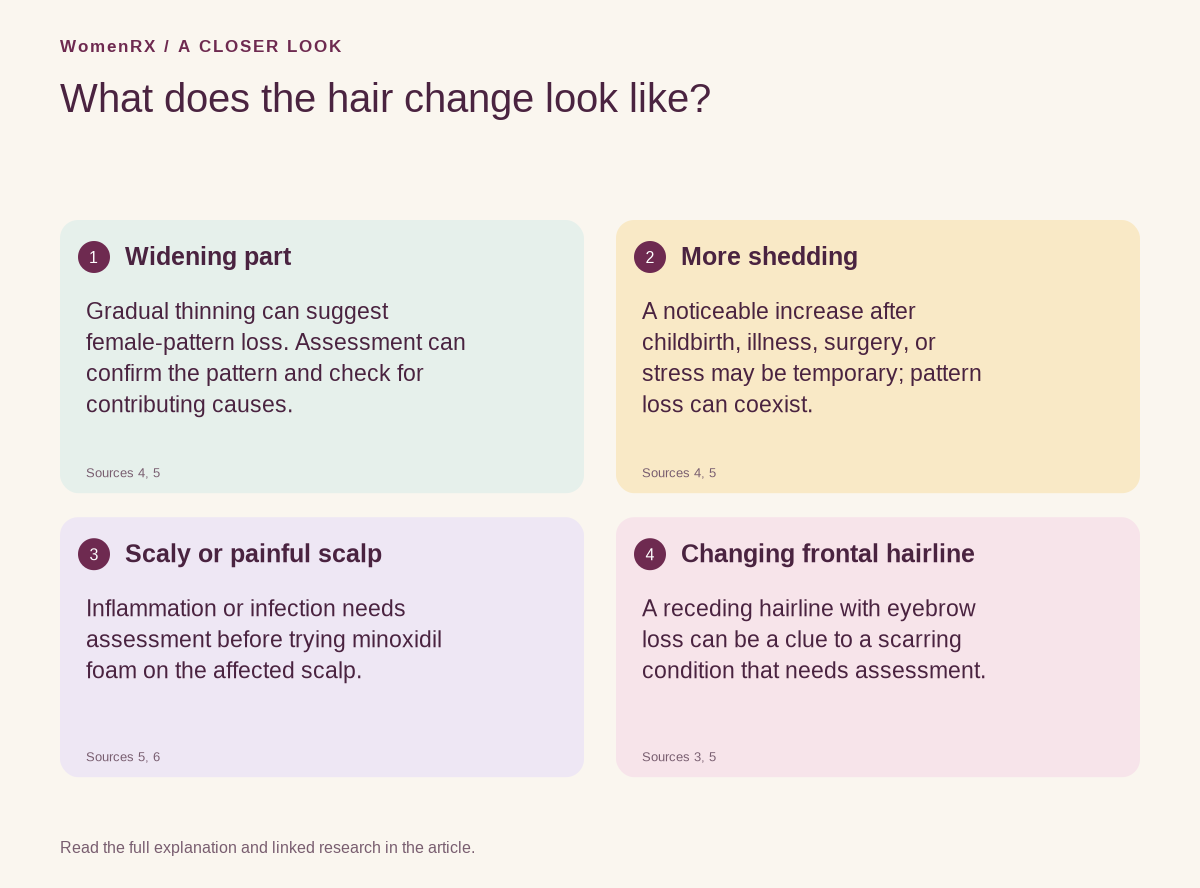
What does the hair change look like?
Widening part: Gradual thinning can suggest female-pattern loss. Assessment can confirm the pattern and check for contributing causes.45
More shedding: A noticeable increase after childbirth, illness, surgery, or stress may be temporary; pattern loss can coexist.45
Scaly or painful scalp: Inflammation or infection needs assessment before trying minoxidil foam on the affected scalp.56
Changing frontal hairline: A receding hairline with eyebrow loss can be a clue to a scarring condition that needs assessment.35
Read the figure as text
The appearance and pace of hair loss help identify which question to answer before choosing treatment.- Widening part: Gradual thinning can suggest female-pattern loss. Assessment can confirm the pattern and check for contributing causes.45
- More shedding: A noticeable increase after childbirth, illness, surgery, or stress may be temporary; pattern loss can coexist.45
- Scaly or painful scalp: Inflammation or infection needs assessment before trying minoxidil foam on the affected scalp.56
- Changing frontal hairline: A receding hairline with eyebrow loss can be a clue to a scarring condition that needs assessment.35
Sources you can check
- Hair loss - NHSAccessed 2026-09-25Return to first citation
- Androgenetic Alopecia in Women: A Narrative Review of Pathophysiology, Clinical Evaluation, and Treatments.Kearney CA, Brinks AL, Lawrence CN, Maas DE, Spindler AJ, Coric C, Gener-Pangilinan LA, Lasheras-Pérez MA, Shapiro J, Lo Sicco KI. · American journal of clinical dermatology · 2026Return to first citation
- Clinical characteristics, trichoscopy, histopathology and treatment outcomes of frontal fibrosing alopecia in an Asian population: A retro-prospective cohort study.Panchaprateep R, Ruxrungtham P, Chancheewa B, Asawanonda P. · The Journal of dermatology · 2020Return to first citation
- Hair loss: Diagnosis and treatmentAccessed 2026-09-25Return to first citation
- Hair loss: Who gets and causesAccessed 2026-09-25Return to first citation
- Womens Rogaine Unscented: minoxidil foam US Drug FactsAccessed 2026-09-26Return to first citation