Does the Menopause Transition Cause Hair Thinning?
Hair can thin around menopause, but the way it changes offers better clues than the timing alone.
Menopause-related hormone changes may play a part in hair thinning, but they don’t explain every change in hair density. Research has not clearly separated the effects of menopause from aging, inherited follicle sensitivity, and other causes. Gradually finer hair and increased shedding offer different clues. Neither pattern, on its own, tells you whether estrogen or testosterone is responsible. 3 4
If you’ve noticed more scalp showing through your part or more hair coming out when you wash it, menopause may be the first explanation that comes to mind. It’s a reasonable question, especially when the change happens alongside other midlife changes. But hair thinning isn’t a reliable sign that estrogen is low, and its timing doesn’t identify the cause. 3 4
What hormones can and can’t explain
Hair follicles respond to hormones, but that response isn’t as simple as “less estrogen means less hair.” Researchers have proposed that declining estrogen and changing androgen effects contribute to hair changes around menopause. Menopause-specific evidence remains limited, though, and it hasn’t clearly established how much thinning is due to the transition itself rather than aging or other factors. 3 4
The androgen pathway is easier to picture. In someone with genetically sensitive scalp follicles, androgen activity can contribute to miniaturization: follicles produce progressively finer hairs, so coverage becomes less dense. That doesn’t mean a woman with thinning hair necessarily has high testosterone. Follicle sensitivity matters, and a blood hormone level doesn’t directly measure how a particular follicle responds. 4
This distinction matters in both perimenopause and postmenopause. A change that begins while periods are becoming irregular, or one noticed years after periods stop, may overlap with hormonal change. Neither timing proves a direct estrogen cause. 3
Finer hair or more shedding?
Try to describe what is changing before deciding why. A gradual loss of coverage, with finer hairs in an area of the scalp, can fit follicle miniaturization. A noticeable increase in loose hairs points toward shedding. Hair normally moves through growth and resting phases, and some forms of hair loss are temporary; illness, for example, can be followed by temporary hair loss. These are clues, not diagnoses, and more than one process can happen at once. 1 4
For example, a part that looks gradually wider is a different observation from a sudden increase in hair left in the shower after an illness. Describing that difference can make an assessment more useful than simply saying the change started “around menopause.” 1 4
There may also be a contributor that has little to do with menopause. Thyroid dysfunction is linked with several types of hair loss, and a menopause-focused review identifies iron deficiency as another possible contributor. That doesn’t mean either is the cause for you. It means midlife timing shouldn’t close off other explanations. 3 4
When to get a closer look
If the thinning is worrying you or the pattern isn’t clear, a primary care clinician or dermatologist can examine your hair and scalp. Be ready to describe whether the change has been gradual or abrupt, whether you’re seeing finer hair or more shedding, and whether an illness or another health change came before it. An examination can help sort out what deserves further assessment. 1 4
An abrupt, severe change after menopause accompanied by signs of virilization deserves a timely assessment rather than an assumption that it’s ordinary menopausal thinning. A review of postmenopausal androgen excess describes ruling out a tumor when abrupt, severe signs with virilization and a testosterone level in the male range occur together. Hair loss by itself does not establish that presentation. 5
Would menopause hormone therapy bring hair back?
A possible hormone contribution doesn’t mean replacing estrogen will restore hair. The 2022 menopause hormone therapy position statement describes benefits for bothersome hot flashes, genitourinary symptoms, and prevention of bone loss; those benefits are not evidence of hair regrowth. If hair density is the concern, identifying the type of hair loss is a more useful first step than assuming a menopause treatment will address it. 2 3 4
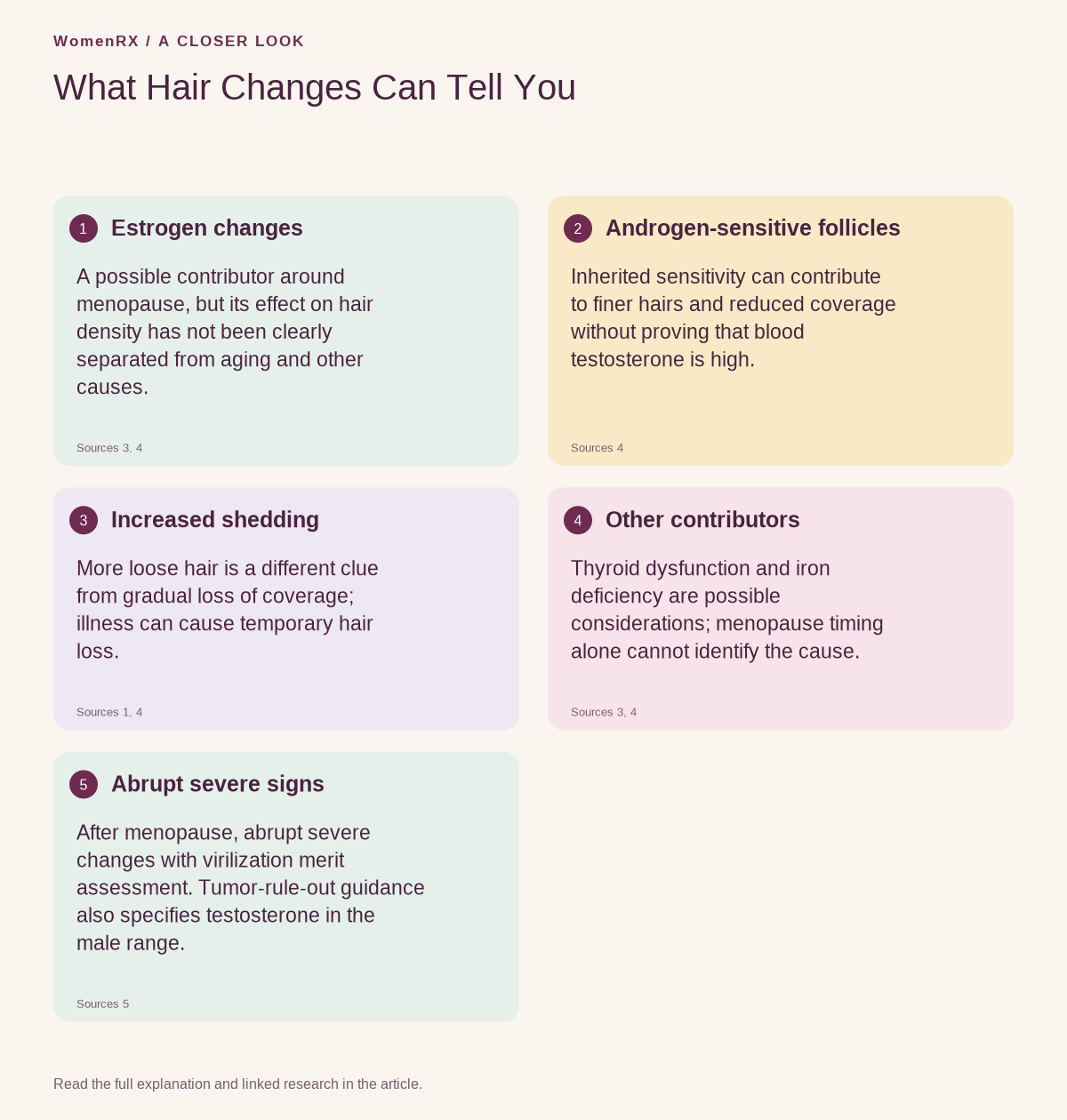
What Hair Changes Can Tell You
Estrogen changes: A possible contributor around menopause, but its effect on hair density has not been clearly separated from aging and other causes.34
Androgen-sensitive follicles: Inherited sensitivity can contribute to finer hairs and reduced coverage without proving that blood testosterone is high.4
Increased shedding: More loose hair is a different clue from gradual loss of coverage; illness can cause temporary hair loss.14
Other contributors: Thyroid dysfunction and iron deficiency are possible considerations; menopause timing alone cannot identify the cause.34
Abrupt severe signs: After menopause, abrupt severe changes with virilization merit assessment. Tumor-rule-out guidance also specifies testosterone in the male range.5
Read the figure as text
This evidence map separates proposed hormone effects from observable patterns and other clues worth considering.- Estrogen changes: A possible contributor around menopause, but its effect on hair density has not been clearly separated from aging and other causes.34
- Androgen-sensitive follicles: Inherited sensitivity can contribute to finer hairs and reduced coverage without proving that blood testosterone is high.4
- Increased shedding: More loose hair is a different clue from gradual loss of coverage; illness can cause temporary hair loss.14
- Other contributors: Thyroid dysfunction and iron deficiency are possible considerations; menopause timing alone cannot identify the cause.34
- Abrupt severe signs: After menopause, abrupt severe changes with virilization merit assessment. Tumor-rule-out guidance also specifies testosterone in the male range.5
More questions, answered
Does thinning hair mean my testosterone is high?
No. Androgen-sensitive scalp follicles can contribute to pattern thinning, but hair appearance alone can’t tell you your testosterone level or how your follicles respond to it. Abrupt, severe changes with signs of virilization after menopause are a different reason to seek assessment. 4 5
Sources you can check
- Hair loss - NHSAccessed 2026-09-25Return to first citation
- The 2022 hormone therapy position statement of The North American Menopause Society.“The 2022 Hormone Therapy Position Statement of The North American Menopause Society” Advisory Panel. · Menopause (New York, N.Y.) · 2022Return to first citation
- Botanical drug preparations for alleviating hair loss in menopausal women: a global ethnopharmacological mini-review.Huang Z, Zhao WJ, Gao YJ, Huang ZR, Huang QR, Cai SZ, Bi MH. · Frontiers in pharmacology · 2025Return to first citation
- The Hormonal Background of Hair Loss in Non-Scarring Alopecias.Owecka B, Tomaszewska A, Dobrzeniecki K, Owecki M. · Biomedicines · 2024Return to first citation
- Hyperandrogenism after menopause: diagnostic evaluation.Fux-Otta C, Torre D, Chedraui P, Melgarejo B, Ramos N, Carlo MD, Benzi M, Banús V, Estario ME, Leiderman S, Gecchelin R, Bartolacci I, Tarletta M, Ziperovich C, Lella SD, Aramayo C... · Climacteric : the journal of the International Menopause Society · 2025Return to first citation