Ashwagandha for Stress: What Human Studies Actually Show
Some short trials find lower self-reported stress, but results vary and a cortisol change is not the same as feeling better.
Ashwagandha may reduce perceived stress for some adults, but the human evidence comes mainly from small, short trials using different extracts, and results aren’t consistent. Studies often measure both questionnaire scores and cortisol; a change in one doesn’t guarantee a change in the other. Most reported results combine women and men, so they don’t establish a women-specific effect. 1 4
What the studies measure
“Perceived stress” usually means a person’s answers to a validated questionnaire, such as the Perceived Stress Scale. Cortisol, by contrast, is a hormone measured in saliva or blood. The questionnaire captures how stressful life feels; cortisol is one biological measure. They offer different kinds of information, and a change in cortisol alone doesn’t show that someone feels less overwhelmed or is functioning better.
That distinction matters because supplement marketing can make a lab result sound like proof of everyday relief. Look for whether a study found a difference between the supplement and placebo on how participants felt, not just whether a biological measure changed. 1 4
What the human trials suggest
Several placebo-controlled trials and a 2021 review suggest that some ashwagandha extracts may reduce self-reported stress over roughly six to eight weeks. The review included seven studies with 491 adults in India; participants took varied preparations, and the studies generally found improvements on stress or anxiety rating scales compared with placebo. Some also reported lower cortisol. These findings are encouraging, but they don’t establish that every product works, or that everyone will notice a meaningful difference. 1
Results aren’t uniform. In a 12-week randomized trial of overweight or mildly obese adults with stress and fatigue, perceived stress improved within the ashwagandha group, but the improvement was not significantly different from placebo. Fatigue did differ between groups. That’s a useful reminder: an improvement from where a group started isn’t automatically an effect beyond placebo. 4
Other trials offer mixed clues rather than a simple answer. A 30-day study in college students reported a sleep difference in a follow-up analysis, while its overall analysis of stress and sleep did not show a significant group-by-time effect. It’s short and specific to students, so it can’t establish what to expect in women generally. 5
Taken together, research supports a possibility, not a reliable promise. Trials use different plant parts, extracts, questionnaires, and durations, making it hard to know whether one product’s results apply to another. Many studies are small or brief, and research that follows people for years is lacking. 1
What the findings say about women
Some trials included women and men, but the reported stress results generally combine participants rather than showing whether the effect differed by sex. So far, that leaves a practical gap: results from mixed-sex groups can’t tell you whether ashwagandha works better, worse, or the same for women. 1 4
Pregnancy and breastfeeding call for particular caution. The NIH Office of Dietary Supplements reports that some experts advise pregnant women to avoid ashwagandha and that a French food-safety agency has recommended against its use during pregnancy and breastfeeding. One small, open-label pregnancy trial reported no adverse events, but a single study of that size and design can’t establish safety for pregnancy or override the broader uncertainty. There isn’t enough information here to conclude that use while breastfeeding is safe. 1 3
A practical label and safety check
Before considering a supplement, check the label and ask the manufacturer or seller specific questions. This won’t prove that a product will help, but it can make clear what you’d actually be taking:
- What plant part and extract is it? Trials have used root-only, root-and-leaf, and other preparations. Products aren’t automatically interchangeable just because they contain ashwagandha. 1
- Does the label identify the extract and its standardization? Research varies in how extracts are prepared and described, which complicates comparisons between products. 1
- Is there independent testing for identity and contaminants? Ask who tests the specific product and whether results are available. This is a question to ask about product quality, not evidence that the supplement reduces stress.
- Could it interact with your medicines or health conditions? Ashwagandha may affect thyroid function and could interact with thyroid hormone medicines, sedatives, immunosuppressants, blood-pressure medicines, and diabetes medicines. Check with a pharmacist or prescriber if any apply to you. 1
Short-term trials suggest that mild effects such as nausea, loose stools, or drowsiness can occur. Rare reports have linked ashwagandha supplements with liver injury; some cases involved products whose contents weren’t verified or combination products. Stop taking it and seek medical advice if you develop yellowing of the skin or eyes, itching, or unusual abdominal discomfort. 1
Ashwagandha has been studied for weeks to a few months, and a safety review of standardized root extracts covered trials lasting up to 180 days in generally healthy adults. Neither that review nor shorter trials settles the safety of long-term use or use by every group. 1 2
Keep expectations grounded
If you’re weighing it, a reasonable expectation is that an extract might help some people feel less stressed after several weeks, but it might not help you, and a lower cortisol result isn’t a guarantee of better day-to-day wellbeing. A product’s extract and ingredients matter, as do pregnancy, breastfeeding, medicines, and thyroid or liver concerns. The studies do not support treating ashwagandha as a sure fix for a stressful period. 1 4
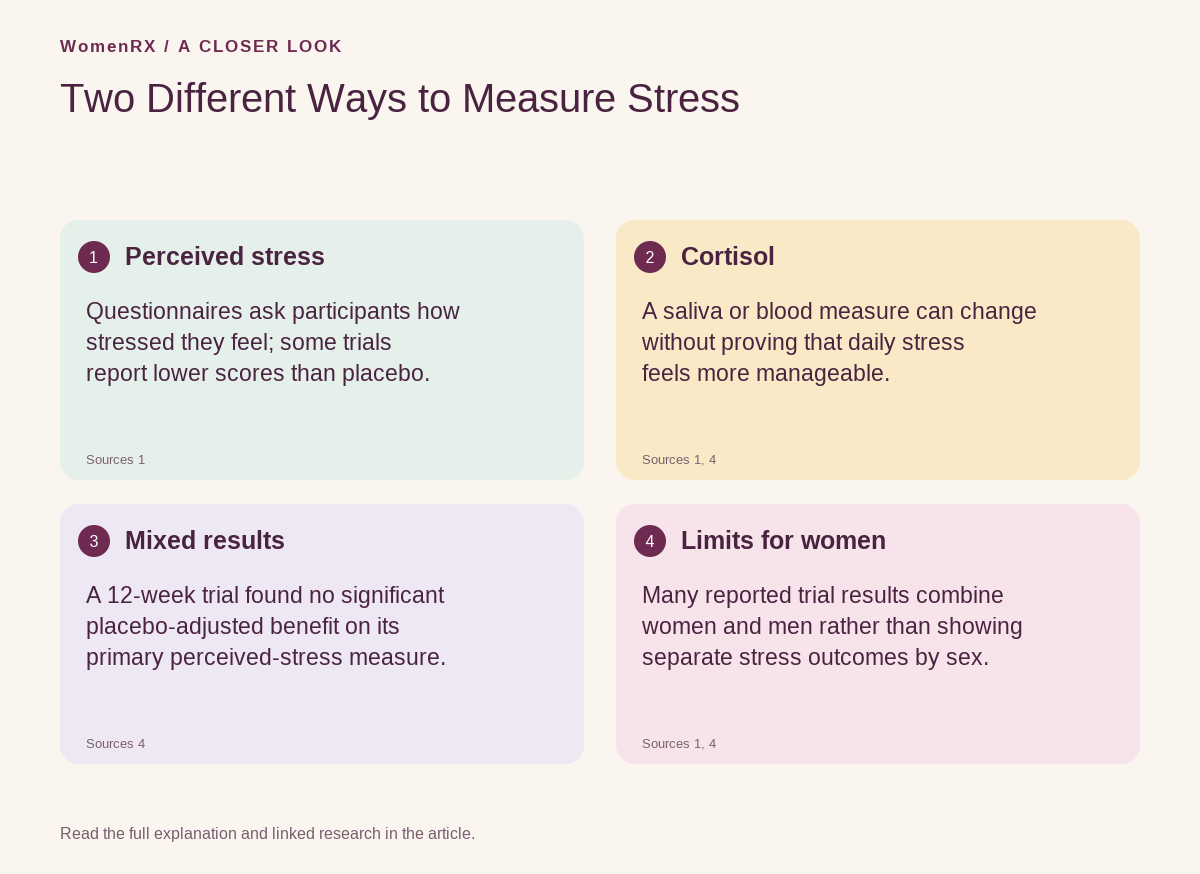
Two Different Ways to Measure Stress
Perceived stress: Questionnaires ask participants how stressed they feel; some trials report lower scores than placebo.1
Cortisol: A saliva or blood measure can change without proving that daily stress feels more manageable.14
Mixed results: A 12-week trial found no significant placebo-adjusted benefit on its primary perceived-stress measure.4
Limits for women: Many reported trial results combine women and men rather than showing separate stress outcomes by sex.14
Read the figure as text
A questionnaire and a cortisol test capture different outcomes; neither should be treated as a stand-in for the other.- Perceived stress: Questionnaires ask participants how stressed they feel; some trials report lower scores than placebo.1
- Cortisol: A saliva or blood measure can change without proving that daily stress feels more manageable.14
- Mixed results: A 12-week trial found no significant placebo-adjusted benefit on its primary perceived-stress measure.4
- Limits for women: Many reported trial results combine women and men rather than showing separate stress outcomes by sex.14
More questions, answered
Does lower cortisol prove that ashwagandha is relieving stress?
No. Cortisol is a biological measure, while perceived-stress questionnaires ask people how they experience stress. A change in one doesn’t establish a meaningful improvement in the other. 1 4
Is ashwagandha safe to use long term?
Long-term safety isn’t established. A review of standardized root extracts covered trials lasting up to 180 days in generally healthy adults, which does not answer what happens with years of use or in every population. 2
Sources you can check
- Ashwagandha: Is it helpful for stress, anxiety, or sleep? - Health Professional Fact SheetAccessed 2026-09-25Return to first citation
- Back to the Roots: Safety and Tolerability of Standardised Ashwagandha (Withania somnifera) Root Extract in Healthy Adults-A Systematic Review of Biomarkers and Adverse Events.Coope OC, Willems MET, Levington A, Tallon MJ, Roman-Viñas B, Spurr TJ. · Pharmaceuticals (Basel, Switzerland) · 2026Return to first citation
- Efficacy and safety of Ashwagandha (Withania somnifera) root extract in pregnant women: a prospective, randomized, comparative, open-label, 12-week study.Ajgaonkar A, Tayade H, Nayak A. · Frontiers in global women's health · 2026Return to first citation
- Exploring the efficacy and safety of a novel standardized ashwagandha (Withania somnifera) root extract (Witholytin®) in adults experiencing high stress and fatigue in a randomized, double-blind, placebo-controlled trial.Smith SJ, Lopresti AL, Fairchild TJ. · Journal of psychopharmacology (Oxford, England) · 2023Return to first citation
- The Impact of Ashwagandha on Stress, Sleep Quality, and Food Cravings in College Students: Quantitative Analysis of a Double-Blind Randomized Control Trial.O'Connor J, Lindsay K, Baker C, Kirby J, Hutchins A, Harris M. · Journal of medicinal food · 2022Return to first citation