Ashwagandha and Cortisol: What a Lab Change Means
A lower cortisol result is a biomarker change, not proof by itself that stress or health has meaningfully improved.
Some trials report lower cortisol alongside improvements in stress or anxiety scores, but the findings aren’t consistent. In one trial, cortisol fell in every group, including placebo; another found no significant cortisol difference in overweight older men. A lab change alone can’t show that ashwagandha helped you feel better, and it doesn’t establish a benefit for a hormone-related condition. 3 4 5
Ashwagandha may affect cortisol measurements in some studies, but a lower result isn’t the same as feeling less stressed or gaining a health benefit. The useful question is whether people taking the supplement felt or functioned better than people taking placebo, not just whether their cortisol changed from the start of the study.
A biomarker and a symptom answer different questions
Cortisol is a biological measure. Stress and anxiety are different outcomes, assessed in these trials with rating scales. A cortisol change can show that a measured hormone level changed; it doesn’t establish that the change caused a symptom improvement or that it matters to your health.
For example, a 60-day placebo-controlled trial in 60 healthy adults with self-reported high stress found a greater reduction in morning cortisol with ashwagandha than with placebo. Scores on the Hamilton Anxiety Rating Scale also improved more than with placebo, while the result on another questionnaire did not reach statistical significance. That’s evidence of a possible anxiety benefit in that group, alongside a cortisol change. It doesn’t show that lowering cortisol caused the anxiety scores to improve. 3
A different eight-week trial makes the comparison especially clear. It included 141 healthy men and women with moderate stress and anxiety. Serum cortisol declined in all three groups: two ashwagandha groups and the placebo group. One extract performed better than placebo on some stress and anxiety measures, but a before-and-after cortisol drop by itself doesn’t tell you whether the supplement caused it. 5
The result depends on what was measured and who took part
Ashwagandha research doesn’t test one uniform product or one uniform cortisol measure. Trials have examined different extracts and measured cortisol in different ways, including morning serum cortisol, serum cortisol and salivary cortisol. Results from one extract or measurement shouldn’t automatically be treated as results for another. 3 4 5
The symptom results vary, too. In a crossover trial of overweight men aged 40 to 70, researchers found no significant between-group difference in cortisol. Measures of fatigue and vigor also did not differ significantly between groups. Because the participants were men, that trial can’t answer whether women would respond the same way. 4
Another 60-day trial studied 60 adults with stress, anxiety and pre-existing hypertension. Stress and anxiety measures improved with a specific standardized extract compared with placebo. The researchers also reported a cortisol decline in the ashwagandha group, but the abstract does not establish that its cortisol change was greater than the placebo group’s. That distinction matters when a product claim points to the cortisol result as proof of an effect. 2
Together, these findings suggest a possible stress or anxiety benefit for some extracts in selected groups, not a reliable rule that ashwagandha lowers cortisol or that lower cortisol is always better. These examples followed participants for eight weeks or 60 days, so they don’t establish longer-term effects. 2 3 4 5
What the research can say about women
Some trials included both men and women. One randomized trial described by the NIH Office of Dietary Supplements included 130 healthy men and women aged 20 to 55 with self-reported stress; its reported results were for the group overall, not separately for women. The eight-week trial of 141 adults also included men and women, but its reported results don’t provide women-specific findings. 1 5
Those results don’t show whether responses differ during the cycling years, perimenopause or postmenopause. They also don’t establish an effect in pregnancy or a benefit for a hormone-related condition. A cortisol result shouldn’t be treated as evidence that ashwagandha treats such a condition.
Four questions to ask about a cortisol claim
When a product promises to “balance cortisol,” look for specifics rather than the slogan:
- Which extract was studied? A result for one standardized extract doesn’t establish the same effect for a different product.
- What was the comparison? A drop from the group’s starting level is less informative than a difference between the supplement and placebo.
- Did people feel better, too? Look for stress or anxiety scores, and whether those outcomes differed from placebo.
- Who was included? Mixed-sex results without separate findings for women don’t answer questions about a specific life stage or hormone-related concern.
A cortisol change can be one clue about what happened in a trial. It isn’t a stand-in for a meaningful benefit. Read it alongside the symptom results, the placebo comparison and the people who actually took part.
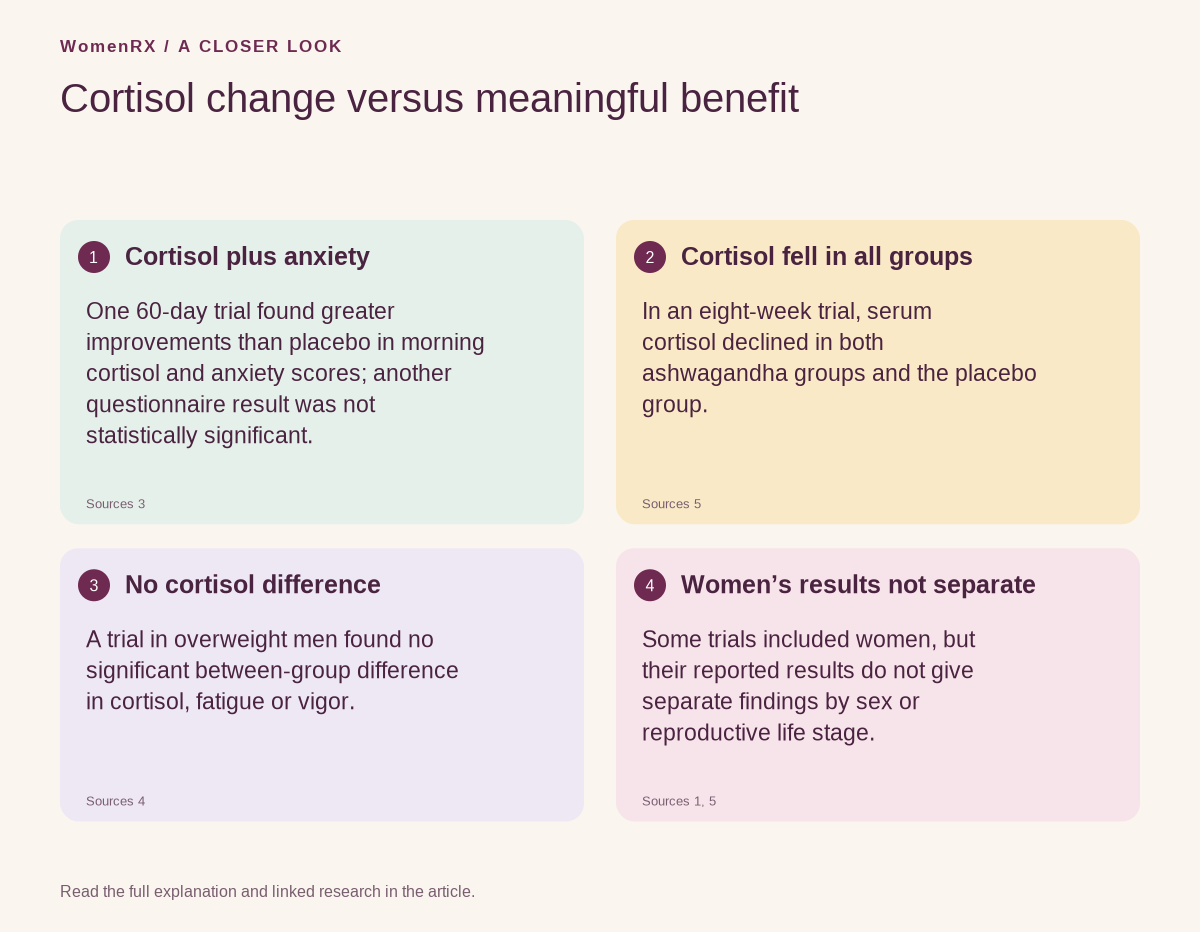
Cortisol change versus meaningful benefit
Cortisol plus anxiety: One 60-day trial found greater improvements than placebo in morning cortisol and anxiety scores; another questionnaire result was not statistically significant.3
Cortisol fell in all groups: In an eight-week trial, serum cortisol declined in both ashwagandha groups and the placebo group.5
No cortisol difference: A trial in overweight men found no significant between-group difference in cortisol, fatigue or vigor.4
Women’s results not separate: Some trials included women, but their reported results do not give separate findings by sex or reproductive life stage.15
Read the figure as text
These trial examples show why a cortisol result needs to be read alongside placebo comparisons, symptoms and the people studied.- Cortisol plus anxiety: One 60-day trial found greater improvements than placebo in morning cortisol and anxiety scores; another questionnaire result was not statistically significant.3
- Cortisol fell in all groups: In an eight-week trial, serum cortisol declined in both ashwagandha groups and the placebo group.5
- No cortisol difference: A trial in overweight men found no significant between-group difference in cortisol, fatigue or vigor.4
- Women’s results not separate: Some trials included women, but their reported results do not give separate findings by sex or reproductive life stage.15
Sources you can check
- Ashwagandha: Is it helpful for stress, anxiety, or sleep? - Health Professional Fact SheetAccessed 2026-09-25Return to first citation
- Safety and efficacy of ashwagen (a standardized withania somnifera extract) in stress and anxiety with hypertension and associated cardiometabolic risk factors: a randomized, placebo-controlled trial.Pattojoshi A, Kumar Patra S, Idrees SA, Behera S, Dalua SS, Tiwari P, Valavan R. · Stress (Amsterdam, Netherlands) · 2026Return to first citation
- An investigation into the stress-relieving and pharmacological actions of an ashwagandha (Withania somnifera) extract: A randomized, double-blind, placebo-controlled study.Lopresti AL, Smith SJ, Malvi H, Kodgule R. · Medicine · 2019Return to first citation
- A Randomized, Double-Blind, Placebo-Controlled, Crossover Study Examining the Hormonal and Vitality Effects of Ashwagandha ( Withania somnifera) in Aging, Overweight Males.Lopresti AL, Drummond PD, Smith SJ. · American journal of men's health · 2019Return to first citation
- A proprietary herbal extract of ashwagandha root for stress and anxiety in healthy adults: a randomized, double-blind, three-arm, placebo-controlled efficacy and safety study.West RE, Biswas A, Rao R, Tayade H, Ademola J. · Journal of medicine and life · 2026Return to first citation