Stress, Cortisol, and Weight: When Testing Makes Sense
Weight gain alone doesn’t point to a cortisol disorder, and a random cortisol result can raise more questions than it answers.
Stress and weight change can happen together, but weight gain alone doesn’t establish that you have too much cortisol or need testing for Cushing syndrome. Clinicians look for a more distinctive pattern, including muscle weakness, easy bruising, or reddish-purple stretch marks. If testing is warranted, a random cortisol measurement is unreliable for screening; the type of test and your circumstances matter. 34
Start with the pattern, not the number on the scale
If your weight has changed during a stressful stretch, it’s reasonable to wonder about cortisol. But there’s a difference between the body’s response to stress and Cushing syndrome, a rare condition involving prolonged exposure to excess cortisol or other glucocorticoids. Long-term use of high-dose steroid medicines is a common cause of Cushing syndrome; in other cases, a pituitary or adrenal problem is involved. 13
Weight change deserves attention without automatically becoming a cortisol diagnosis. In a German registry of people already referred with suspected Cushing syndrome, obesity or weight gain was the main reason for referral in 4 of 93 people whose Cushing syndrome was confirmed, compared with 85 of 284 in whom it was ruled out. That comparison doesn’t tell us the chance that any one person with weight gain has Cushing syndrome. It does show why weight alone is a poor way to sort these possibilities. 4
Stress may coincide with changes in eating. Eating more in response to stress is one possible route to weight gain, but noticing these changes cannot establish what caused an individual’s weight change or show prolonged cortisol excess. 23 Cortisol normally follows a daily rhythm, and loss of that rhythm can occur early in Cushing syndrome. A single random reading cannot capture that daily pattern. 3 A review of randomized workplace wellness studies found inconsistent results and no observable association between reducing measured psychological stress and changes in food choice or weight management across the included studies. Those trials weren’t designed to determine what caused an individual woman’s weight gain. 2
Clues that make cortisol excess worth discussing
Cushing syndrome becomes a more specific concern when several features appear together or progress over time. Particularly suggestive findings include weakness in the muscles around the hips or shoulders, easy bruising, reddish-purple stretch marks, and a noticeably red or flushed face. A clinician may also consider the possibility when someone has an unusual problem for her age, such as osteoporosis or high blood pressure at a young age, or an adrenal growth found on imaging. None of these findings diagnoses Cushing syndrome by itself. 3
Medication history matters here. If you’ve used steroid medicines over a long period, tell the clinician assessing the change, including the medicine’s name and how you use it. Don’t change a prescribed steroid on the basis of a cortisol result or a weight change: when steroid-related Cushing syndrome is treated, reducing the medicine may need to be gradual. 1
Why a random cortisol result may mislead
Cortisol testing for suspected Cushing syndrome isn’t simply a matter of asking whether one blood value is “high.” A random cortisol measurement is unreliable as a screening test. Established initial screening approaches include late-night salivary cortisol, 24-hour urinary free cortisol, and an overnight dexamethasone suppression test. Test selection and interpretation depend on the person’s situation, and an abnormal result may need further evaluation. 3
Context can change what a result means. Pregnancy can alter cortisol regulation and complicate standard testing. Estrogen therapy increases a blood protein that binds cortisol, making some serum cortisol measurements harder to interpret; salivary and urinary free cortisol tests are not affected by that binding-protein change in the same way. This does not mean you should stop an estrogen-containing medicine before testing. It means the person choosing and interpreting the test needs to know you’re pregnant or using one. 35
If you already have a cortisol result, the useful next question is what test was done and why? A one-off blood result ordered for another reason isn’t equivalent to a Cushing screening assessment. If you also have the more distinctive changes above, or a history of prolonged steroid use, bring the result and that context to a medical visit rather than trying to interpret the number alone. 13
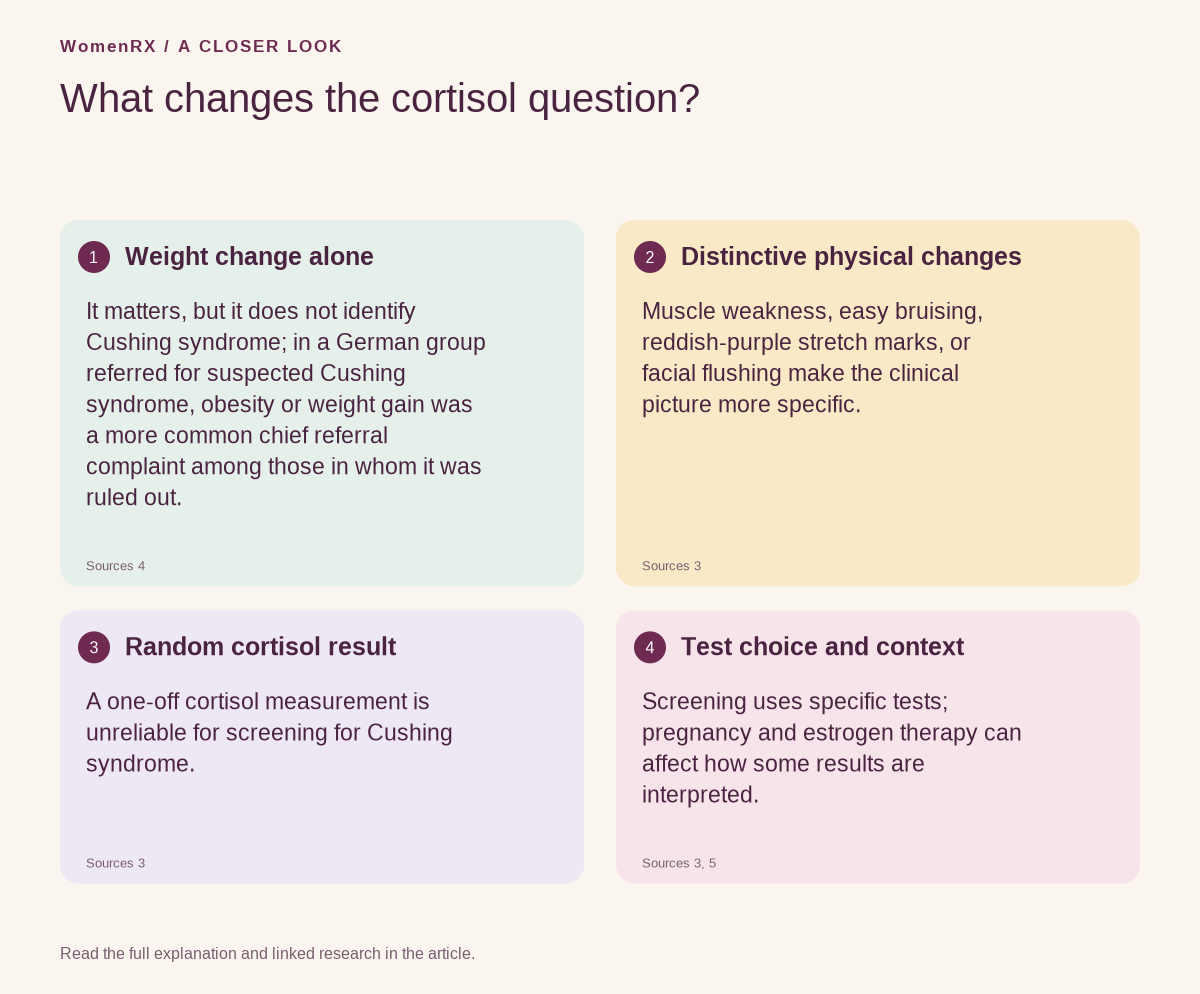
What changes the cortisol question?
Weight change alone: It matters, but it does not identify Cushing syndrome; in a German group referred for suspected Cushing syndrome, obesity or weight gain was a more common chief referral complaint among those in whom it was ruled out.4
Distinctive physical changes: Muscle weakness, easy bruising, reddish-purple stretch marks, or facial flushing make the clinical picture more specific.3
Random cortisol result: A one-off cortisol measurement is unreliable for screening for Cushing syndrome.3
Test choice and context: Screening uses specific tests; pregnancy and estrogen therapy can affect how some results are interpreted.35
Read the figure as text
These distinctions help separate a weight concern from a reason to assess cortisol excess.- Weight change alone: It matters, but it does not identify Cushing syndrome; in a German group referred for suspected Cushing syndrome, obesity or weight gain was a more common chief referral complaint among those in whom it was ruled out.4
- Distinctive physical changes: Muscle weakness, easy bruising, reddish-purple stretch marks, or facial flushing make the clinical picture more specific.3
- Random cortisol result: A one-off cortisol measurement is unreliable for screening for Cushing syndrome.3
- Test choice and context: Screening uses specific tests; pregnancy and estrogen therapy can affect how some results are interpreted.35
Sources you can check
- Cushing's syndrome - NHSAccessed 2026-09-25Return to first citation
- A systematic review of randomized controlled trials examining workplace wellness interventions.Murphy B, Parekh N, Vieira DL, O'Connor JA. · Nutrition and health · 2022Return to first citation
- Screening for Cushing Syndrome at the Primary Care Level: What Every General Practitioner Must Know.Yorke E, Atiase Y, Akpalu J, Sarfo-Kantanka O. · International journal of endocrinology · 2017Return to first citation
- Whom Should We Screen for Cushing Syndrome? The Endocrine Society Practice Guideline Recommendations 2008 Revisited.Braun LT, Vogel F, Zopp S, Marchant Seiter T, Rubinstein G, Berr CM, Künzel H, Beuschlein F, Reincke M. · The Journal of clinical endocrinology and metabolism · 2022Return to first citation
- Endocrine causes of hypertension in pregnancy.Affinati AH, Auchus RJ. · Gland surgery · 2020Return to first citation