Cortisol and Weight Gain: When Testing Makes Sense
Weight gain alone doesn’t point to a cortisol disorder, but a progressing pattern of symptoms or long-term steroid use can change the picture.
Cushing syndrome can cause weight gain when the body is exposed to too much cortisol for a prolonged time. But a change on the scale, even during a stressful period, doesn’t establish that diagnosis. Clinicians consider the pattern of physical changes, other health findings, and steroid medicine use before deciding whether targeted cortisol testing makes sense. 1 5 6
What weight can and can’t tell you
If your weight has changed, cortisol may be one explanation you’ve come across. The scale can’t settle that question. Body weight includes fat, muscle, bone, and water, and a change in weight doesn’t identify which of those changed or why. 3
Stress or poor sleep may be part of what’s happening in your life. Neither experience, by itself, establishes the prolonged cortisol excess that defines Cushing syndrome. That distinction matters: investigating a possible cortisol disorder is different from looking for one hormone result to explain a difficult stretch or an unexpected change in weight. 5
The pattern that raises concern for Cushing syndrome
Cushing syndrome is a rare condition caused by prolonged exposure to excess cortisol. Long-term use of high-dose steroid medicines is its most common overall cause. Less often, the body produces too much cortisol, sometimes because of a growth in the pituitary or adrenal glands. 1 5
Weight gain is only one possible feature. A more concerning pattern combines new or progressing changes such as more fat around the middle, face, or upper back with relatively thin arms or legs; a rounder, flushed face; wide purple stretch marks; easy bruising or fragile skin; or weakness that shows up when you climb stairs or rise from a chair. High blood pressure, high blood sugar, or menstrual changes can add to the picture. No single feature proves Cushing syndrome, but several developing together deserve a medical assessment. 4 5
A study of 377 people referred in Germany because Cushing syndrome was suspected helps show why weight isn’t a stand-alone screen. Obesity was recorded more often as the chief complaint among people in whom Cushing syndrome was ruled out than among those whose diagnosis was confirmed. Recent weight gain could still occur in confirmed cases. These findings describe a referred group, not the likelihood of Cushing syndrome for any one person with weight gain. 6
Why the medicine question comes before a test
Steroid medicines are an essential part of this discussion. Tell the clinician assessing your symptoms which ones you use and how long you’ve used them. Long-term high-dose use can cause Cushing syndrome, so the answer may change what needs investigating. If a prescribed steroid could be contributing, its prescriber can assess whether a change is appropriate; don’t stop it on your own. 1 5
When the overall picture suggests Cushing syndrome, clinicians can use tests designed to detect excess cortisol, including a 24-hour urine test, a late-night saliva test, or a dexamethasone suppression test. Further evaluation may be needed to identify the cause. These tests answer a specific clinical question. They aren’t a general weight-loss screen or a way to read the cause of weight gain from one number. 5
Where life stage fits
If you’re pregnant or recently gave birth, include that context when you describe a weight change. It doesn’t, on its own, establish a cortisol disorder; the other symptoms and your medicines still matter. An unexpected weight change is worth discussing rather than automatically attributing it to one hormone. 3 5
In perimenopause, irregular periods can be common. A change in your cycle alone may therefore tell a different story from menstrual changes that appear alongside progressive skin changes, muscle weakness, and other features of Cushing syndrome. The same principle applies after menopause: describe the whole pattern rather than treating weight gain as a cortisol result. 2 4 5
If your weight changes suddenly or without an apparent reason, bring it up in a medical visit even if you don’t recognize a Cushing pattern. There are other possible medical explanations, and weight is only one piece of the assessment. 3
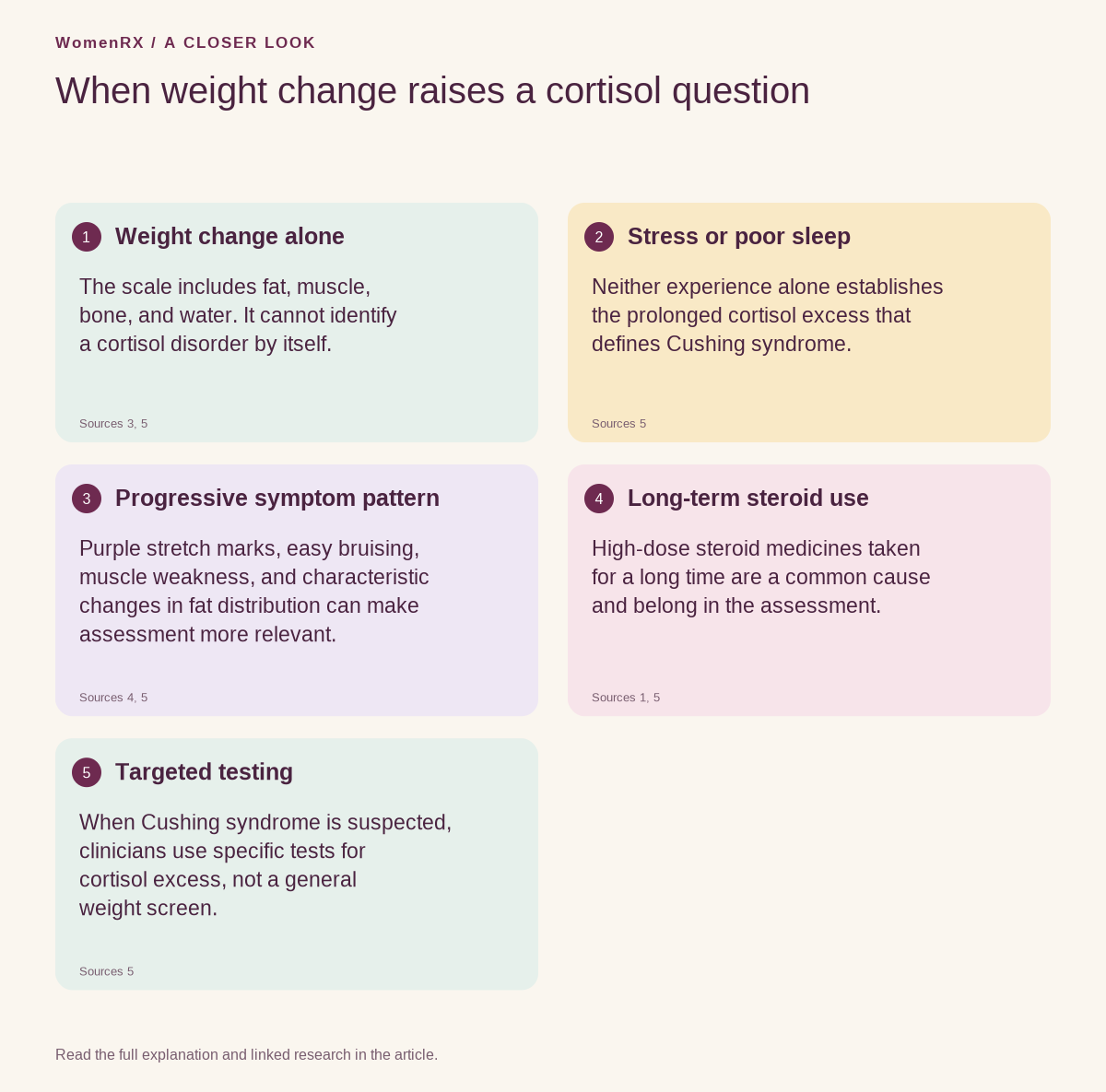
When weight change raises a cortisol question
Weight change alone: The scale includes fat, muscle, bone, and water. It cannot identify a cortisol disorder by itself.35
Stress or poor sleep: Neither experience alone establishes the prolonged cortisol excess that defines Cushing syndrome.5
Progressive symptom pattern: Purple stretch marks, easy bruising, muscle weakness, and characteristic changes in fat distribution can make assessment more relevant.45
Long-term steroid use: High-dose steroid medicines taken for a long time are a common cause and belong in the assessment.15
Targeted testing: When Cushing syndrome is suspected, clinicians use specific tests for cortisol excess, not a general weight screen.5
Read the figure as text
The difference is not a number on the scale. It’s whether other characteristic findings or steroid exposure make prolonged cortisol excess plausible.- Weight change alone: The scale includes fat, muscle, bone, and water. It cannot identify a cortisol disorder by itself.35
- Stress or poor sleep: Neither experience alone establishes the prolonged cortisol excess that defines Cushing syndrome.5
- Progressive symptom pattern: Purple stretch marks, easy bruising, muscle weakness, and characteristic changes in fat distribution can make assessment more relevant.45
- Long-term steroid use: High-dose steroid medicines taken for a long time are a common cause and belong in the assessment.15
- Targeted testing: When Cushing syndrome is suspected, clinicians use specific tests for cortisol excess, not a general weight screen.5
More questions, answered
Can one cortisol result tell me why I gained weight?
No. When Cushing syndrome is suspected, clinicians choose a test designed to check for cortisol excess and may need further evaluation to establish its cause. A weight change or a single result doesn’t identify the full explanation. 3 5
Sources you can check
- Cushing's syndrome - NHSAccessed 2026-09-25Return to first citation
- Period problems - NHSAccessed 2026-09-25Return to first citation
- Body Weight: MedlinePlusAccessed 2026-09-25Return to first citation
- Cushing´s syndrome: Clinical presentation and associated comorbidities.Lomba AA, Salazar-Solarte AM, Vernaza Trujillo DA, Rivera-Martínez WA. · Vitamins and hormones · 2026Return to first citation
- Cushing Syndrome: A Review.Reincke M, Fleseriu M. · JAMA · 2023Return to first citation
- Whom Should We Screen for Cushing Syndrome? The Endocrine Society Practice Guideline Recommendations 2008 Revisited.Braun LT, Vogel F, Zopp S, Marchant Seiter T, Rubinstein G, Berr CM, Künzel H, Beuschlein F, Reincke M. · The Journal of clinical endocrinology and metabolism · 2022Return to first citation