How Stress and Weight Changes May Be Connected
Stress may affect weight through sleep and eating patterns, but a cortisol level alone doesn’t explain why your weight changed.
Stress triggers a hormone response, but weight change isn’t a simple readout of it. Long-running stress can coincide with trouble sleeping or changes in eating, both of which may affect weight; medicines and medical conditions are also worth reviewing. A small trial found that reducing stress and cortisol didn’t produce greater weight loss, and unexpected weight change deserves attention in its own right. 234
Stress is one influence, not a weight-control switch
When your brain responds to a challenge, your body releases hormones that help you become alert and ready to act. This short-term stress response can raise blood pressure, heart rate, and blood sugar. That short-term response alone doesn’t explain why body weight changes. 23
Over time, stress may be part of a wider pattern. MedlinePlus identifies stress, sleep habits, diet, and activity level as factors that can affect body weight. It also notes that long-term stress may come with trouble sleeping or eating changes that lead to unwanted weight changes. Those are possible routes, not proof that stress caused a particular person’s gain or loss. 23
Stress and weight can also be linked in more than one direction. A review of 14 human studies found associations among higher stress, less healthy eating patterns, and higher body weight. The pattern was more pronounced in women than men, but the review describes associations, not evidence that stress itself caused weight gain or that every woman responds the same way. 5
What cortisol can, and can’t, tell you
A stress response is not the same thing as Cushing’s syndrome, a rare condition involving too much cortisol. Long-term use of high doses of steroid medicines is a common cause; growths in the pituitary or adrenal glands can also cause it. Cushing’s syndrome is more common in women than men, but that doesn’t mean ordinary stress or a weight change points to the condition. 1
A cortisol result, by itself, doesn’t establish why your weight changed. In a randomized trial of 74 adults with obesity, adding cognitive behavioral stress management to an online weight-loss program reduced measures of psychological stress and saliva cortisol at three months. It did not produce greater weight loss than the weight-loss program alone: the reported losses across the two groups were 1.8 kg and 2.1 kg. Lower stress or cortisol, then, shouldn’t be treated as a guarantee of weight loss. 4
Consider sleep, medicines, and other health factors
Stress may make sleep harder, and changes in sleep habits are among the factors MedlinePlus lists as relevant to weight. Eating changes can matter too. That makes it more useful to look at what has changed in your everyday life than to assume one hormone is responsible. 23
Medicines and medical conditions are also worth reviewing. MedlinePlus mentions certain medicines when discussing unexpected weight changes, but the information here doesn’t identify particular drugs or show how much they may affect weight. If a change started after a medicine was added or adjusted, bring that timing into a conversation with the prescriber. 3
If your weight changes during pregnancy, postpartum, or around menopause, mention the timing when discussing the change with a healthcare provider.
When a weight change deserves a closer look
If you’re gaining or losing weight without trying, especially if the change is sudden, MedlinePlus recommends discussing it with a healthcare provider because an unexpected change can sometimes signal a medical problem. 3
If you take steroid medicine and notice a gradual weight change alongside other unusual physical changes, mention both the medicine and the changes. Long-term, high-dose steroid use is a common cause of Cushing’s syndrome, and symptoms can develop gradually. 1
A useful starting point is to note when the change began and whether sleep, eating, stress, medicines, or health circumstances changed around the same time. That won’t diagnose the cause, but it can help distinguish a possible life-pattern link from a change that needs medical assessment. Weight includes water, muscle, bone, and fat, so the scale alone can’t describe the full picture of your health. 3
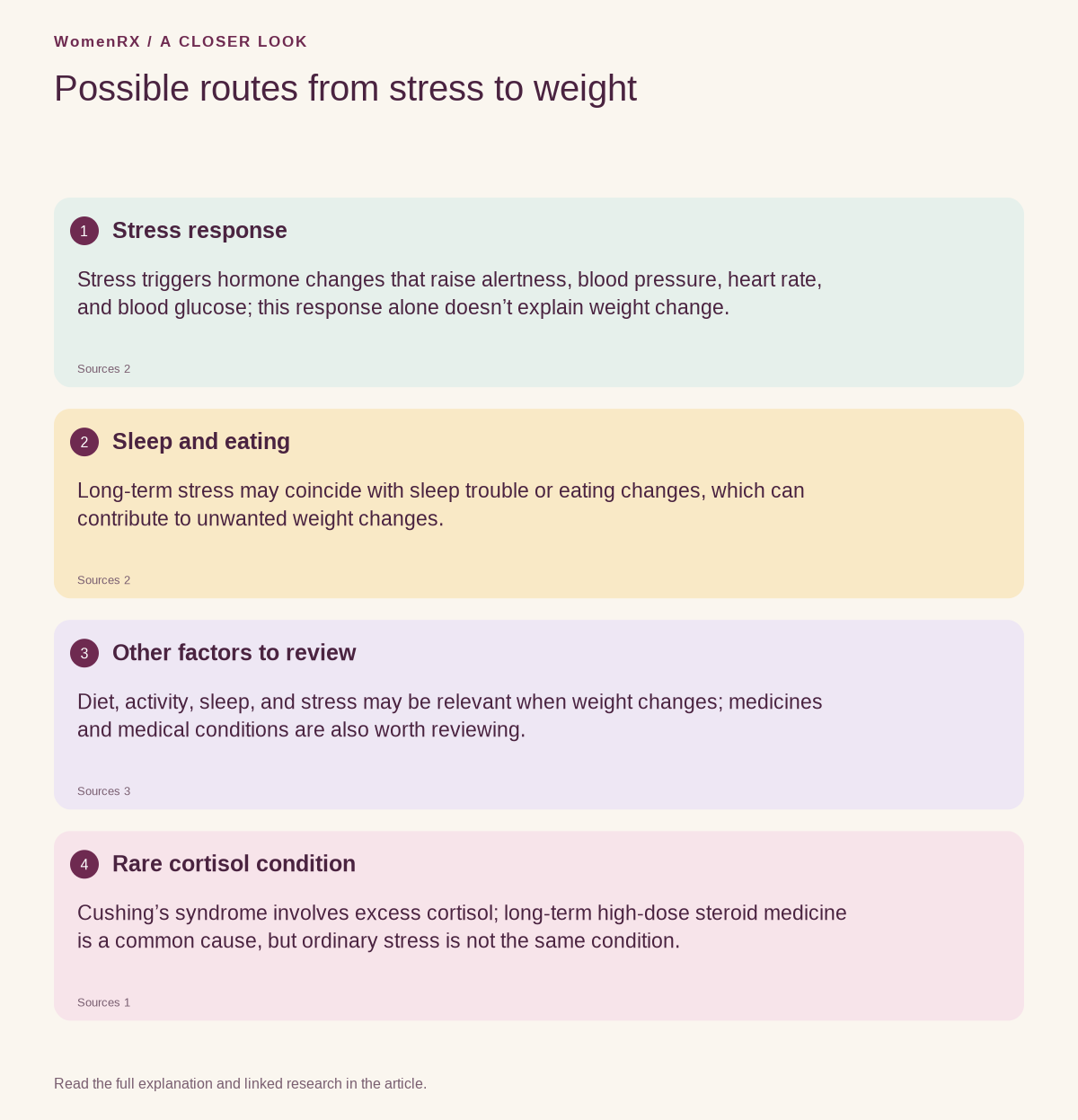
Possible routes from stress to weight
Stress response: Stress triggers hormone changes that raise alertness, blood pressure, heart rate, and blood glucose; this response alone doesn’t explain weight change.2
Sleep and eating: Long-term stress may coincide with sleep trouble or eating changes, which can contribute to unwanted weight changes.2
Other factors to review: Diet, activity, sleep, and stress may be relevant when weight changes; medicines and medical conditions are also worth reviewing.3
Rare cortisol condition: Cushing’s syndrome involves excess cortisol; long-term high-dose steroid medicine is a common cause, but ordinary stress is not the same condition.1
Read the figure as text
Stress may connect with weight through daily patterns, while medicines and health conditions are also worth reviewing. The diagram separates these routes rather than treating cortisol as a single cause.- Stress response: Stress triggers hormone changes that raise alertness, blood pressure, heart rate, and blood glucose; this response alone doesn’t explain weight change.2
- Sleep and eating: Long-term stress may coincide with sleep trouble or eating changes, which can contribute to unwanted weight changes.2
- Other factors to review: Diet, activity, sleep, and stress may be relevant when weight changes; medicines and medical conditions are also worth reviewing.3
- Rare cortisol condition: Cushing’s syndrome involves excess cortisol; long-term high-dose steroid medicine is a common cause, but ordinary stress is not the same condition.1
More questions, answered
Does stress always cause weight gain?
No. Long-term stress can be associated with eating and sleep changes that affect weight, but people respond differently, and weight change can have other causes. The available human evidence shows associations rather than a predictable effect for everyone. 235
Should I ask for a cortisol test if my weight changes?
A weight change alone doesn’t establish that cortisol is the cause. Cushing’s syndrome is rare, though long-term use of high-dose steroid medicine is a common cause. If you’re gaining or losing weight without trying, discuss the change and any related symptoms or medicines with a healthcare provider. 13
Sources you can check
- Cushing's syndrome - NHSAccessed 2026-09-25Return to first citation
- Stress: MedlinePlusAccessed 2026-09-25Return to first citation
- Body Weight: MedlinePlusAccessed 2026-09-25Return to first citation
- The effect of cognitive behavioral stress management on perceived stress, biological stress markers and weight loss/regain, from a diet-induced weight loss program: A randomized controlled trial.Saranapala DMMK, Baranoff J, Rushworth RL, Westley I, Collins K, Burke ALJ, Parker A, Licinio J, Clifton PM, Torpy DJ. · Comprehensive psychoneuroendocrinology · 2022Return to first citation
- Social position, psychological stress, and obesity: a systematic review.Moore CJ, Cunningham SA. · Journal of the Academy of Nutrition and Dietetics · 2012Return to first citation