Berries and Menopause Symptoms: What Research Tested
A study in postmenopausal women included berries in a mixed-fruit juice, but its reported findings concern gene expression, not symptom relief.
This human study gave postmenopausal women a combination of dark chocolate, green tea, and mixed-fruit juice containing berries, then reported changes in gene expression. Those findings don’t provide evidence that berries relieve hot flashes or other menopause symptoms, and they can’t isolate berries’ effects. A separate bilberry-extract study tested bone outcomes in rats, not people. 3 4
What the human study can tell us
In a two-month study, postmenopausal women consumed dark chocolate, green tea, and a mixed-fruit juice containing pomegranate, berries, and orange. Researchers collected blood samples before and after the intervention and reported changes in gene expression. The reported findings concern those biological measures; they don’t provide evidence that the foods relieved menopause symptoms. The study description gives no participant count, so its size can’t be assessed here. 3
Because the foods were combined, the findings can’t be attributed to berries alone. And gene-expression changes aren’t the same as a person experiencing fewer hot flashes, sleeping better, or feeling less bothered by other symptoms. The study also doesn’t establish that eating whole berries has the same effects as drinking a mixed-fruit juice. 3
A bilberry extract is a different test
A separate study tested anthocyanin-rich bilberry extract in ovariectomized rats and assessed bone measures. The researchers reported no significant effects on bone mineral density or the measured bone-structure outcomes. This animal study doesn’t show whether whole berries affect bone health or menopause symptoms in people. 4
Whole fruit, juice blends, and concentrated extracts aren’t interchangeable. The type of berry product matters, as do the study population and the outcomes researchers measure. A result from an extract in rats can’t establish what eating whole fruit does for a person experiencing menopause.
What menopause guidance adds
The North American Menopause Society’s 2023 position statement does not recommend supplements and herbal remedies for vasomotor symptoms, such as hot flashes. That recommendation addresses supplements and herbal remedies broadly; it isn’t a berry-specific finding and does not say that eating whole berries has been shown not to work. 2
The practical takeaway is that this research doesn’t establish berries as a treatment for menopause symptoms. It also doesn’t settle whether whole berries affect symptoms. If you enjoy berries, you can eat them as food without treating them as a proven remedy. For bothersome symptoms, established options depend on the symptom and your circumstances; menopause guidance identifies hormone therapy as the most effective treatment for vasomotor symptoms and recognizes several evidence-supported nonhormonal options. 1 2
What the berry research tested
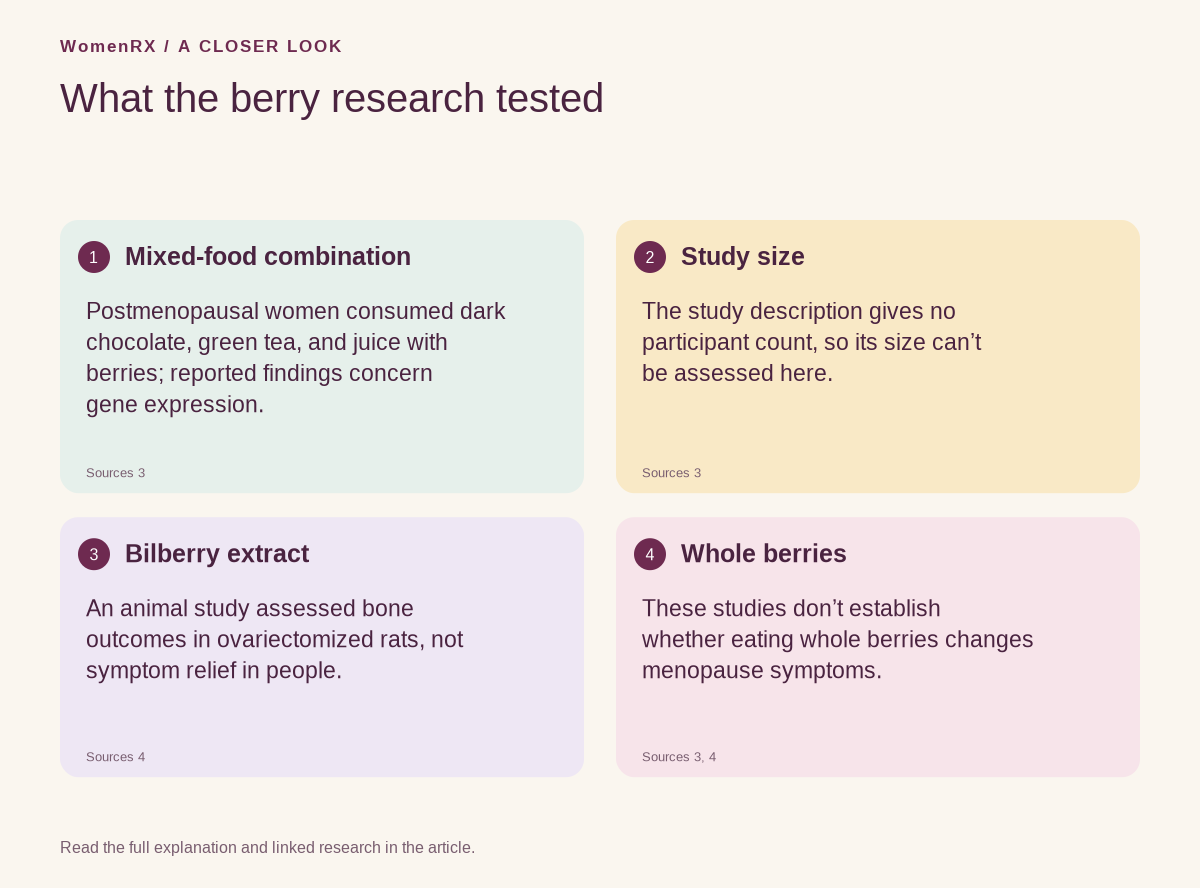
Mixed-food combination: Postmenopausal women consumed dark chocolate, green tea, and juice with berries; reported findings concern gene expression.3
Study size: The study description gives no participant count, so its size can’t be assessed here.3
Bilberry extract: An animal study assessed bone outcomes in ovariectomized rats, not symptom relief in people.4
Whole berries: These studies don’t establish whether eating whole berries changes menopause symptoms.34
Read the figure as text
Compare the product, population, and reported outcome before applying a study’s findings to eating berries for menopause symptoms.- Mixed-food combination: Postmenopausal women consumed dark chocolate, green tea, and juice with berries; reported findings concern gene expression.3
- Study size: The study description gives no participant count, so its size can’t be assessed here.3
- Bilberry extract: An animal study assessed bone outcomes in ovariectomized rats, not symptom relief in people.4
- Whole berries: These studies don’t establish whether eating whole berries changes menopause symptoms.34
More questions, answered
Did the human study test berries on their own?
No. Participants consumed a combination of dark chocolate, green tea, and mixed-fruit juice containing pomegranate, berries, and orange. The study therefore can’t isolate an effect of berries. 3
Does guidance against supplements mean I should avoid whole berries?
No. The menopause position statement’s recommendation concerns supplements and herbal remedies for vasomotor symptoms. It doesn’t make a berry-specific recommendation about eating whole fruit. 2
Sources you can check
- The 2022 hormone therapy position statement of The North American Menopause Society.“The 2022 Hormone Therapy Position Statement of The North American Menopause Society” Advisory Panel. · Menopause (New York, N.Y.) · 2022Return to first citation
- The 2023 nonhormone therapy position statement of The North American Menopause Society.Menopause (New York, N.Y.) · 2023Return to first citation
- Chronic consumption of (poly)phenol-rich foods exerts multigenomic modification of genes linked to cardiometabolic health in postmenopausal women.Sánchez-Martínez L, Milenkovic D, Periago MJ, González-Barrio R. · Food research international (Ottawa, Ont.) · 2026Return to first citation
- Effect of anthocyanin-rich bilberry extract on bone metabolism in ovariectomized rats.Shimizu S, Matsushita H, Morii Y, Ohyama Y, Morita N, Tachibana R, Watanabe K, Wakatsuki A. · Biomedical reports · 2018Return to first citation