Pomegranate Arils, Juice, and Extract: What Actually Differs
Arils give you fruit and fiber; juice and extracts have been studied for specific outcomes, but their findings aren’t interchangeable.
A half-cup of raw pomegranate arils provides about 3.5 grams of fiber and 1.5 grams of protein. Juice is a sugar-containing beverage, while extract capsules are concentrated products, not fruit servings. Human trials have tested juice and extracts for blood pressure, UVB skin response, and PCOS-related markers, but their limited or mixed findings don’t establish that one form prevents disease. 4578
First, decide whether you want fruit or a studied product
If you’re adding pomegranate to breakfast, arils make sense as fruit: you eat the edible seeds and the surrounding juicy flesh. A half-cup of raw arils has about 72 calories, 3.5 grams of fiber, and 1.5 grams of protein. Fiber helps with fullness and digestion; the protein amount is modest. These are food-composition estimates for raw fruit, not values for a particular packaged product. 28
Juice makes a different tradeoff. It’s a sugar-containing drink, and drinking it doesn’t tell you how much fiber you’re getting. Check its Nutrition Facts if fiber or sugar is part of your decision. A pomegranate extract is different again: trials have used concentrated preparations, including capsules, to study fruit compounds. An extract isn’t a substitute for eating fruit, and the word concentrated doesn’t tell you that one product delivers more benefit than another. 45
Think of these as different purchases rather than three ways to get the same nutrition: arils are food with measured fiber and modest protein; juice is a beverage whose label can tell you what that product contains; and an extract is a concentrated product rather than a fruit portion. The raw-aril numbers shouldn’t be assigned to a glass of juice or an extract capsule. 458
Blood pressure findings aren’t a reason to swap treatments
An eight-week randomized, placebo-controlled trial enrolled 55 adults without symptomatic disease to study pomegranate extract. Diastolic blood pressure fell within the extract group, while the reported systolic decrease did not reach statistical significance. Body-fat percentage, waist measurements, and lean body mass also did not significantly differ between groups at the end of the trial. This doesn’t establish that extract treats high blood pressure or helps with weight loss. The results weren’t reported as a women-specific benefit. 5
Pomegranate juice has also been studied for blood pressure, with differing results across the studies described by the extract-trial authors. A broader review found the evidence for pomegranate in cardiovascular disease prevention or treatment inconclusive or contradictory. If you already take blood pressure medicine, juice or extract isn’t a replacement: blood pressure often needs ongoing lifestyle measures and, sometimes, medication. 561
What was actually tested in women?
In one randomized trial, 74 women ages 30 to 45 were assigned to pomegranate juice, extract, or placebo for 12 weeks. Both pomegranate groups had a higher minimal erythema dose, a measure of how much controlled UVB exposure caused visible skin redness, compared with placebo. The study was open-label and measured a laboratory skin response, not rates of sunburn in everyday life or skin cancer. It doesn’t show that pomegranate replaces sun protection. 4
A separate trial enrolled 44 women ages 18 to 40 who had polycystic ovary syndrome (PCOS) and a BMI of at least 25. After eight weeks, the concentrated-juice group had a lower testosterone measure than a no-intervention control group. The researchers did not find significant between-group differences in the measured inflammation or oxidative-stress factors after adjustment. This is a finding about a particular group and product, not evidence that ordinary pomegranate juice improves PCOS symptoms or fertility. 7
Some reviews also discuss pomegranate compounds, inflammation, and fatty liver disease. They bring together different fruit parts, preparations, and kinds of research, including animal experiments. Antioxidant activity or a change in a blood marker should not be mistaken for demonstrated disease prevention in women. 3
The choice in front of you
For everyday eating, choose arils when you want the fruit itself and consider juice as a beverage, not a nutritionally identical shortcut. If a juice or extract catches your eye because of a health claim, look for the form studied, the people studied, and the outcome measured. A result from an extract capsule can’t be assigned to arils; a UVB skin test can’t establish cardiovascular protection. 4568
The trials discussed above do not establish benefits or safety for pomegranate extracts during pregnancy or lactation. Findings in women with PCOS or in healthy women ages 30 to 45 shouldn’t be stretched to those life stages. 47
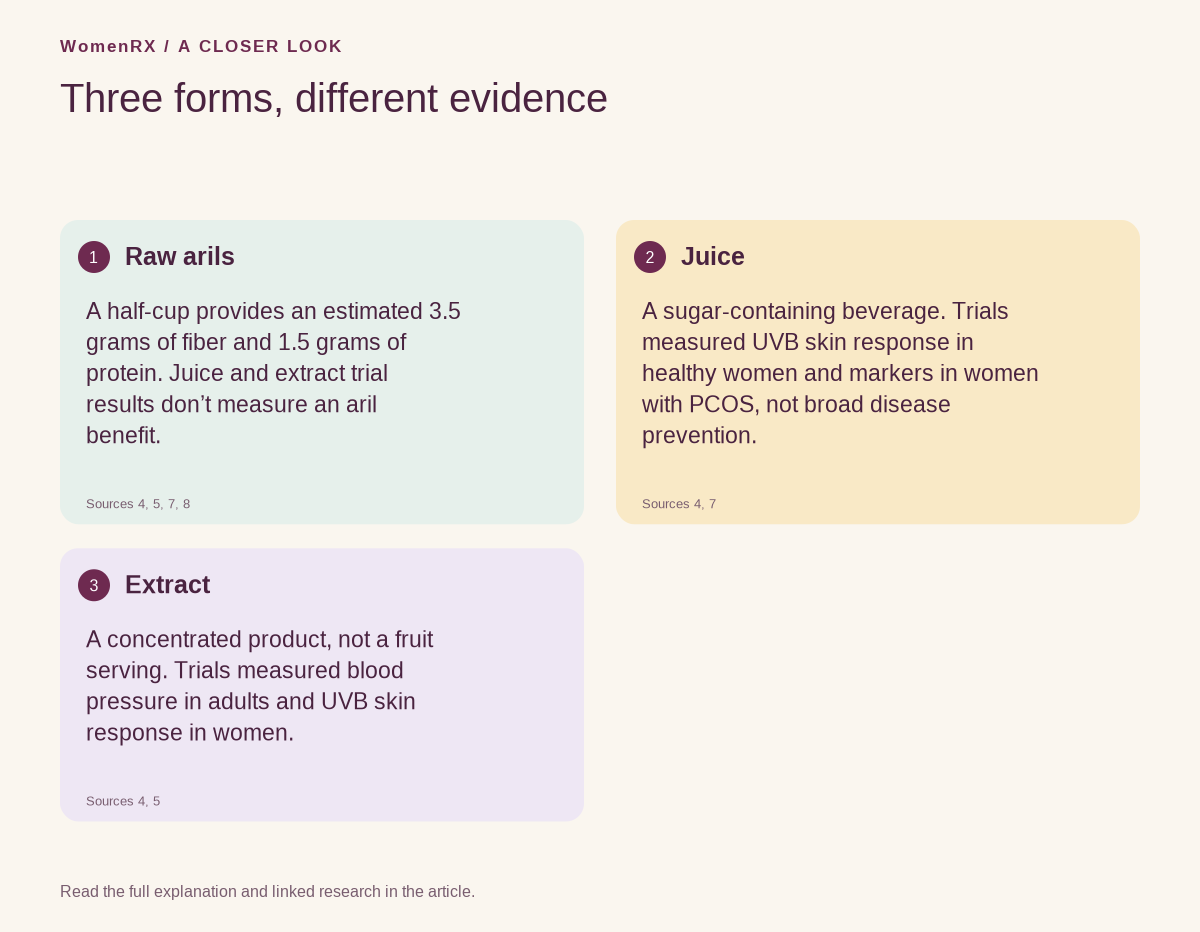
Three forms, different evidence
Raw arils: A half-cup provides an estimated 3.5 grams of fiber and 1.5 grams of protein. Juice and extract trial results don’t measure an aril benefit.4578
Juice: A sugar-containing beverage. Trials measured UVB skin response in healthy women and markers in women with PCOS, not broad disease prevention.47
Extract: A concentrated product, not a fruit serving. Trials measured blood pressure in adults and UVB skin response in women.45
Read the figure as text
Compare what you get as food or a product with the outcomes researchers measured.- Raw arils: A half-cup provides an estimated 3.5 grams of fiber and 1.5 grams of protein. Juice and extract trial results don’t measure an aril benefit.4578
- Juice: A sugar-containing beverage. Trials measured UVB skin response in healthy women and markers in women with PCOS, not broad disease prevention.47
- Extract: A concentrated product, not a fruit serving. Trials measured blood pressure in adults and UVB skin response in women.45
Sources you can check
- Blood Pressure Medicines | MedlinePlusAccessed 2026-09-25Return to first citation
- Dietary Fiber: MedlinePlusAccessed 2026-09-25Return to first citation
- A review of experimental and clinical studies on the therapeutic effects of pomegranate (Punica granatum) on non-alcoholic fatty liver disease: Focus on oxidative stress and inflammation.Zamanian MY, Sadeghi Ivraghi M, Khachatryan LG, Vadiyan DE, Bali HY, Golmohammadi M. · Food science & nutrition · 2023Return to first citation
- Pomegranate Juice and Extract Consumption Increases the Resistance to UVB-induced Erythema and Changes the Skin Microbiome in Healthy Women: a Randomized Controlled Trial.Henning SM, Yang J, Lee RP, Huang J, Hsu M, Thames G, Gilbuena I, Long J, Xu Y, Park EH, Tseng CH, Kim J, Heber D, Li Z. · Scientific reports · 2019Return to first citation
- Effect of pomegranate extract on blood pressure and anthropometry in adults: a double-blind placebo-controlled randomised clinical trial.Stockton A, Farhat G, McDougall GJ, Al-Dujaili EAS. · Journal of nutritional science · 2017Return to first citation
- A Critical Approach to Evaluating Clinical Efficacy, Adverse Events and Drug Interactions of Herbal Remedies.Izzo AA, Hoon-Kim S, Radhakrishnan R, Williamson EM. · Phytotherapy research : PTR · 2016Return to first citation
- The effect of concentrated pomegranate juice on biomarkers of inflammation, oxidative stress, and sex hormones in overweight and obese women with polycystic ovary syndrome: A randomized controlled trial.Abedini M, Ramezani-Jolfaie N, Ghasemi-Tehrani H, Tarrahi MJ, Amani R. · Phytotherapy research : PTR · 2023Return to first citation
- USDA SR Legacy: Pomegranates, raw (FDC 169134)Accessed 2026-09-25Return to first citation