Resveratrol in women: what the trials actually tested
Some trials have studied women directly, but the results are narrow: changes in lab markers or fertility-treatment measures don’t establish broad health benefits.
Yes, researchers have tested resveratrol in women, including women with PCOS undergoing fertility treatment and postmenopausal women. A few trials found changes in specific measures, such as embryo quality or oxidative-stress markers, but pregnancy rates and other clinically meaningful outcomes often did not improve. Several studies tested resveratrol alongside another ingredient, so their results can’t show what resveratrol alone did. 1 2 7
The short version: tested in women, not proven for every claim
Resveratrol research in women isn’t just extrapolated from studies in men. Trials have enrolled women with PCOS, women undergoing IVF, and postmenopausal women. But “studied in women” doesn’t mean a health benefit has been established. The key questions are what the trial measured, what the comparison group received, and whether the difference mattered to health beyond a lab result.
Fertility studies show mixed, limited findings
One randomized, placebo-controlled trial enrolled 56 women with PCOS who were undergoing assisted reproduction. After 60 days, the resveratrol group had higher oocyte-maturity and high-quality-embryo rates than the placebo group. However, chemical and clinical pregnancy rates did not differ significantly. Those laboratory and treatment outcomes are worth studying, but they don’t show that resveratrol improves the chance of pregnancy. 2
A separate exploratory trial studied women older than 35 with good ovarian reserve who were preparing for IVF. It found no statistically significant differences between resveratrol and placebo in the number of eggs retrieved, biochemical or clinical pregnancy, or live birth. Some measures of follicle response were higher with the resveratrol-based supplement, but that did not translate into a demonstrated improvement in those pregnancy outcomes in this small study. 7
Taken together, these trials don’t support a general claim that resveratrol improves fertility. They concern particular groups and treatment settings, and their results differ depending on what was measured. They also don’t establish that findings in women undergoing IVF apply to women trying to conceive without fertility treatment.
PCOS combination studies can’t isolate resveratrol
Other PCOS trials tested resveratrol with a second ingredient. In one randomized study, women received resveratrol plus myo-inositol or a combination of metformin and pioglitazone. The study reported changes in several hormone, metabolic, and menstrual measures, but because the resveratrol was paired with myo-inositol, those findings can’t identify resveratrol’s individual contribution. The comparison also wasn’t resveratrol against a placebo. 5
A later trial compared resveratrol alone with resveratrol plus metformin, rather than with a no-resveratrol placebo. Both groups had reported improvements, but this design can’t establish how much of those changes were caused by resveratrol compared with no resveratrol or another treatment. 6
These studies are relevant to PCOS research, not proof that resveratrol is an established treatment for PCOS or a substitute for care tailored to the condition.
Postmenopause: marker changes aren’t the same as better health
A small randomized trial in postmenopausal women with insulin resistance compared resveratrol, resveratrol plus vitamin C, and vitamin C. It measured oxidative-stress and antioxidant-capacity markers. Some markers changed within treatment groups, while the study found no significant differences among groups for insulin resistance. The results are preliminary and don’t show that resveratrol prevents heart disease, diabetes, or other illness. 1
A separate trial in postmenopausal women found changes in bone-turnover markers and whole-body bone mineral density after a supplement containing both equol and resveratrol. Because the participants received the combination, the study can’t tell whether resveratrol, equol, or both contributed. Bone markers and a change in measured density also aren’t the same as evidence that a supplement prevents fractures. 4
Mixed-sex findings need a closer look
A randomized study of 48 healthy adults aged 55 to 65 included 24 women and 24 men. It compared resveratrol with energy restriction over 30 days. Some results were reported for the combined study population; a reported association between SIRT1 and a measure of vascular function appeared in men, not women. This study therefore doesn’t demonstrate a resveratrol benefit specific to women’s vascular health. 3
Another small study tested red wine with different resveratrol content, not an isolated resveratrol supplement. High-resveratrol wine was associated with increased sex hormone-binding globulin (SHBG) in women but not men. Because participants drank wine rather than resveratrol alone, and the trial measured SHBG rather than a health outcome, this finding can’t establish that a resveratrol supplement improves women’s health. 8
What the evidence can support
The fairest conclusion is specific: researchers have tested resveratrol in women, and some trials report promising changes in selected reproductive or laboratory measures. The evidence does not establish a broad benefit for women’s health, a reliable fertility benefit, or prevention of menopause-related disease. Combination products, small or exploratory trials, and outcomes that are not the same as pregnancy or fracture prevention all limit what can be concluded.
When you see a claim about resveratrol “for women,” check whether the study actually enrolled women, whether it reported results separately by sex, and whether it tested the outcome named in the claim. A change in a biomarker can be a reason for further study, but it isn’t automatically a health improvement.
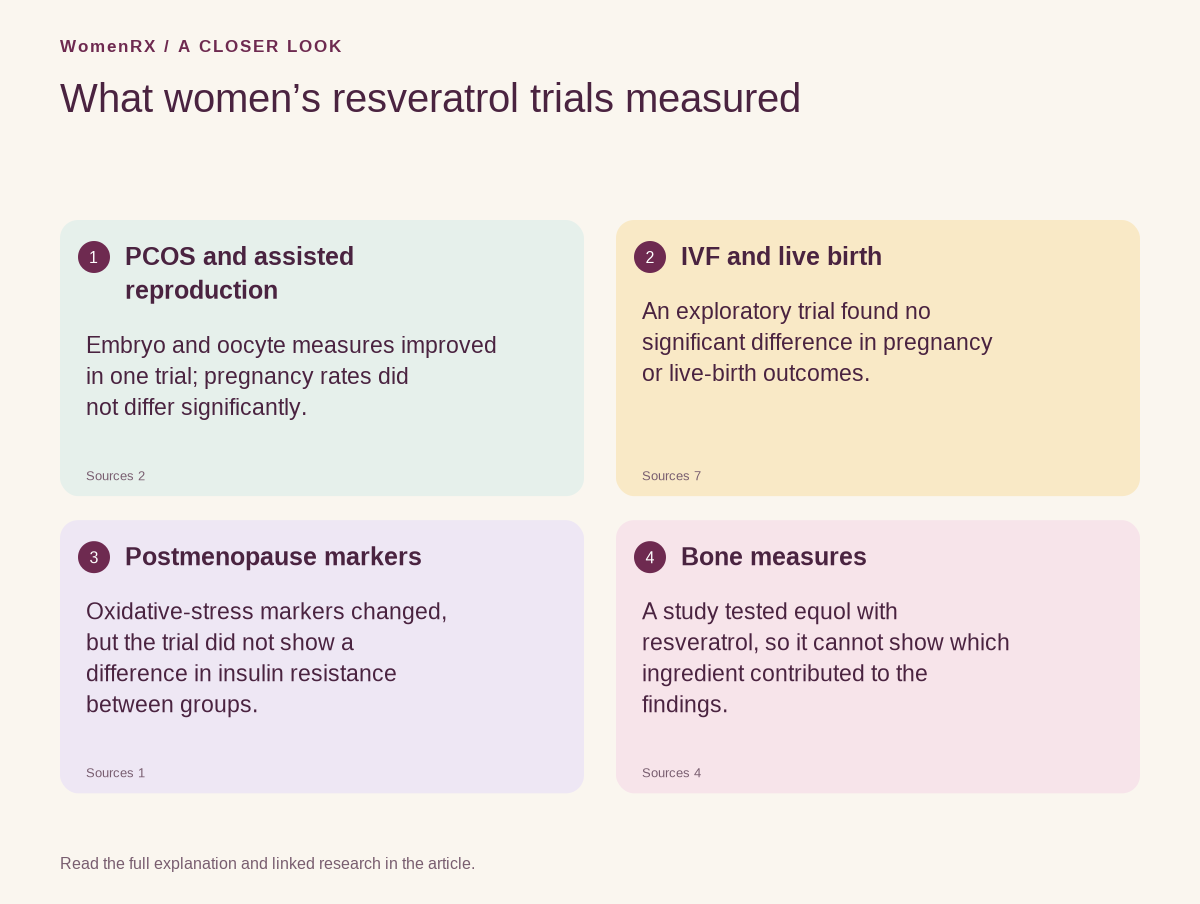
What women’s resveratrol trials measured
PCOS and assisted reproduction: Embryo and oocyte measures improved in one trial; pregnancy rates did not differ significantly.2
IVF and live birth: An exploratory trial found no significant difference in pregnancy or live-birth outcomes.7
Postmenopause markers: Oxidative-stress markers changed, but the trial did not show a difference in insulin resistance between groups.1
Bone measures: A study tested equol with resveratrol, so it cannot show which ingredient contributed to the findings.4
Read the figure as text
These examples distinguish the outcomes tested from the broader claims the results can support.- PCOS and assisted reproduction: Embryo and oocyte measures improved in one trial; pregnancy rates did not differ significantly.2
- IVF and live birth: An exploratory trial found no significant difference in pregnancy or live-birth outcomes.7
- Postmenopause markers: Oxidative-stress markers changed, but the trial did not show a difference in insulin resistance between groups.1
- Bone measures: A study tested equol with resveratrol, so it cannot show which ingredient contributed to the findings.4
Sources you can check
- The Administration of Resveratrol and Vitamin C Reduces Oxidative Stress in Postmenopausal Women-A Pilot Randomized Clinical Trial.Montoya-Estrada A, García-Cortés AY, Romo-Yañez J, Ortiz-Luna GF, Arellano-Eguiluz A, Belmont-Gómez A, Lopéz-Ugalde V, León-Reyes G, Flores-Pliego A, Espejel-Nuñez A, Solis-Paredes... · Nutrients · 2024Return to first citation
- Resveratrol ameliorates mitochondrial biogenesis and reproductive outcomes in women with polycystic ovary syndrome undergoing assisted reproduction: a randomized, triple-blind, placebo-controlled clinical trial.Ardehjani NA, Agha-Hosseini M, Nashtaei MS, Khodarahmian M, Shabani M, Jabarpour M, Fereidouni F, Rastegar T, Amidi F. · Journal of ovarian research · 2024Return to first citation
- Sirtuin 1 and Vascular Function in Healthy Women and Men: A Randomized Clinical Trial Comparing the Effects of Energy Restriction and Resveratrol.Gonçalinho GHF, Kuwabara KL, Faria NFO, Goes MFDS, Roggerio A, Avakian SD, Strunz CMC, Mansur AP. · Nutrients · 2023Return to first citation
- Equol and Resveratrol Improve Bone Turnover Biomarkers in Postmenopausal Women: A Clinical Trial.Corbi G, Nobile V, Conti V, Cannavo A, Sorrenti V, Medoro A, Scapagnini G, Davinelli S. · International journal of molecular sciences · 2023Return to first citation
- Treatment with combined resveratrol and myoinositol ameliorates endocrine, metabolic alterations and perceived stress response in women with PCOS: a double-blind randomized clinical trial.Hassan S, Shah M, Malik MO, Ehtesham E, Habib SH, Rauf B. · Endocrine · 2023Return to first citation
- A randomized controlled trial comparing the efficacy of resveratrol combined with metformin versus resveratrol monotherapy in the management of polycystic ovary syndrome.Zahra M, Shah M, Ahmad F, Zulfiqar F, Tariq A, Iqbal N. · Naunyn-Schmiedeberg's archives of pharmacology · 2026Return to first citation
- The impact of resveratrol on the outcome of the in vitro fertilization: an exploratory randomized placebo-controlled trial.Conforti A, Iorio GG, Di Girolamo R, Rovetto MY, Picarelli S, Cariati F, Gentile R, D'Amato A, Gliozheni O, Fioretti B, Alviggi C. · Journal of ovarian research · 2024Return to first citation
- Effect of Resveratrol Content in Red Wine on Circulating Sex Hormone-Binding Globulin: Lessons from a Pilot Clinical Trial.Briansó-Llort L, Simó-Servat O, Ramos-Perez L, Torres-Torronteras J, Hernandez C, Simó R, Selva DM. · Molecular nutrition & food research · 2022Return to first citation