Resveratrol After 40: What Menopause Research Actually Shows
One trial in postmenopausal women found possible symptom benefits, but it doesn’t show that resveratrol is a proven menopause treatment or that age 40 changes its effects.
Resveratrol has been studied in postmenopausal women, but the evidence is limited. One randomized trial reported improvements in pain, some somatic menopause symptoms, and general well-being; it doesn’t establish that resveratrol treats hot flashes, works during perimenopause, or benefits women simply because they’re over 40. A menopause society statement does not recommend supplements as a group for hot flashes and night sweats. 12
The age in the label isn’t the age in the evidence
“After 40” can mean very different things: cycling years, perimenopause, or years after the final menstrual period. The human trial most directly relevant here enrolled 125 healthy postmenopausal women. It was a randomized, double-blind, placebo-controlled crossover study lasting 24 months. That offers some direct evidence in postmenopause, but it doesn’t tell us whether resveratrol works differently with age or has the same effects during perimenopause. 2
What the postmenopause trial found
Participants took resveratrol or placebo in alternating study periods. Researchers assessed pain, mood, depressive symptoms, menopause symptoms, sleep, and quality of life using questionnaires as secondary outcomes. The study reported a lower composite pain score and improvements in somatic menopause symptoms and general well-being during resveratrol supplementation. 2
That’s a promising signal, not a settled answer. The abstract doesn’t give the size of the symptom changes, so it’s hard to judge how noticeable or meaningful they would be in everyday life. And “somatic symptoms” shouldn’t be read as proof that resveratrol eases hot flashes or night sweats: the reported finding doesn’t establish that specific benefit. The study also doesn’t show that resveratrol prevents disease or slows aging.
Match the claim to the reason you’re considering it
If your main concern is pain, this trial is relevant enough to discuss, but it doesn’t establish resveratrol as a treatment. If you’re considering it for overall menopause symptoms, the evidence is still preliminary. If you’re looking for relief from hot flashes or night sweats, don’t assume that the trial’s somatic-symptom finding answers that question.
The North American Menopause Society’s 2023 statement does not recommend dietary supplements and herbal remedies as a group for vasomotor symptoms such as hot flashes and night sweats. It does identify other options with evidence for these symptoms, including hormone therapy and certain nonhormonal treatments. That statement evaluates supplements as a category, not resveratrol alone, but it’s a reason not to treat a supplement claim as established menopause care. 1
A systematic review of clinical trials across many health conditions likewise concluded that the evidence wasn’t conclusive enough to recommend resveratrol in a healthcare setting. This broader review isn’t a verdict on that one menopause trial; it does underline why a single positive study shouldn’t be treated as proof. 3
A useful question before buying it
Start with the outcome you want. You might ask your clinician: “Is there evidence that resveratrol helps this specific symptom, or was the study measuring something different?” If you’re considering a product, bring its label and your current medication list so you can discuss whether it fits your situation. The practical takeaway: postmenopause research offers an early signal for some reported symptoms, but age 40 itself isn’t a reason to take resveratrol, and it isn’t a proven substitute for menopause treatments with stronger evidence.
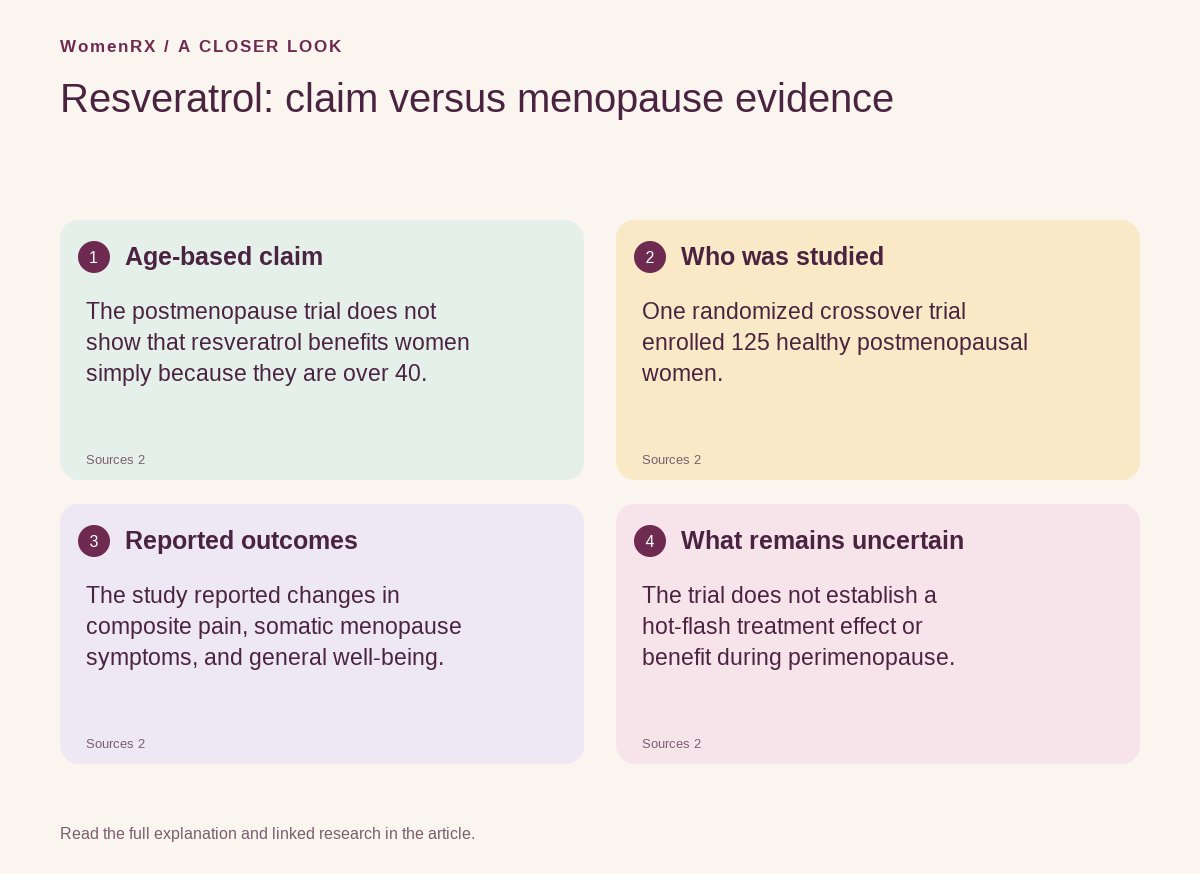
Resveratrol: claim versus menopause evidence
Age-based claim: The postmenopause trial does not show that resveratrol benefits women simply because they are over 40.2
Who was studied: One randomized crossover trial enrolled 125 healthy postmenopausal women.2
Reported outcomes: The study reported changes in composite pain, somatic menopause symptoms, and general well-being.2
What remains uncertain: The trial does not establish a hot-flash treatment effect or benefit during perimenopause.2
Read the figure as text
Compare the broad appeal of an age-based supplement claim with the population and outcomes in the most directly relevant trial.- Age-based claim: The postmenopause trial does not show that resveratrol benefits women simply because they are over 40.2
- Who was studied: One randomized crossover trial enrolled 125 healthy postmenopausal women.2
- Reported outcomes: The study reported changes in composite pain, somatic menopause symptoms, and general well-being.2
- What remains uncertain: The trial does not establish a hot-flash treatment effect or benefit during perimenopause.2
More questions, answered
Does the trial apply to perimenopause?
Not directly. The 24-month trial enrolled postmenopausal women, so its findings don’t establish whether resveratrol helps during perimenopause. 2
Sources you can check
- The 2023 nonhormone therapy position statement of The North American Menopause Society.Menopause (New York, N.Y.) · 2023Return to first citation
- Long-term resveratrol supplementation improves pain perception, menopausal symptoms, and overall well-being in postmenopausal women: findings from a 24-month randomized, controlled, crossover trial.Thaung Zaw JJ, Howe PRC, Wong RHX. · Menopause (New York, N.Y.) · 2020Return to first citation
- Resveratrol for the Management of Human Health: How Far Have We Come? A Systematic Review of Resveratrol Clinical Trials to Highlight Gaps and Opportunities.Brown K, Theofanous D, Britton RG, Aburido G, Pepper C, Sri Undru S, Howells L. · International journal of molecular sciences · 2024Return to first citation