Resveratrol Dose: What the Human Evidence Can Actually Tell You
There’s no established daily dose for resveratrol, and a dose studied for one outcome isn’t a proven recommendation for another.
There isn’t a proven daily resveratrol dose for menopause, longevity, or general health. One trial in postmenopausal women tested 75 mg twice daily and reported improvements in some symptom measures, but that research dose isn’t an established treatment recommendation. Compare products by the amount and formulation on the label, and don’t assume a blend or different product matches a trial. 12
A study dose is not a recommended dose
A supplement label may make one daily amount look like the answer. The human research doesn’t establish a single resveratrol dose for a particular health goal, though. A systematic review of clinical trials found no consensus treatment regimen for any condition or outcome. The review described resveratrol as generally well tolerated in trials at doses up to 1 gram a day; that is a summary of research, not a target dose or a guarantee of safety for you. 2
The useful question is not simply “How much?” It’s “Was this amount tested for the outcome I care about, in people like me, using a comparable product?”
What menopause research tested
In a randomized, double-blind, placebo-controlled crossover trial, 125 healthy postmenopausal women took 75 mg twice daily. The study reported improvements in composite pain scores, somatic menopause symptoms, and general well-being during resveratrol use. These were secondary outcomes, measured alongside the trial’s cognitive-performance research. The findings are worth knowing about, but one trial in postmenopausal women doesn’t establish a dose for all women, for perimenopause, or for treating menopause symptoms. 1
A separate small trial in postmenopausal women with insulin resistance tested resveratrol alone, resveratrol with vitamin C, and vitamin C alone. Some antioxidant markers changed within one group, but the study found no significant differences between groups. That distinction matters: a change in a laboratory marker, especially when groups don’t differ, isn’t proof that a supplement improves how someone feels or prevents disease. 3
So if a product is marketed for menopause, don’t treat the 75 mg twice-daily trial amount as a personalized recommendation. It tells you what one study tested, not what you should take or whether a product will help.
Reproductive-health claims need a different yardstick
Resveratrol has also been studied in assisted reproduction, but that evidence doesn’t establish a daily fertility dose. A 2026 systematic review and meta-analysis included seven studies with 3,411 patients, of whom 274 received resveratrol. It found a higher fertilization rate with supplementation, but no significant difference in clinical pregnancy or live birth. A fertilization result alone doesn’t show that resveratrol improves the chance of having a baby. 4
Pregnancy and breastfeeding are different from postmenopause or fertility treatment. The menopause and assisted-reproduction findings don’t establish a safe dose in pregnancy or while breastfeeding. Animal research cannot settle that question for people. If you’re pregnant, breastfeeding, trying to conceive, or receiving fertility treatment, get advice from your obstetric or fertility care team before using a resveratrol supplement. 45
How to compare products without false precision
Start with the label, not a headline claim. Check the amount of resveratrol per serving, whether it’s a single ingredient or part of a blend, and whether the formulation is named. Then compare it with the actual human study you’re considering. The clinical-trial review focused on products with a defined amount of purified resveratrol; it allowed different formulations, so the studies don’t establish that every product with the same milligram amount is interchangeable. 2
Be especially cautious about claims that jump from cell or animal experiments to “anti-aging” benefits in people. Laboratory and animal findings can suggest questions for human research, but they don’t demonstrate a health or longevity benefit from a supplement in women. 2
If you take prescription medicines, show the exact product label to a pharmacist or prescriber before starting. That’s a practical way to review your specific medication list and the product’s full ingredient panel; don’t assume that a different dose or taking it at a different time makes a product suitable.
The clearest takeaway is simple: choose an intended outcome first, then look for human studies that actually tested it. If there’s no close match in population, formulation, and outcome, a dose printed on a bottle is not a research-backed answer.
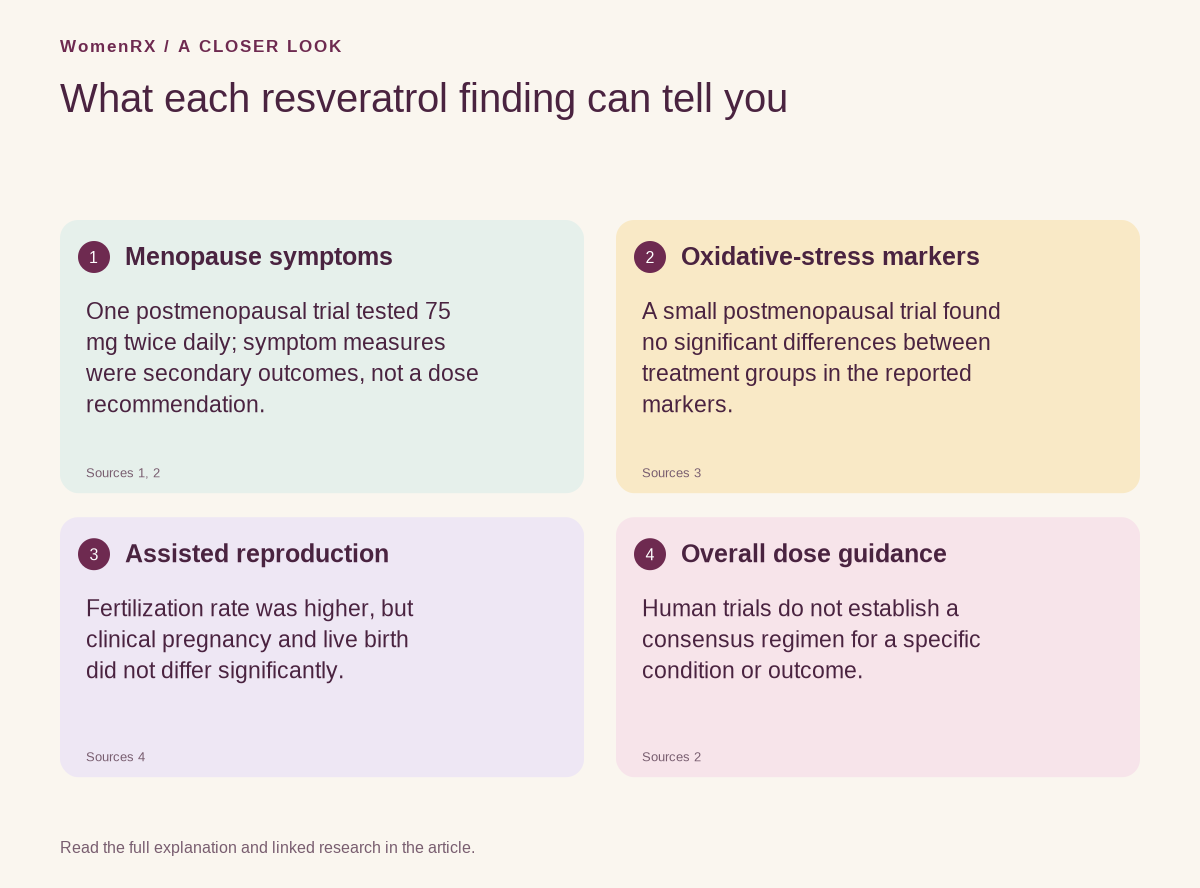
What each resveratrol finding can tell you
Menopause symptoms: One postmenopausal trial tested 75 mg twice daily; symptom measures were secondary outcomes, not a dose recommendation.12
Oxidative-stress markers: A small postmenopausal trial found no significant differences between treatment groups in the reported markers.3
Assisted reproduction: Fertilization rate was higher, but clinical pregnancy and live birth did not differ significantly.4
Overall dose guidance: Human trials do not establish a consensus regimen for a specific condition or outcome.2
Read the figure as text
The studied amount only makes sense alongside the outcome, population, and limits of each human finding.- Menopause symptoms: One postmenopausal trial tested 75 mg twice daily; symptom measures were secondary outcomes, not a dose recommendation.12
- Oxidative-stress markers: A small postmenopausal trial found no significant differences between treatment groups in the reported markers.3
- Assisted reproduction: Fertilization rate was higher, but clinical pregnancy and live birth did not differ significantly.4
- Overall dose guidance: Human trials do not establish a consensus regimen for a specific condition or outcome.2
More questions, answered
Does 75 mg twice daily mean that’s the right menopause dose?
No. That was the amount tested in one trial of healthy postmenopausal women, not an established recommendation. The trial’s findings don’t show that the same dose is right for perimenopause or for every resveratrol product. 12
Should I take resveratrol for fertility or during pregnancy?
The assisted-reproduction review found no significant improvement in clinical pregnancy or live birth, despite a higher fertilization rate. Those findings don’t establish a fertility dose or pregnancy safety. Ask your fertility or obstetric care team before using it. 45
Sources you can check
- Long-term resveratrol supplementation improves pain perception, menopausal symptoms, and overall well-being in postmenopausal women: findings from a 24-month randomized, controlled, crossover trial.Thaung Zaw JJ, Howe PRC, Wong RHX. · Menopause (New York, N.Y.) · 2020Return to first citation
- Resveratrol for the Management of Human Health: How Far Have We Come? A Systematic Review of Resveratrol Clinical Trials to Highlight Gaps and Opportunities.Brown K, Theofanous D, Britton RG, Aburido G, Pepper C, Sri Undru S, Howells L. · International journal of molecular sciences · 2024Return to first citation
- Targeting Oxidative Stress in Insulin-Resistant Postmenopausal Women: Effects of Resveratrol and Vitamin C on Oxidative Damage and Antioxidant Defenses in a Randomized Clinical Trial.Reyes-Muñoz E, Arellano-Eguiluz A, Ortiz-Luna GF, Guzmán-Grenfell AM, Flores-Pliego A, Espejel-Nuñez A, Parra-Hernández SB, García-Gómez E, Romo-Yañez J, Montoya-Estrada A. · Antioxidants (Basel, Switzerland) · 2026Return to first citation
- Resveratrol supplementation and assisted reproduction outcomes: A systematic review and meta-analysis.Lemos MJ, Oliveira JA, Queiroz LF, Campos NV, de Oliveira FR. · European journal of obstetrics, gynecology, and reproductive biology · 2026Return to first citation
- Developmental exposure to resveratrol induces context-dependent vascular effects in adult offspring: protection in SHR and adverse remodeling in normotensive rats.Blascke de Mello MM, de Oliveira RR, Gomes BQ, Dourado TMH, Manoel LB, da Rocha EV, Tirapelli CR, Castro MM. · European journal of pharmacology · 2026Return to first citation