Berries: Fiber, Protein, and Fresh Versus Frozen
Raspberries have more fiber than blueberries or strawberries by equal weight, while all three provide little protein.
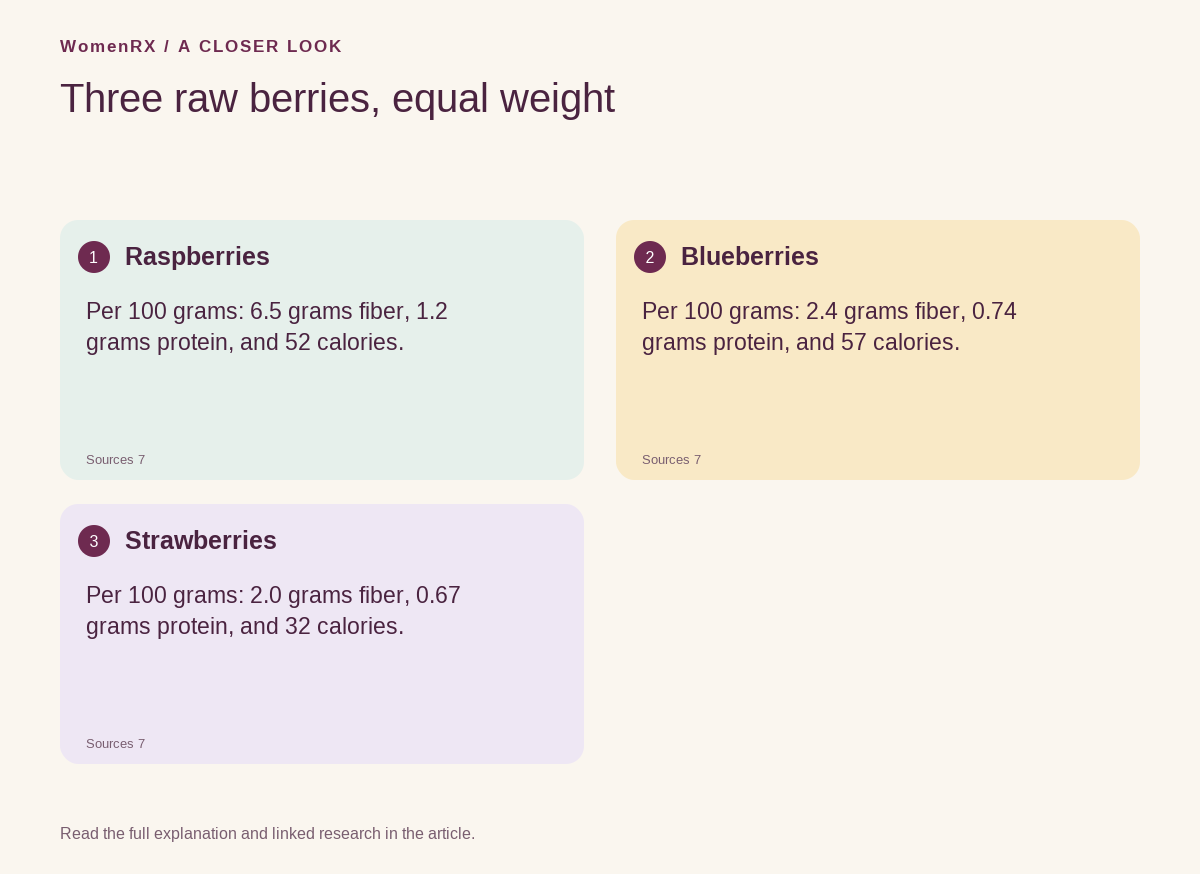
For the same 100-gram amount of raw fruit, raspberries have about 6.5 grams of fiber, blueberries 2.4 grams, and strawberries 2.0 grams. None is a meaningful protein source. 7 Both fresh and frozen berries can fit into meals, but a laboratory comparison of strawberries doesn’t establish that one form is nutritionally better across all berries. 53
What changes when you choose a different berry?
If fiber is what you’re looking for, raspberries stand out in a like-for-like comparison. USDA reference values for 100 grams of raw fruit list 6.5 grams of fiber in raspberries, 2.4 grams in blueberries, and 2.0 grams in strawberries. Those are food-composition estimates, not a promise that every carton will measure exactly the same. 7
Blueberries and strawberries still contribute fiber. Fruit is one of several food sources of dietary fiber, which helps digestion and can help you feel full. If you’re adding substantially more fiber to your meals, going gradually may help avoid gas, bloating, or cramps. 1
The comparison looks different if you measure by the cup. One cup of raw blueberries weighs 148 grams in the USDA reference profile and provides an estimated 3.6 grams of fiber. A cup isn’t the same weight across berry types or even different ways of preparing the same berry: the USDA listings include separate cup weights for whole, halved, and sliced strawberries. For a fair comparison between types, use the same weight; for your own meal, use the amount you actually eat. 67
Berries are fruit, not the protein part of a meal
Per 100 grams, the USDA values list about 0.7 grams of protein for blueberries, 0.7 grams for strawberries, and 1.2 grams for raspberries. The fiber difference is useful; the protein difference is small in everyday meal terms. If you’re choosing berries for breakfast, think of them as the fruit alongside other foods rather than as your protein source. For example, you could add them to a bowl of yogurt. 72
The same reference values put 100 grams of raw strawberries at 32 calories, raspberries at 52, and blueberries at 57. These figures describe equal weights of plain raw fruit, not equal-size bowls, smoothies, or packaged berry products. They can help you understand what’s in the fruit without turning a few calories’ difference into a reason to avoid a berry you enjoy. 7
Fresh or frozen? Start with the actual product
Berries are eaten fresh and frozen, as well as in products such as jams, drinks, and flavored yogurt. That makes the form and other ingredients worth noticing. Plain frozen berries can be an option when fresh berries aren’t convenient; a berry drink or jam is a different food, so check its label rather than treating it as a serving of plain berries. 52
Fresh and frozen aren’t interchangeable in every nutrient measurement, either. In one laboratory digestion study of strawberries, the tested fresh fruit had more accessible micronutrients than the tested frozen fruit. That finding is specific to those strawberries and the laboratory method. It doesn’t show that fresh berries deliver better health outcomes, or that fresh always beats frozen across berry types. 3
You may also hear about anthocyanins, the pigments studied in many berries. One analysis found different anthocyanin amounts in samples of several fruits, but measuring pigments in extracted fruit doesn’t tell you that one berry will prevent disease or offer a special benefit for women. For an everyday choice, the clearer distinction is practical: raspberries provide more fiber by equal weight, all three offer little protein, and the ingredients matter when you move beyond plain fruit. 475
Three raw berries, equal weight
Raspberries: Per 100 grams: 6.5 grams fiber, 1.2 grams protein, and 52 calories.7
Blueberries: Per 100 grams: 2.4 grams fiber, 0.74 grams protein, and 57 calories.7
Strawberries: Per 100 grams: 2.0 grams fiber, 0.67 grams protein, and 32 calories.7
Read the figure as text
USDA reference values compare 100 grams of each raw berry, so the amounts use the same basis rather than differently sized cups.Sources you can check
- Dietary Fiber: MedlinePlusAccessed 2026-09-25Return to first citation
- Nutrition: MedlinePlusAccessed 2026-09-25Return to first citation
- Bioaccessibility of micronutrients in fresh and frozen strawberry fruits grown under elevated carbon dioxide and temperature.Balasooriya H, Dasanayake K, Ajlouni S. · Food chemistry · 2020Return to first citation
- Trend in Detection of Anthocyanins from Fresh Fruits and the Influence of Some Factors on Their Stability Impacting Human Health: Kinetic Study Assisted by UV-Vis Spectrophotometry.Ionescu C, Samide A, Tigae C. · Antioxidants (Basel, Switzerland) · 2025Return to first citation
- Food intake biomarkers for berries and grapes.Ulaszewska M, Garcia-Aloy M, Vázquez-Manjarrez N, Soria-Florido MT, Llorach R, Mattivi F, Manach C. · Genes & nutrition · 2020Return to first citation
- USDA SR Legacy: Blueberries, raw (FDC 171711)Accessed 2026-09-25Return to first citation
- USDA SR Legacy: berries reference food comparisonAccessed 2026-09-25Return to first citation