How to Start Swimming for Fitness at Your Own Pace
A good first swim is built around water confidence, manageable effort, and rest, not a target number of laps.
If you’re comfortable and safe in the water, start with easy lengths broken up by rests; choose a pace that lets you keep your form steady. If you’re still learning, begin with lessons or water-confidence practice rather than a fitness set. Older-adult research offers some support for water-based exercise and cardiorespiratory fitness, but much of the swimming review focused on people with cognitive impairment. It doesn’t establish an ideal beginner plan or show that water aerobics and lap swimming have the same effects. 12
First, choose the kind of water workout that fits
Lap swimming means moving through the water using a stroke, with breathing and technique shaping how hard the workout feels. Water aerobics usually means doing exercises in the water, often upright, rather than swimming lengths. Both can be ways to be active, but they aren’t interchangeable skills: being comfortable with water aerobics doesn’t necessarily mean you’re ready to swim laps.
A small randomized study of sedentary adults aged 60 to 75 tested a program that combined swimming and aqua aerobics, twice a week for 21 weeks. Both that group and a stretching group improved estimated cardiorespiratory fitness. Because the water program combined activities, the study can’t tell us whether lap swimming or aqua aerobics was responsible for the change, or which is better. 2
So let your current ability and pool access guide the choice. If you can swim comfortably, try easy lengths. If you can’t yet swim confidently, look for instruction or a water-confidence class. If laps aren’t practical, a water-aerobics class may be another way to use the pool, but it won’t teach lap-swimming technique by itself.
Build a session around skill, effort, and rest
Treat your first visit as a chance to find a comfortable rhythm, not to prove how much you can do. If you already swim safely, try this flexible structure:
- Check your comfort and conditions. Choose a pool and area where you can swim within your ability. If you aren’t confident in the water, get instruction before attempting a swimming workout.
- Begin easily. Swim a short length or a manageable stretch, then pause at the wall. Pick a pace that lets you keep your stroke controlled.
- Rest as needed. Take another easy length when you feel ready. There’s no need to follow a fixed work-to-rest ratio or hit a lap target.
- Finish while your form is steady. End the session when you’re tired enough that staying controlled becomes difficult. Next time, repeat a similar session before deciding whether to swim a little longer or take shorter rests.
This is a practical starting framework, not a tested training prescription. The older-adult study used a twice-weekly combined water program, but it doesn’t establish that frequency as the right schedule for every beginner or specify how to progress a swim session. 2
If pool access is limited, a class or occasional session can still help you practice the activity you’ve chosen; don’t feel you need to copy a particular schedule from a study. For lap swimming, lessons or feedback on technique may be more useful than pushing for more lengths when your stroke still feels unfamiliar.
What older-adult studies tell us about fitness and bone
A systematic review of swimming studies focused on older adults with cognitive impairment; most included participants had dementia. It reported cardiorespiratory fitness and strength among the physiological improvements most consistently noted in that evidence base. The review included varied study designs and called for more rigorous research with clearer descriptions of exercise programs. Its findings don’t establish fitness effects for older adults generally or a specific beginner routine. 1
Those review findings come largely from people with dementia, while the separate water-exercise trial enrolled sedentary older adults and combined swimming with aqua aerobics. Neither establishes whether effects differ for women or specifically for postmenopausal women, or directly compares swimming with weight-bearing exercise for cardiorespiratory fitness in those groups. 12
For bone health, a youth-focused review says aerobic training may have a lesser or neutral effect on bone mineral density enhancement than resistance training, particularly plyometric jump training. That comparison in young people doesn’t establish how swimming compares with weight-bearing exercise for bone health in adult or postmenopausal women. 3
The useful takeaway is simple: choose the pool activity you can do safely and consistently, and match the session to your present swimming skill. If bone health is part of your reason for exercising, the youth-focused bone-density finding doesn’t establish that swimming has the same effect as weight-bearing exercise for adult women. 3
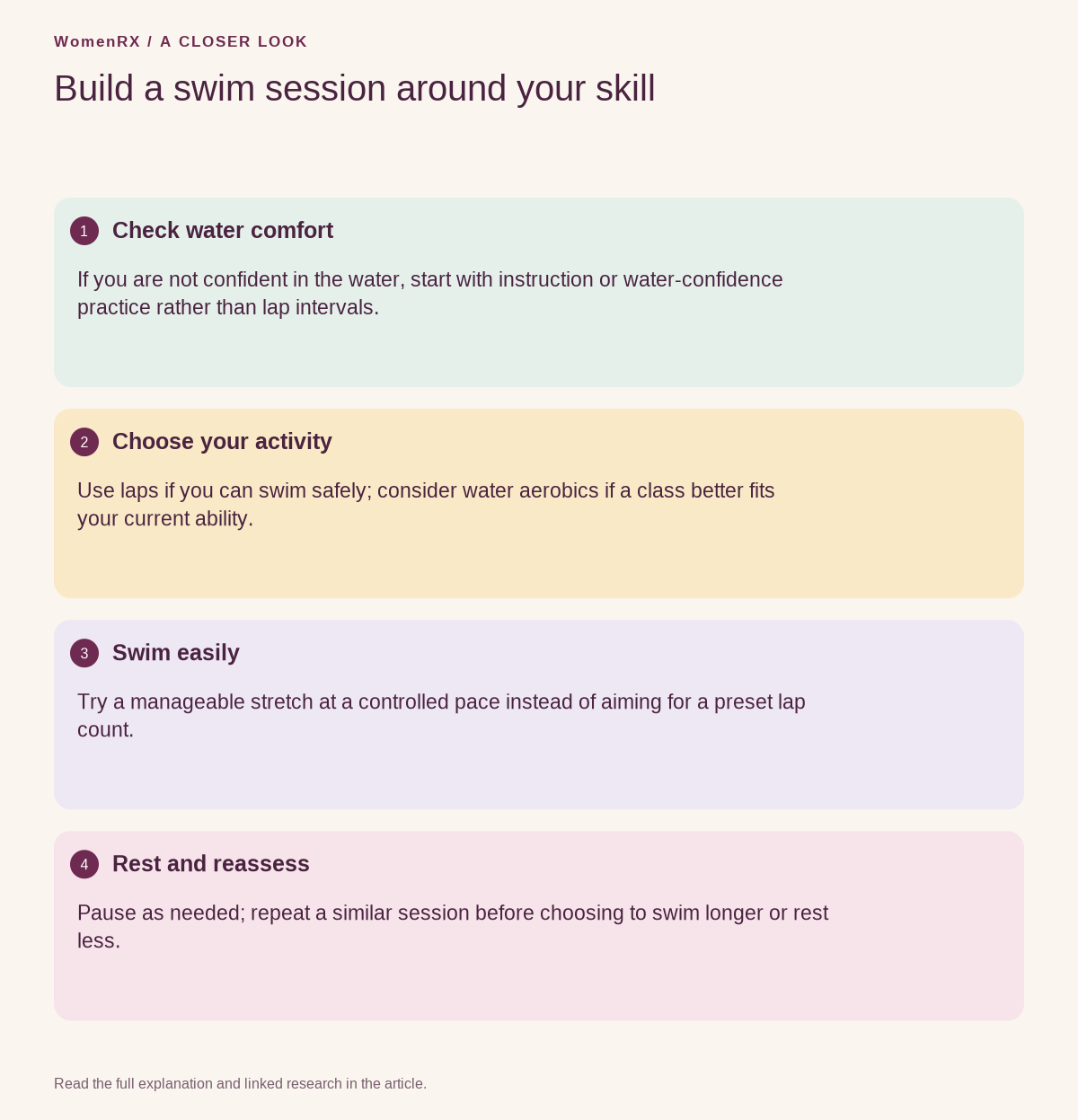
Build a swim session around your skill
Check water comfort: If you are not confident in the water, start with instruction or water-confidence practice rather than lap intervals.
Choose your activity: Use laps if you can swim safely; consider water aerobics if a class better fits your current ability.
Swim easily: Try a manageable stretch at a controlled pace instead of aiming for a preset lap count.
Rest and reassess: Pause as needed; repeat a similar session before choosing to swim longer or rest less.
Read the figure as text
A practical sequence for choosing a pool activity and shaping a first session. It is not a validated training protocol.- Check water comfort: If you are not confident in the water, start with instruction or water-confidence practice rather than lap intervals.
- Choose your activity: Use laps if you can swim safely; consider water aerobics if a class better fits your current ability.
- Swim easily: Try a manageable stretch at a controlled pace instead of aiming for a preset lap count.
- Rest and reassess: Pause as needed; repeat a similar session before choosing to swim longer or rest less.
More questions, answered
Does water aerobics count as swimming?
They’re different activities. Water aerobics is exercise in the water; lap swimming involves swimming a stroke through the pool. The older-adult trial combined swimming and aqua aerobics, so it can’t separate their effects. 2
Is swimming enough to support bone health after menopause?
The youth-focused bone-density comparison doesn’t establish whether swimming supports bone health in postmenopausal women or how it compares with weight-bearing exercise for them. It discusses aerobic training in relation to resistance training, particularly plyometric jump training, in young people. 3
Sources you can check
- Effects of swimming on cognitive and health outcomes in older adults and insights into participation facilitators and barriers: a systematic review.Jaana M, Cruise D, Georges C. · Frontiers in medicine · 2026Return to first citation
- Executive functions improvement following a 5-month aquaerobics program in older adults: Role of cardiac vagal control in inhibition performance.Albinet CT, Abou-Dest A, André N, Audiffren M. · Biological psychology · 2016Return to first citation
- The Era of Resistance Training as a Primary Form of Physical Activity for Physical Fitness and Health in Youth Has Come.Chaabene H, Ramirez-Campillo R, Moran J, Schega L, Prieske O, Sandau I, Negra Y, Behrens M. · Sports medicine (Auckland, N.Z.) · 2025Return to first citation