How to Start Balance Training at Your Own Level
A steady start means choosing a challenge you can control, then building toward the movements that matter in daily life.
Begin on a stable surface with a level of support that lets you move without feeling close to falling. Build from steady, two-foot positions toward weight shifts and more active tasks only as control improves. 6 If you’ve fallen or feel newly unsteady, get your balance and possible contributing factors assessed before trying harder drills. Balance work can support steadier movement, but it doesn’t guarantee you won’t fall. 3
Start with control, not a test
Balance practice should feel like a manageable challenge, not a gamble. If standing feels secure, begin on a firm, level surface. As practical setup advice, keep something sturdy within reach if you need to hold on. Keep the task simple enough that you can stay in control.
A useful first step is a steady stance with both feet on the ground; when that feels comfortable, practice small, deliberate shifts of weight. A program for older women with and without knee osteoarthritis described a progression from stable support positions to more demanding sensory, movement, and everyday-task exercises. It progressed after a person had gained the earlier skill, rather than treating the hardest version as the goal. 6
If you don’t feel safe standing, or you’ve recently fallen, don’t use a difficult balance exercise to find out what you can manage. Get assessed first. Falls can have several contributors, including balance problems, leg weakness, vision changes, some medicines, and health conditions. A fall or concern about balance is a reason to discuss mobility and possible causes with a clinician. 2 3
What counts as a progression?
Think of progression as changing one challenge at a time, while keeping the exercise controlled:
- Steady base: Practice standing with both feet supported on a firm surface. Keep a sturdy handhold close if you need it.
- Small movements: Once steady, add gentle weight shifts or a simple movement task. The aim is to stay controlled, not to see how far you can lean.
- Everyday movement: With better control, work toward movements such as getting up from a chair or walking around an obstacle. These resemble tasks included in a balance-and-gait program for older women. 6
- More complex drills: Unstable surfaces, one-foot positions, faster movement, or reduced visual cues make balance harder. They aren’t necessary starting points; a program described these as different exercise variables, not a requirement for everyone. 6
That sequence is a practical way to think about challenge, not a validated home test or a guarantee of safety. If you need to grab for support, feel dizzy, or can’t control the movement, make it easier and get guidance before progressing.
Balance and strength do different jobs
Balance practice works on staying steady while still or moving. Strength work helps build the leg power used to rise from a chair and manage uneven ground. Fall prevention guidance recommends regular activity that includes strength and balance, rather than relying on balance drills alone. 2 3
For example, a 12-week randomized study enrolled 102 older women with a history of falls and compared elastic-band resistance exercise, vibration training, their combination, and a control condition. Participants in the exercise groups did lower-body movements; the study reported improvements in balance and mobility measures and in confidence about falling. These are encouraging results in women who had previously fallen, but the measured changes don’t establish that a particular program prevents future falls in everyday life. Vibration equipment also isn’t needed to start practicing balance. 5
If osteoporosis or fracture risk is part of the picture
Balance training and bone-focused exercise are related, but they aren’t interchangeable. Improving balance may help with steadier movement; weight-bearing and resistance exercise are specifically highlighted for supporting bone density. 1 Osteoporosis also matters because a fall is more likely to cause a fracture, especially in someone with weaker bones. 2
If you have diagnosed osteoporosis, a history of fracture, or substantial concern about falling, the safest starting level depends on your movement and health, not just your age. Ask for a plan that considers both balance and strength, and whether any movements should be adapted. A systematic review of exercise programs in older patients with osteoporosis reported possible differences between regimens, but its authors said the evidence was not strong enough to treat its rankings as definitive recommendations. 4
When to step back and get assessed
An assessment is especially useful if you’ve fallen, feel unsteady during ordinary walking, or notice that balance has changed. A review can consider more than exercise selection, including strength, vision, medications, and health conditions that may contribute. 2 3 Until then, favor a stable setting and supported, familiar movement over unsupported balance challenges. Regular activity can be part of fall-risk reduction, but safer movement usually takes more than one exercise or one explanation of what caused a fall. 2 3
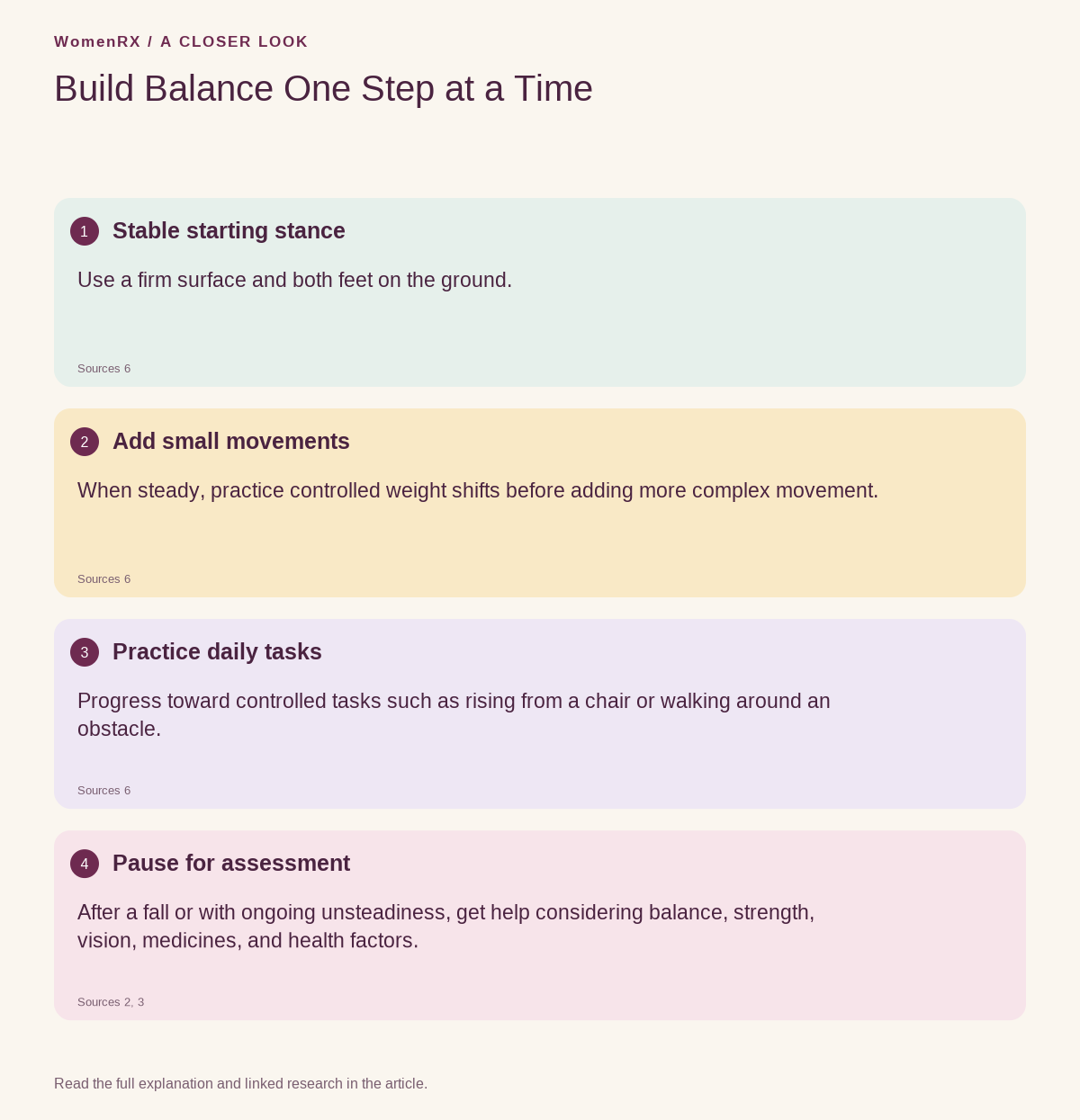
Build Balance One Step at a Time
Stable starting stance: Use a firm surface and both feet on the ground.6
Add small movements: When steady, practice controlled weight shifts before adding more complex movement.6
Practice daily tasks: Progress toward controlled tasks such as rising from a chair or walking around an obstacle.6
Pause for assessment: After a fall or with ongoing unsteadiness, get help considering balance, strength, vision, medicines, and health factors.23
Read the figure as text
A practical way to picture increasing challenge. Keep sturdy support close if needed as a setup precaution. A fall or ongoing unsteadiness calls for individual assessment.- Stable starting stance: Use a firm surface and both feet on the ground.6
- Add small movements: When steady, practice controlled weight shifts before adding more complex movement.6
- Practice daily tasks: Progress toward controlled tasks such as rising from a chair or walking around an obstacle.6
- Pause for assessment: After a fall or with ongoing unsteadiness, get help considering balance, strength, vision, medicines, and health factors.23
More questions, answered
Does balance exercise also strengthen bones?
Not necessarily. Balance practice targets steadiness; weight-bearing and resistance exercise are the types specifically highlighted for supporting bone density. A plan may include more than one kind of activity. 1
Should I practice on an unstable surface to improve faster?
No need to start there. Unstable surfaces and one-foot positions make a task more challenging, and a clinical program treated them as exercise variables within a progression. Start with a level you can control; ask for guidance if you feel unsafe. 6
Sources you can check
- Osteoporosis - Prevention - NHSAccessed 2026-09-25Return to first citation
- Falls: MedlinePlusAccessed 2026-09-25Return to first citation
- Falls - NHSAccessed 2026-09-25Return to first citation
- Effects of exercise regimens on balance ability in older patients with osteoporosis: a systematic review and Bayesian network meta-analysis of randomized controlled trials.Liu X, Chang M, Yuan H, Zheng X, Tian W, Li D, Liao D, Cui L. · Frontiers in physiology · 2026Return to first citation
- Synergistic effects of elastic band and vibration training on muscle strength, balance, and mobility in older women with a history of falls: a randomised controlled trial.Zhang Z, Xiong W, Liu H. · Frontiers in bioengineering and biotechnology · 2025Return to first citation
- Effect of Rehabilitation Program for Muscle Strength, Balance, and Gait Retraining with Visual Feedback in Older Women with and Without Knee Osteoarthritis: Clinical Trial.de Souza TS, Pereira DB, Hagihara RJ, Fuzinato CT, Ribeiro AP. · Journal of personalized medicine · 2025Return to first citation