Swimming During Menopause: What Weight and Joint Research Shows
Aquatic exercise has shown some body-composition benefits in postmenopausal women, but the research doesn’t establish a weight or fitness advantage for lap swimming.
Swimming can be a reasonable activity choice during menopause if you enjoy it and can do it regularly. A small trial of structured aquatic exercise in older postmenopausal women reported improved body composition, while a broader review found body-fat benefits from exercise. Neither establishes that lap swimming improves fitness more than other activities or reliably causes weight loss. 3 5
What the menopause research actually studied
Swimming and aquatic exercise overlap, but they aren’t interchangeable. Lap swimming means moving through the water using swimming strokes. Aquatic exercise can also include water-based movements or resistance exercises, and these studies don’t establish that lap swimming itself produces a particular fitness or weight outcome.
One small randomized trial enrolled 30 South Korean women aged 70 to 82; 22 remained at the end, with 12 in the exercise group and 10 controls. The exercise group took part in aquatic exercise for 60 minutes, three times a week, for 12 weeks. The researchers reported improvements in body composition and some health measures, but the study was small, and the reported information doesn’t give enough detail to estimate how much body composition changed. These women were older postmenopausal adults, so the findings may not translate directly to women in perimenopause or younger postmenopause. 3
What about fitness? The aquatic trial measured body composition and health markers such as blood lipids and glucose-related measures, rather than reporting a result from a swimming test or a direct measure of aerobic fitness. A change in body fat is not the same outcome as being able to swim farther or feeling less winded. Research discussed in a knee osteoarthritis study protocol found that aquatic exercise can improve pain and physical function in people with knee or hip osteoarthritis, with short-term effects similar to land exercise. That speaks to moving more comfortably, not to lap-swimming performance. 3 4
A review of 17 randomized trials involving 792 menopausal women found that exercise overall improved some measures, including body fat and waist circumference. Its aerobic-exercise subgroup also showed an improvement in body fat. Those results support exercise as a useful option, but they don’t identify swimming as the cause or show that it outperforms other aerobic activities. 5
The practical difference may be comfort
Water’s buoyancy reduces the forces acting on joints. A study protocol for women with mild knee osteoarthritis describes this as one reason aquatic exercise may feel more comfortable, and notes that earlier research found short-term benefits for pain and function from aquatic exercise similar to land exercise. The protocol itself reports a planned study, not results proving that swimming treats knee pain. 4
That distinction can still help you choose. If walking or another land activity bothers your knees, water exercise may feel easier to try. If you enjoy lap swimming and have a pool nearby, that may be the activity you’re more likely to keep doing. If getting to a pool is difficult, a land-based option that feels comfortable may be more practical. These are fit-and-access considerations, not evidence that one activity is medically best for every woman.
For example, someone who finds laps tiring or uncomfortable might prefer a water-exercise class; someone who likes swimming might choose laps instead. This research doesn’t tell us which approach leads to better outcomes.
Keep weight goals separate from activity choice
A swim can contribute to physical activity, but it doesn’t guarantee weight loss. Body weight reflects more than body fat: it includes muscle, bone, and water, so a change in fitness or body composition may not show up as a simple change on the scale. 2 Weight is also influenced by the balance between calories taken in and used through activity and daily living, among other factors. 1
So it may be more useful to ask, “Can I do this regularly, and does it feel workable for my body and schedule?” rather than “Is swimming the best exercise for menopause weight loss?” Menopause studies support exercise in general, and one small study supports further interest in aquatic exercise for older postmenopausal women. They don’t establish a unique weight-loss effect from swimming. 3 5
A simple way to decide
Consider pool access, comfort in the water, how you feel during and after activity, and whether the format suits you. If you want low-impact movement, aquatic exercise may be worth considering, especially if joint symptoms make land activity less comfortable. If you prefer another aerobic activity and can do it consistently, the available menopause research doesn’t give a reason to switch to swimming solely for weight outcomes. The best-supported conclusion is modest: choose an activity that fits your life, and don’t treat swimming as a menopause-specific weight treatment.
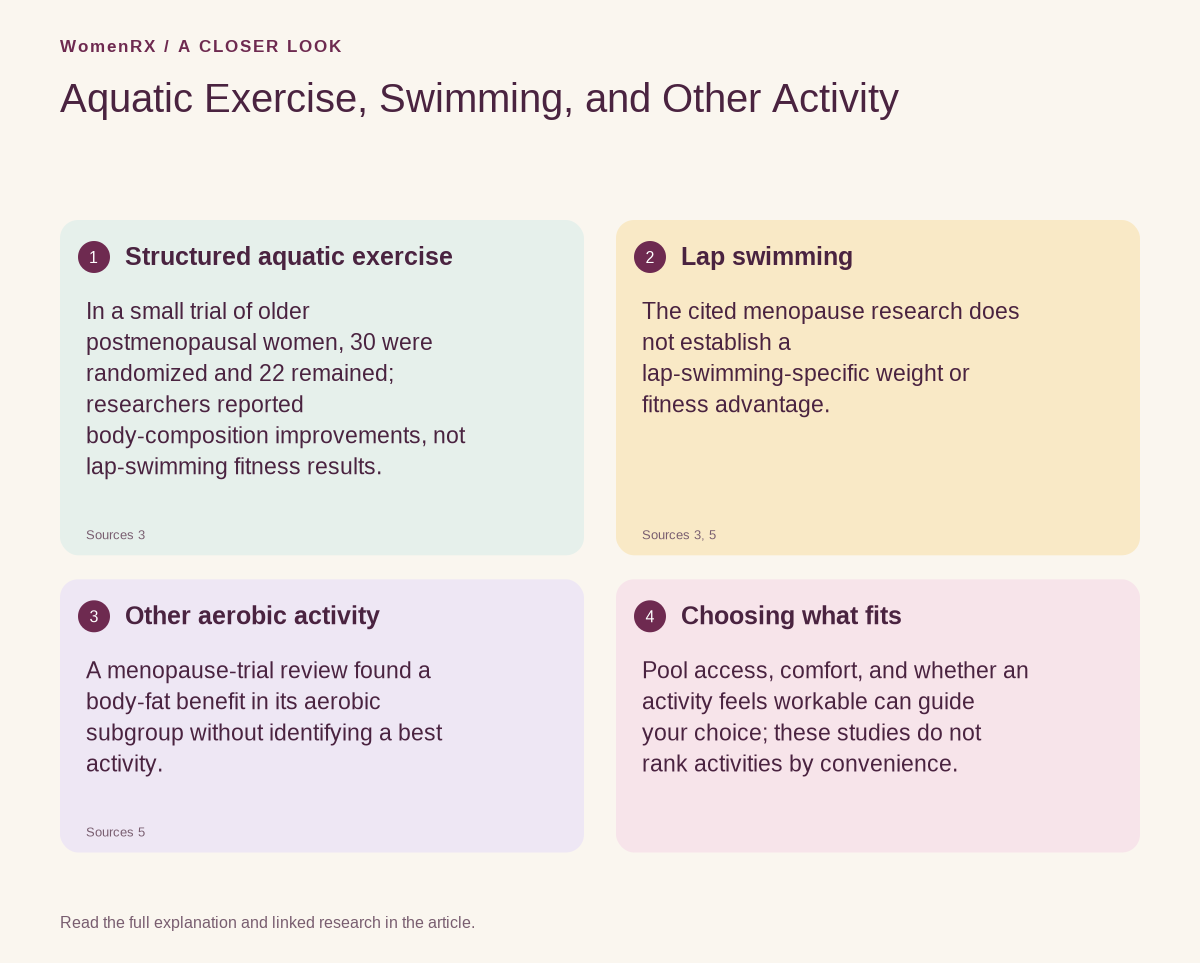
Aquatic Exercise, Swimming, and Other Activity
Structured aquatic exercise: In a small trial of older postmenopausal women, 30 were randomized and 22 remained; researchers reported body-composition improvements, not lap-swimming fitness results.3
Lap swimming: The cited menopause research does not establish a lap-swimming-specific weight or fitness advantage.35
Other aerobic activity: A menopause-trial review found a body-fat benefit in its aerobic subgroup without identifying a best activity.5
Choosing what fits: Pool access, comfort, and whether an activity feels workable can guide your choice; these studies do not rank activities by convenience.
Read the figure as text
Which outcomes have been studied, and what remains a practical choice rather than a proven advantage.- Structured aquatic exercise: In a small trial of older postmenopausal women, 30 were randomized and 22 remained; researchers reported body-composition improvements, not lap-swimming fitness results.3
- Lap swimming: The cited menopause research does not establish a lap-swimming-specific weight or fitness advantage.35
- Other aerobic activity: A menopause-trial review found a body-fat benefit in its aerobic subgroup without identifying a best activity.5
- Choosing what fits: Pool access, comfort, and whether an activity feels workable can guide your choice; these studies do not rank activities by convenience.
More questions, answered
Does swimming help with menopause symptoms such as hot flashes?
Exercise may be valuable for general health, but a menopause position statement does not recommend exercise as a treatment for vasomotor symptoms such as hot flashes. Swimming shouldn’t be presented as a proven hot-flash treatment. 6
Sources you can check
- Obesity: MedlinePlusAccessed 2026-09-25Return to first citation
- Body Weight: MedlinePlusAccessed 2026-09-25Return to first citation
- Aquatic Exercise Positively Affects Physiological Frailty among Postmenopausal Women: A Randomized Controlled Clinical Trial.Kim JH, Ha MS, Ha SM, Kim DY. · Healthcare (Basel, Switzerland) · 2021Return to first citation
- Effects of a progressive aquatic resistance exercise program on the biochemical composition and morphology of cartilage in women with mild knee osteoarthritis: protocol for a randomised controlled trial.Waller B, Munukka M, Multanen J, Rantalainen T, Pöyhönen T, Nieminen MT, Kiviranta I, Kautiainen H, Selänne H, Dekker J, Sipilä S, Kujala UM, Häkkinen A, Heinonen A. · BMC musculoskeletal disorders · 2013Return to first citation
- Exercises improve body composition, cardiovascular risk factors and bone mineral density for menopausal women: A systematic review and meta-analysis of randomized controlled trials.Yeh ML, Liao RW, Hsu CC, Chung YC, Lin JG. · Applied nursing research : ANR · 2018Return to first citation
- The 2023 nonhormone therapy position statement of The North American Menopause Society.Menopause (New York, N.Y.) · 2023Return to first citation