Can Yoga Help With Weight Management During Menopause?
Yoga may support some weight-related measures, but the menopause research doesn’t show that it reliably produces weight loss on its own.
A review of randomized trials in women experiencing menopause found an improvement in BMI, but BMI is not the same as measured fat loss, and the finding doesn’t show how many pounds changed or whether any change lasted. Yoga may be worthwhile for other outcomes, including sleep and anxiety, while its effect on body weight remains less certain. 2
Yoga may have a place in your approach to weight management during menopause, but it’s best viewed as one part of the picture, not a proven stand-alone way to lose weight. The research offers a positive signal for BMI, alongside findings on other health measures, but it doesn’t show that yoga reliably reduces body fat or keeps weight off.
What menopause-specific trials measured
A systematic review and meta-analysis pooled 24 randomized trials involving 2,028 women experiencing menopause. It reported a statistically significant improvement in body mass index (BMI) with yoga. The review also reported improvements in sleep quality, anxiety, depressive symptoms, and menopause-related symptoms. 2
That’s encouraging, but BMI is a height-and-weight measure, not a direct measurement of body fat or where fat is carried. It also can’t tell you whether an individual woman lost weight. 1 The reported BMI finding, by itself, doesn’t tell you how many pounds changed or demonstrate lasting fat loss. So it’s not a basis for promising a particular amount of weight loss.
Why yoga practitioners’ lower weight doesn’t prove cause
In a separate study, researchers compared 28 women who had practiced yoga for at least five years with 30 women who practiced other physical activities and 50 sedentary women. The yoga practitioners had lower weight and several more favorable body measurements than the sedentary group. But the researchers compared existing groups rather than assigning women to begin yoga, so the study can show an association, not that yoga caused the differences. 4
The yoga practitioners had also begun before menopause. That makes the study relevant to women reaching midlife, but it doesn’t tell us what a woman starting yoga during perimenopause or after menopause should expect. 4
Yoga’s other benefits are a separate question
Weight isn’t the only useful outcome. The menopause-trial review reported benefits for sleep and anxiety as well as BMI. Those results may make yoga worthwhile even if the scale doesn’t change. The same review did not find a significant difference in hot flashes compared with usual care, so don’t count on yoga to relieve them. 2
A proposed model for perimenopausal women suggests that meditative movement, including yoga, could influence body composition indirectly through factors such as mood, sleep, activity, and eating behaviors. That paper lays out a potential explanation; it isn’t proof that yoga changes weight through those pathways. 3
Does the style of yoga matter?
The menopause-trial review reports an overall finding for yoga interventions, but it doesn’t establish whether a more physically demanding class changes weight more than a gentler one. The findings don’t identify a best style for weight loss. 2
If you enjoy yoga, choose a class you can take comfortably and consistently, and think of its value more broadly than calories burned. For weight-related goals, MedlinePlus describes good nutrition and exercise as helpful parts of weight loss; yoga can be one form of movement within a broader plan. 1 If your main goal is strength, aerobic fitness, or a specific change in body composition, the menopause yoga findings don’t establish that yoga alone will meet it.
The practical takeaway: yoga is a reasonable choice for movement and may support well-being during menopause. There’s a promising BMI finding, but the evidence doesn’t establish yoga as a dependable weight-loss method or identify one yoga style as best for that purpose.
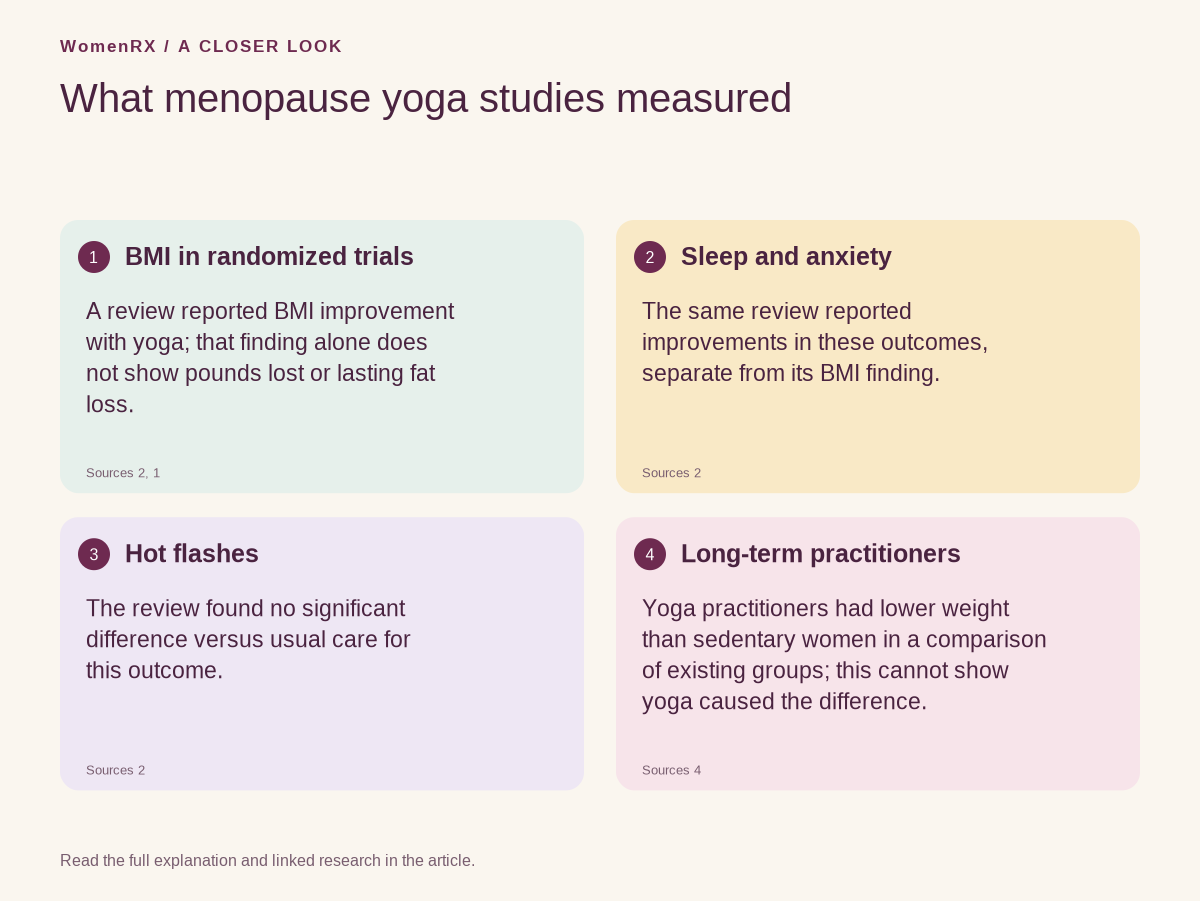
What menopause yoga studies measured
BMI in randomized trials: A review reported BMI improvement with yoga; that finding alone does not show pounds lost or lasting fat loss.21
Sleep and anxiety: The same review reported improvements in these outcomes, separate from its BMI finding.2
Hot flashes: The review found no significant difference versus usual care for this outcome.2
Long-term practitioners: Yoga practitioners had lower weight than sedentary women in a comparison of existing groups; this cannot show yoga caused the difference.4
Read the figure as text
These findings distinguish a BMI result in menopause trials from other measured outcomes and from comparisons of existing yoga practitioners.- BMI in randomized trials: A review reported BMI improvement with yoga; that finding alone does not show pounds lost or lasting fat loss.21
- Sleep and anxiety: The same review reported improvements in these outcomes, separate from its BMI finding.2
- Hot flashes: The review found no significant difference versus usual care for this outcome.2
- Long-term practitioners: Yoga practitioners had lower weight than sedentary women in a comparison of existing groups; this cannot show yoga caused the difference.4
More questions, answered
Does yoga reduce belly fat during menopause?
The menopause-trial review reported an improvement in BMI, but that finding does not demonstrate a reduction in abdominal fat or show that yoga targets belly fat. 2
Is one type of yoga better for weight loss?
The menopause-trial findings don’t compare yoga styles, so they can’t identify one as better for weight loss. 2
Sources you can check
- Body Weight: MedlinePlusAccessed 2026-09-25Return to first citation
- The effectiveness of yoga on menopausal symptoms: A systematic review and meta-analysis of randomized controlled trials.Wang H, Liu Y, Kwok JYY, Xu F, Li R, Tang J, Tang S, Sun M. · International journal of nursing studies · 2025Return to first citation
- Mechanisms of improved body composition among perimenopausal women practicing Meditative Movement: a proposed biobehavioral model.James DL, Larkey LK, Evans B, Sebren A, Goldsmith K, Ahlich E, Hawley NA, Kechter A, Sears DD. · Menopause (New York, N.Y.) · 2023Return to first citation
- Anthropometric, biochemical and clinical parameters in climacteric yoga practitioners.Souza LACE, Lima AA. · Climacteric : the journal of the International Menopause Society · 2022Return to first citation