Mini-Trampoline Exercise: A Safer Way to Decide If It Fits
A small study suggests rebounding may help some balance measures in older adults, but it hasn’t established that mini-trampolines are safer or better than walking for everyone.
Mini-trampoline exercise may be worth trying if you feel steady getting on and off the equipment and can begin with small, controlled movements. In one six-week study of 47 older adults, both trampoline exercise and walking improved some measures; the trampoline group improved more on a single-leg balance test, but women-specific results weren’t reported. A yielding surface doesn’t remove the possibility of losing your balance. 3
What the evidence says, and what it doesn’t
The most directly relevant comparison involved 47 adults with an average age of about 71. Participants did either mini-trampoline exercise or walking for 20 minutes, three times a week, for six weeks. Both groups improved on the six-minute walk test and a stepping test. The trampoline group improved on a single-leg standing test, with a difference in change between groups on that measure. That’s a promising finding for one aspect of balance, not proof that rebounding prevents falls or is generally better than walking. 3
The study abstract doesn’t report a women’s subgroup, so it can’t tell us whether the result applies specifically to older women. A paper proposing a 12-week program for healthy postmenopausal women aged 50 to 69 describes a study plan, not results. It therefore doesn’t establish effects on balance, bone health, or pelvic floor function in postmenopausal women. 3 4
A scoping review of 11 reports found that rebounding research varies in participants and outcomes, and identified gaps around evidence and equipment safety. The trampoline surface yields, which may reduce some repetitive jarring, but that doesn’t show that it prevents joint pain or makes falls unlikely. 5
Think about steadiness before bounce
The practical question isn’t only whether you can exercise. It’s whether you feel in control of the particular movements and equipment. Consider how steady you feel when turning, stepping onto a raised surface, or shifting your weight. If those actions are already difficult, bouncing may add a balance challenge that isn’t necessary to get active.
If you try a mini-trampoline, make the first movements deliberately simple: stand or march gently rather than aiming for height or speed. Use a clear, level area, check that the equipment is stable, and have a solid, fixed support within reach if that helps you feel secure. A loose chair or table that could slide isn’t a dependable handhold. These are cautious setup suggestions, not a tested mini-trampoline safety program.
A class may offer an instructor and other people nearby; at home, you can choose to keep a fixed support close and stop if you feel unsteady. You don’t have to progress to jumping. If even gentle movements feel uncomfortable or hard to control, step off and choose another activity.
Compare it with options that feel steadier
Walking is a useful comparison: in the older-adult study, it improved some of the same measured outcomes as trampoline exercise. For older adults, MedlinePlus describes endurance, strength, balance, and flexibility as different kinds of activity, with balance exercises helping to prevent falls. The best fit can be an activity you can do confidently and keep doing, rather than the one with the bounciest equipment. 1 3
For example, if you want aerobic movement but don’t feel secure on a trampoline, walking on a flat route may be a simpler option. If balance is your main goal, consider balance activities you can do with appropriate support instead. Strength and flexibility work address different aspects of fitness, so a trampoline doesn’t have to replace them. 1
Regular exercise in general can support weight management, but the available trampoline study compared balance, mobility, and walking capacity, not weight loss. It doesn’t show that rebounding is a special or guaranteed way to lose weight. 2 3
A practical readiness check
Before a first session, ask yourself whether you can get on and off the equipment steadily, whether your space is clear, and whether a fixed support or supervised class would help. Choose a lower-challenge option if you’re unsure. Feeling confident enough to stop, step off, or switch activities is part of deciding whether this exercise suits you.
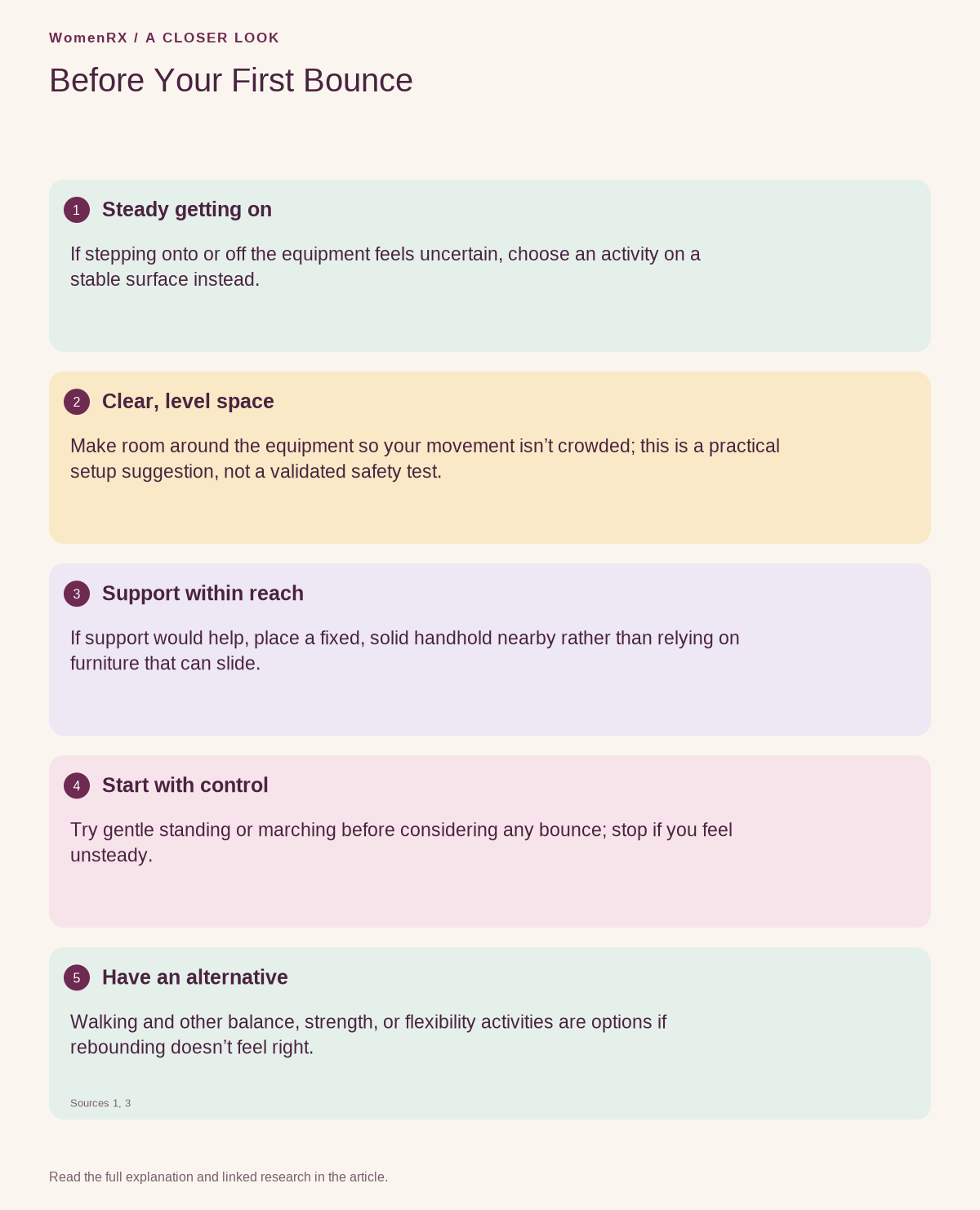
Before Your First Bounce
Steady getting on: If stepping onto or off the equipment feels uncertain, choose an activity on a stable surface instead.
Clear, level space: Make room around the equipment so your movement isn’t crowded; this is a practical setup suggestion, not a validated safety test.
Support within reach: If support would help, place a fixed, solid handhold nearby rather than relying on furniture that can slide.
Start with control: Try gentle standing or marching before considering any bounce; stop if you feel unsteady.
Have an alternative: Walking and other balance, strength, or flexibility activities are options if rebounding doesn’t feel right.13
Read the figure as text
A practical, cautious setup check to help decide whether the equipment and level of challenge feel manageable.- Steady getting on: If stepping onto or off the equipment feels uncertain, choose an activity on a stable surface instead.
- Clear, level space: Make room around the equipment so your movement isn’t crowded; this is a practical setup suggestion, not a validated safety test.
- Support within reach: If support would help, place a fixed, solid handhold nearby rather than relying on furniture that can slide.
- Start with control: Try gentle standing or marching before considering any bounce; stop if you feel unsteady.
- Have an alternative: Walking and other balance, strength, or flexibility activities are options if rebounding doesn’t feel right.13
More questions, answered
Is rebounding proven to prevent falls in older women?
No. One small study in older adults found improvement on a single-leg balance test in the trampoline group, but the abstract doesn’t report a women’s subgroup or show that rebounding prevents falls. 3
Does a mini-trampoline guarantee a low-impact workout?
No. The surface gives under your weight, and a review discusses potentially reduced repetitive loading, but that isn’t proof that rebounding prevents joint pain or injury. 5
Sources you can check
- Exercise for Older Adults: MedlinePlusAccessed 2026-09-25Return to first citation
- Benefits of Exercise: MedlinePlusAccessed 2026-09-25Return to first citation
- Six Weeks of Mini-Trampoline Training Improves Balance, Mobility, and Walking Capacity in Older Adults.Kendall BJ, Dykstra BJ, Anderson QT, Breuer RE, Bergen SH, Hayes ES. · Journal of aging and physical activity · 2026Return to first citation
- Mini-Trampoline Jumping as an Exercise Intervention in Postmenopausal Women to Improve Women Specific Health Risk Factors.Fricke A, Fink PW, Mundel T, Lark SD, Shultz SP. · International journal of preventive medicine · 2021Return to first citation
- Rebound Exercises in Rehabilitation: A Scoping Review.Rathi MA, Joshi R, Munot P, Pandit S, Kulkarni CA. · Cureus · 2024Return to first citation