What Rebounding Can and Can’t Do in Menopause
Rebounding may be a way to stay active, but its effect on menopause-related weight and health outcomes remains uncertain.
Rebounding may be a practical activity if you enjoy it and feel steady on the moving surface. A small study in 17 sedentary women reportedly found little improvement in cardiorespiratory fitness and no significant body-composition changes after 11 weeks; their menopausal status wasn’t specified. Other studies don’t establish menopause-specific benefits or weight loss. General exercise can support weight management alongside eating habits, but that isn’t proof of a mini-trampoline advantage. 4 1
The short version: an activity option, not a menopause treatment
If bouncing feels appealing, a mini-trampoline can be one way to add movement to your routine. The more useful question is whether it feels comfortable, accessible, and sustainable for you, not whether it has a proven menopause-specific effect. A small study in women and a proposed postmenopause study provide some relevant context, but neither establishes that rebounding causes weight loss during menopause or works better than other forms of exercise. 4 5
Regular physical activity can help with weight management, but weight loss depends on using more energy than you take in over time. MedlinePlus describes exercise as part of weight management alongside diet, not a stand-alone guarantee of weight loss. 1
What rebounding studies have actually looked at
A 2021 paper focused on postmenopause is a research protocol, not a report of results. It proposed a 12-week mini-trampoline program for 50 healthy postmenopausal women ages 50 to 69, with assessments planned for fitness, balance, bone health, and pelvic floor function. Because it describes planned research, it can’t tell us whether the program improved those outcomes. 5
There is also a more directly relevant, but limited, finding in women. The discussion passage in a study of adolescent boys cites an 11-week rebounding study in 17 sedentary women, reporting minimal improvement in cardiorespiratory fitness and no significant changes in body composition. The women’s menopausal status isn’t specified, and this report doesn’t tell us whether rebounding affects weight or health outcomes during menopause. 4
Other trampoline studies answer different questions. One study examined 20 weeks of trampoline training in boys ages 11 to 14 and assessed body-fat percentage and motor performance. The report doesn’t specify whether the training used a mini-trampoline. Its findings don’t establish what would happen for a menopausal woman or whether rebounding helps with weight management in adulthood. 4 Another small trial measured blood glucose during a single trampoline session in trained, normoglycemic adults. An immediate measurement during exercise isn’t evidence of lasting weight loss or menopause-related benefit. 3
That difference matters: a study showing that an activity can change a short-term measure, or improve a particular skill in a different population, doesn’t demonstrate a durable menopause outcome.
Think about the footing, not just the workout
A rebounder’s surface moves beneath you. That changes the feel of the activity, so don’t assume it will be easier for balance than walking on a firm floor. Consider whether you can get on and off comfortably, feel steady while moving, and use the equipment in a space that works for you. Those are practical fit questions, not a validated safety checklist.
If the moving surface feels awkward, or equipment and space are barriers, a firm-ground activity may be a better fit. The useful choice is one you can do consistently and comfortably. General exercise has health benefits and can support weight management; a rebounder isn’t required to be active. 1
Don’t expect it to treat hot flashes
Exercise can be worthwhile for fitness and general health without being a proven treatment for every menopause symptom. The North American Menopause Society’s 2023 position statement does not recommend exercise as a treatment for vasomotor symptoms such as hot flashes, based on its evidence review. That guidance addresses symptom treatment; it doesn’t mean exercise has no value for other reasons. 2
So, rebounding is best viewed as an optional way to be active, not a proven shortcut for menopause-related weight change or symptom relief. Choose it for how it fits your preferences and circumstances, without expecting a menopause-specific result.
Try the movement before buying the equipment
A useful first comparison is practical: a rebounder versus an activity you can already do.
| Question | Rebounder | Firm-ground option |
|---|---|---|
| Where will it happen? | Check floor space, ceiling clearance and storage. | Identify an indoor route or an outdoor path. |
| How does the footing feel? | Notice whether the moving surface feels steady to you. | Compare how you feel on a stable surface. |
| What does it cost to try? | Look for a trial class or existing equipment before buying. | Consider walking or another activity that needs no new equipment. |
| What would make you return? | Enjoyment and a workable setup matter. | The same question applies. |
This comparison does not rank the activities by weight loss. It helps separate an exercise you want to do from equipment you may not use.
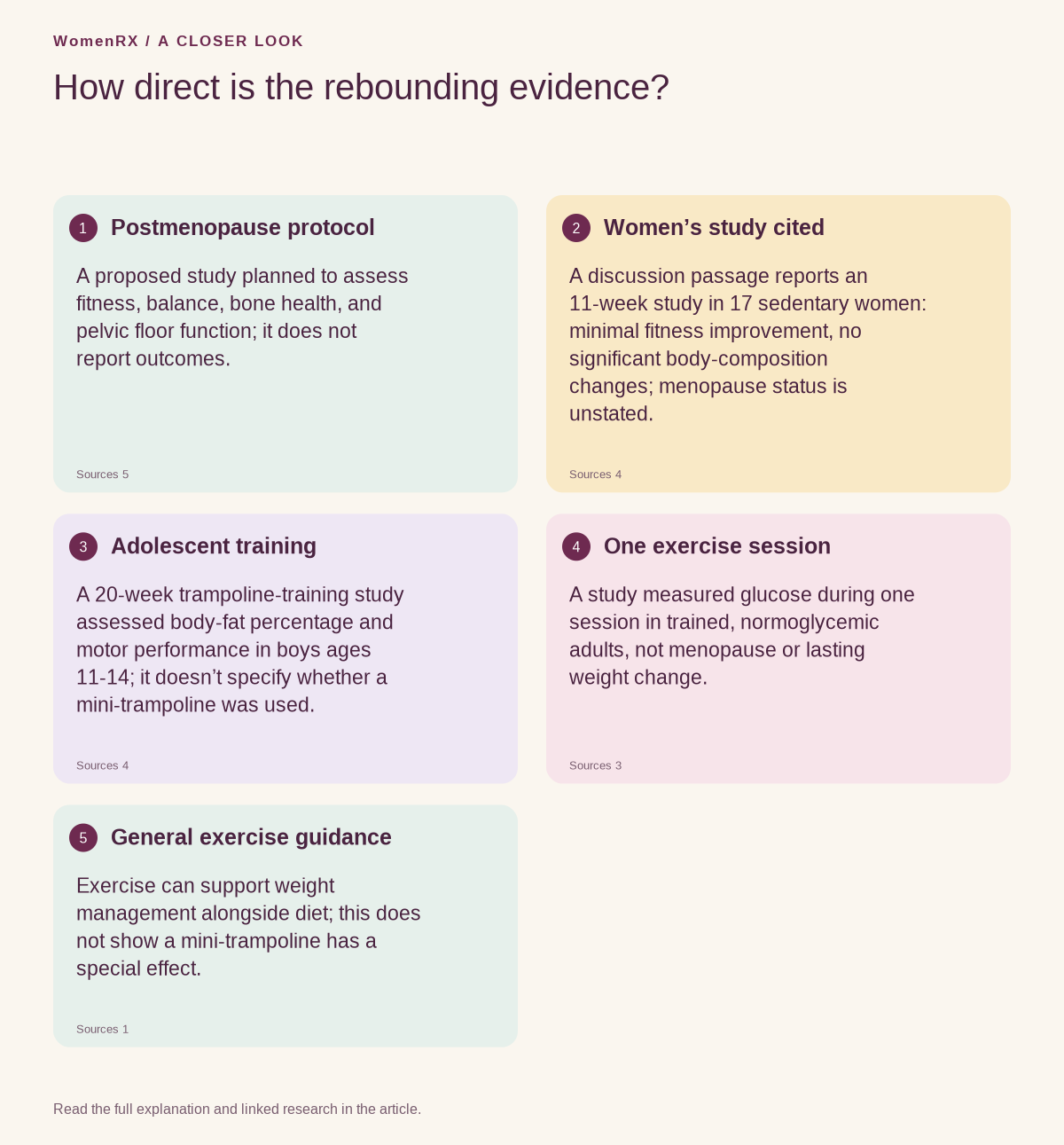
How direct is the rebounding evidence?
Postmenopause protocol: A proposed study planned to assess fitness, balance, bone health, and pelvic floor function; it does not report outcomes.5
Women’s study cited: A discussion passage reports an 11-week study in 17 sedentary women: minimal fitness improvement, no significant body-composition changes; menopause status is unstated.4
Adolescent training: A 20-week trampoline-training study assessed body-fat percentage and motor performance in boys ages 11-14; it doesn’t specify whether a mini-trampoline was used.4
One exercise session: A study measured glucose during one session in trained, normoglycemic adults, not menopause or lasting weight change.3
General exercise guidance: Exercise can support weight management alongside diet; this does not show a mini-trampoline has a special effect.1
Read the figure as text
These findings and research plans differ in population, study purpose, and whether outcomes were actually reported.- Postmenopause protocol: A proposed study planned to assess fitness, balance, bone health, and pelvic floor function; it does not report outcomes.5
- Women’s study cited: A discussion passage reports an 11-week study in 17 sedentary women: minimal fitness improvement, no significant body-composition changes; menopause status is unstated.4
- Adolescent training: A 20-week trampoline-training study assessed body-fat percentage and motor performance in boys ages 11-14; it doesn’t specify whether a mini-trampoline was used.4
- One exercise session: A study measured glucose during one session in trained, normoglycemic adults, not menopause or lasting weight change.3
- General exercise guidance: Exercise can support weight management alongside diet; this does not show a mini-trampoline has a special effect.1
Sources you can check
- Benefits of Exercise: MedlinePlusAccessed 2026-09-25Return to first citation
- The 2023 nonhormone therapy position statement of The North American Menopause Society.Menopause (New York, N.Y.) · 2023Return to first citation
- Changes in blood glucose among trained normoglycemic adults during a mini-trampoline exercise session.Martins Cunha R, Raiana Bentes M, Araújo VH, DA Costa Souza MC, Vasconcelos Noleto M, Azevedo Soares A, Machado Lehnen A. · The Journal of sports medicine and physical fitness · 2016Return to first citation
- Effect of a Trampoline Exercise on the Anthropometric Measures and Motor Performance of Adolescent Students.Aalizadeh B, Mohammadzadeh H, Khazani A, Dadras A. · International journal of preventive medicine · 2016Return to first citation
- Mini-Trampoline Jumping as an Exercise Intervention in Postmenopausal Women to Improve Women Specific Health Risk Factors.Fricke A, Fink PW, Mundel T, Lark SD, Shultz SP. · International journal of preventive medicine · 2021Return to first citation