HIIT During Menopause: A Useful Option, Not a Must
HIIT can build fitness, but current research doesn’t show that it beats moderate exercise for menopause-related weight loss.
HIIT may be worth considering if short, harder intervals suit you, but it isn’t a proven shortcut for weight loss during menopause. In a small study of postmenopausal women, high- and moderate-intensity interval exercise both reduced the rise in blood fats after a meal, with no clear advantage for HIIT. Broader research finds similar average fitness gains from high- and moderate-intensity training. 3 4
HIIT alternates harder bursts of exercise with easier recovery periods. It can be a useful way to train, but menopause doesn’t make it necessary, and the available research doesn’t establish it as a better weight-loss strategy than moderate activity.
What menopause-specific studies tell us
The most direct comparison is a small randomized study of 11 sedentary postmenopausal women. The study compared high-intensity intervals, moderate-intensity intervals, and a rest condition. Both exercise sessions reduced post-meal triglycerides compared with rest. HIIT did not outperform moderate intervals on that measure. Participants also reported greater exertion during HIIT. This was a short-term study of a blood-fat response, not a trial of long-term weight loss or menopause symptoms. 3
A separate six-week HIIT study enrolled 59 women with obesity who were perimenopausal or postmenopausal. It reported decreases in body measurements, but it did not compare HIIT with moderate exercise. The report doesn’t provide enough detail here to tell how large those changes were or whether HIIT would produce better weight outcomes than another activity. 2
So, HIIT may accompany changes in body measurements, but there’s not a strong menopause-specific comparison showing it leads to more weight loss than moderate exercise. These studies also don’t show that HIIT changes menopause-related fat distribution or balances hormones.
Fitness gains don’t require the hardest option
A large review of exercise-training studies found similar average improvements in aerobic fitness with high-intensity interval training and endurance training, which includes lower- or moderate-intensity continuous exercise. Its results came from a broad, mixed population, not a menopause-specific trial. The review reported that menopause did not influence increases in mitochondrial content, but that finding doesn’t establish whether menopause affects overall fitness gains or which approach is best for an individual woman. 4
The review also found that HIIT and sprint training could improve some measures of fitness per hour of exercise. That’s a potential time-efficiency advantage, not evidence of greater weight loss, better menopause symptoms, or an easier workout. 4
Choose by effort, recovery, and what you’ll repeat
HIIT asks for more effort during its harder intervals. Moderate exercise may feel more manageable, and in the small postmenopausal comparison it produced a similar change in post-meal triglycerides with lower reported exertion. That makes tolerability a real part of the comparison, not a sign that one approach is automatically better. 3
For example, if you enjoy brief hard efforts and feel able to recover between them, HIIT could be one way to work on fitness. If those efforts feel unpleasant or difficult to recover from, moderate activity is still a reasonable option. The evidence doesn’t support treating HIIT as a menopause-specific requirement or assuming that the more intense choice will mean more weight loss.
One other distinction matters: exercise shouldn’t be chosen as a proven treatment for hot flashes. The North American Menopause Society’s 2023 evidence review did not recommend exercise as a treatment for vasomotor symptoms. You can still choose activity for fitness or other goals, without expecting it to reliably reduce hot flashes. 1
The practical takeaway: HIIT is an option if its intensity and recovery demands suit you. Moderate activity can also support fitness, and direct menopause-specific evidence has not shown HIIT to be superior for weight management.
HIIT and moderate activity: what differs
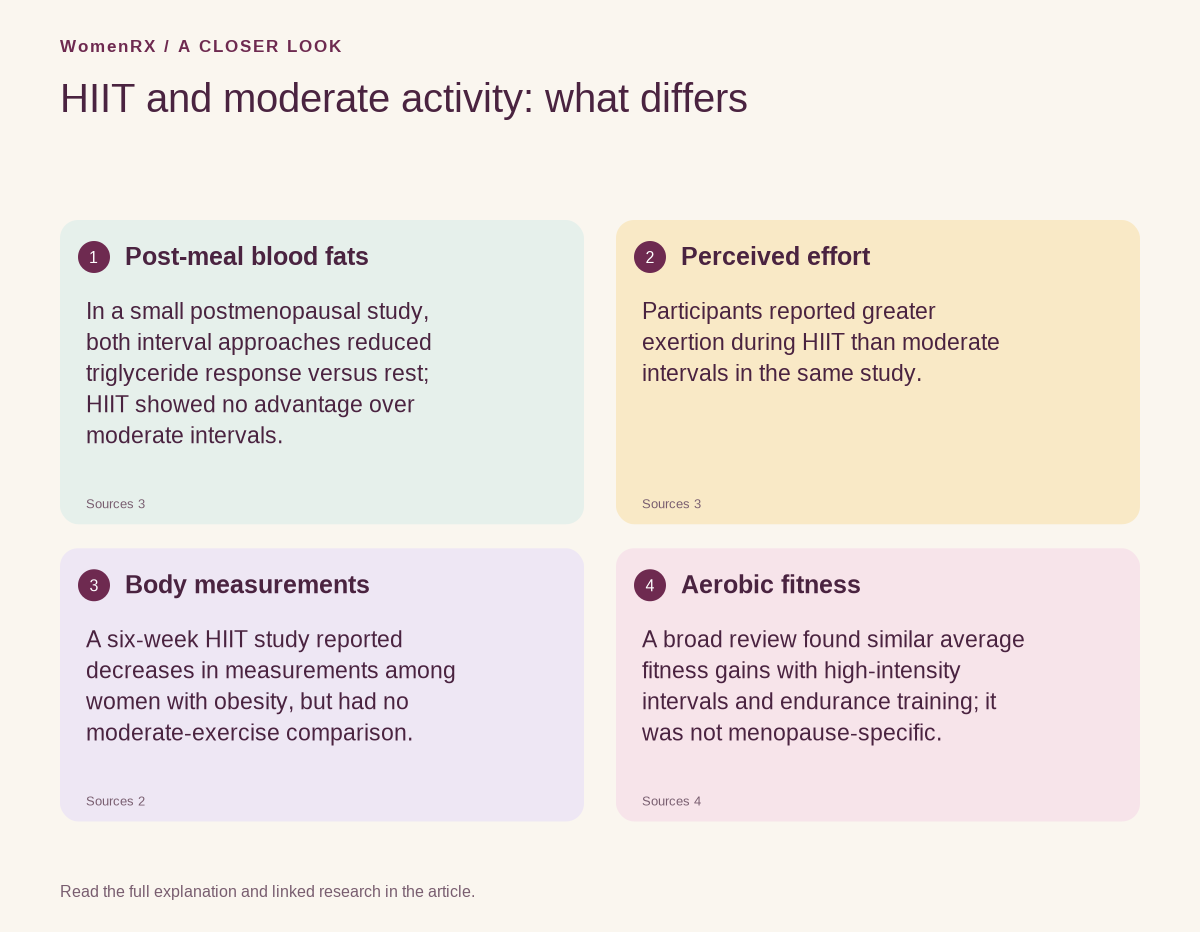
Post-meal blood fats: In a small postmenopausal study, both interval approaches reduced triglyceride response versus rest; HIIT showed no advantage over moderate intervals.3
Perceived effort: Participants reported greater exertion during HIIT than moderate intervals in the same study.3
Body measurements: A six-week HIIT study reported decreases in measurements among women with obesity, but had no moderate-exercise comparison.2
Aerobic fitness: A broad review found similar average fitness gains with high-intensity intervals and endurance training; it was not menopause-specific.4
Read the figure as text
The comparison separates findings from direct studies in menopausal women from broader fitness evidence.- Post-meal blood fats: In a small postmenopausal study, both interval approaches reduced triglyceride response versus rest; HIIT showed no advantage over moderate intervals.3
- Perceived effort: Participants reported greater exertion during HIIT than moderate intervals in the same study.3
- Body measurements: A six-week HIIT study reported decreases in measurements among women with obesity, but had no moderate-exercise comparison.2
- Aerobic fitness: A broad review found similar average fitness gains with high-intensity intervals and endurance training; it was not menopause-specific.4
More questions, answered
Does HIIT reduce hot flashes?
Exercise has not been recommended as a treatment for vasomotor symptoms in the North American Menopause Society’s 2023 evidence review. That doesn’t rule out exercise for other goals, but it does mean HIIT shouldn’t be relied on to treat hot flashes. 1
Is HIIT better than moderate exercise for fitness?
A broad review found similar average improvements in aerobic fitness with high-intensity interval and endurance training. Because that review wasn’t a menopause-specific trial, it can’t determine which option will suit you best. 4
Sources you can check
- The 2023 nonhormone therapy position statement of The North American Menopause Society.Menopause (New York, N.Y.) · 2023Return to first citation
- Plasma volume variations in response to high intensity interval training in obese women: The influential role of menopausal status and age.Jabbour G, Sellami M, Iancu HD. · Experimental gerontology · 2025Return to first citation
- Effects of high- and moderate-intensity interval training on postprandial lipemia in postmenopausal women after a high-fat meal.Teixeira BC, Munhoz SV, Bicalho CCF, Vieira AF, Lima SS, Assis Lauria A, Vieira de Carvalho M, Monteiro-Junior RS, Heck TG. · Journal of bodywork and movement therapies · 2025Return to first citation
- Effects of Exercise Training on Mitochondrial and Capillary Growth in Human Skeletal Muscle: A Systematic Review and Meta-Regression.Mølmen KS, Almquist NW, Skattebo Ø. · Sports medicine (Auckland, N.Z.) · 2025Return to first citation