How Much Walking Is Useful for Weight Management?
Start with walking you can repeat, then build from there without treating any step count as a promise about the scale.
There isn’t a daily step count that guarantees weight loss. Walking adds to the energy your body uses, but weight also depends on food intake and other factors that differ between people. Note how much you walk now, choose one manageable increase, and adjust it as your capacity changes. Exercise can have benefits even without substantial weight loss, although the liver-fat finding isn’t specific to walking. 1 3
Pick a target from your starting point
If you’re mostly sedentary, a sudden jump to a high step count may feel like a plan made for someone else. Start by noting your usual walking over several ordinary days. Then choose one small increase you could repeat, such as taking a short walk on a day you don’t usually walk, or extending a familiar route. Once that feels comfortable and repeatable, you can keep it, add another day, or make the route a little longer. If it doesn’t fit, scale it back. You can use minutes, a route, or steps to describe your target.
That’s a planning method, not a proven weight-loss dose. There isn’t a universal number of daily steps or minutes that guarantees a predictable amount of weight loss. MedlinePlus describes body weight as affected by the balance between calories taken in and calories used, with the right balance differing between people. Activity is one part of that picture, not a guarantee by itself. 1
Why the same walking goal can lead to different scale changes
A step total counts movement; it doesn’t tell you exactly how much energy you used or what happened with your overall energy balance. In a randomized trial of 255 male Veterans, everyone received five weight-loss sessions with a dietitian as well as a walking program. Over six months, the group using internet-enhanced pedometer feedback lost an average of 1.9 kg, compared with 0.7 kg in the time-based group and 0.6 kg in the simple-pedometer group. Because the trial compared ways to monitor walking within a broader program, it doesn’t show that one step target works for everyone, or that walking alone caused the weight change. It also can’t tell us whether women would have the same results. 5
Another study illustrates why a headline number shouldn’t be treated as a prescription: adults in a 12-week weight-loss program walked 10,000 steps a day alongside an energy-restricted diet and a probiotic or placebo. Participants lost weight, but that combined design can’t isolate the effect of walking or show that 10,000 steps is necessary for weight loss. 6
Your starting activity, capacity, and the rest of your routine matter. MedlinePlus lists activity level, medical conditions, and certain medicines among factors that can affect body weight. 1 Another MedlinePlus page lists stress level among factors relevant to body weight. 2 If the scale changes slowly or not at all, that doesn’t make your walks pointless; it means the scale isn’t a direct score for your walking effort.
Walking can matter beyond weight
Some exercise benefits can show up even without substantial weight loss. In a meta-analysis of 14 randomized trials involving 551 adults with nonalcoholic fatty liver disease, exercise training was associated with a greater chance of a meaningful reduction in MRI-measured liver fat than no exercise training. The association was independent of clinically significant weight loss. The analysis describes an exercise dose equivalent to brisk walking as an example, but it studied exercise training and doesn’t establish a walking-specific effect. This finding applies to people with that condition; it shouldn’t be read as a promise of the same result for everyone who walks. 3
A healthy body weight is also more than a number on the scale, and weight is only one part of assessing health. 2 It can be reasonable to value a walking routine for movement and health goals even when weight loss isn’t happening as hoped.
Let your target fit your body now
A step counter is optional. If seeing a number helps you notice your activity or stick with a routine, it may be useful; if it makes walking feel like a daily pass-or-fail test, use time, route, or consistency instead. A review of 25 studies of activity trackers in weight-loss programs found that participants were mostly women, but its possible short-term advantage was reported for middle-aged or older adults, not younger adults. The review doesn’t establish one ideal tracking method for every woman. 4
The baseline-first method can also accommodate a changing capacity. During pregnancy or postpartum recovery, for example, start with what walking is manageable now rather than a weight-loss step count taken from a general adult study, and revise the plan if your capacity changes. If mobility limits how far you walk, a comfortable route or repeatable amount of time may be a more useful personal target than someone else’s steps. These are ways to plan around your circumstances, not pregnancy, postpartum, or mobility-specific exercise prescriptions. The adult walking programs discussed here do not establish targets for those situations. 5 6
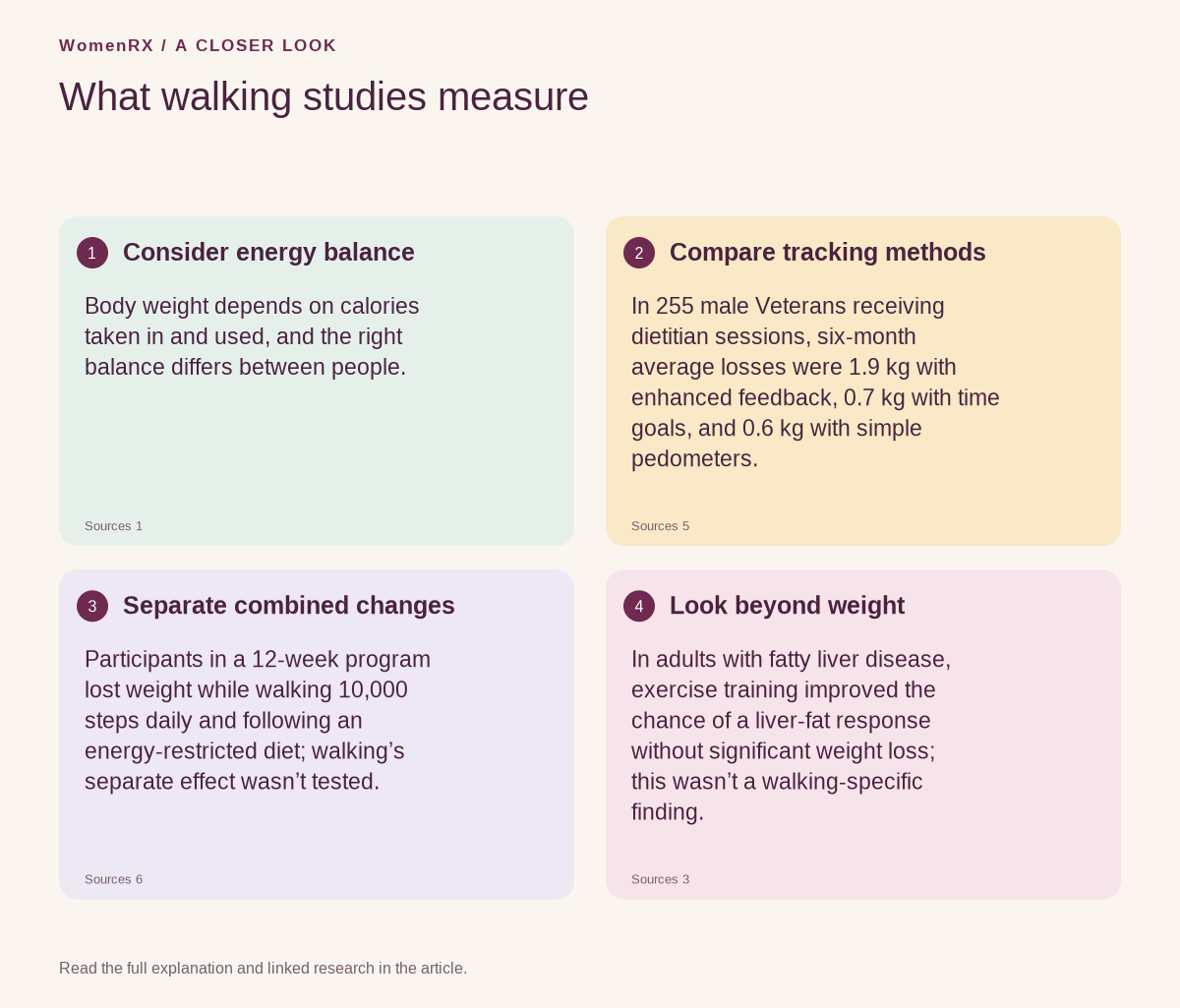
What walking studies measure
Consider energy balance: Body weight depends on calories taken in and used, and the right balance differs between people.1
Compare tracking methods: In 255 male Veterans receiving dietitian sessions, six-month average losses were 1.9 kg with enhanced feedback, 0.7 kg with time goals, and 0.6 kg with simple pedometers.5
Separate combined changes: Participants in a 12-week program lost weight while walking 10,000 steps daily and following an energy-restricted diet; walking’s separate effect wasn’t tested.6
Look beyond weight: In adults with fatty liver disease, exercise training improved the chance of a liver-fat response without significant weight loss; this wasn’t a walking-specific finding.3
Read the figure as text
The walking target, accompanying changes, and outcome all matter when deciding what a study can tell you.- Consider energy balance: Body weight depends on calories taken in and used, and the right balance differs between people.1
- Compare tracking methods: In 255 male Veterans receiving dietitian sessions, six-month average losses were 1.9 kg with enhanced feedback, 0.7 kg with time goals, and 0.6 kg with simple pedometers.5
- Separate combined changes: Participants in a 12-week program lost weight while walking 10,000 steps daily and following an energy-restricted diet; walking’s separate effect wasn’t tested.6
- Look beyond weight: In adults with fatty liver disease, exercise training improved the chance of a liver-fat response without significant weight loss; this wasn’t a walking-specific finding.3
More questions, answered
Do I need to reach 10,000 steps a day?
No. A 12-week adult program used 10,000 steps a day alongside dietary changes and other study components. Participants lost weight, but the study doesn’t show that this number is required or that walking alone caused the loss. 6
Can walking be worthwhile if my weight stays the same?
The scale isn’t the only possible measure of health. Exercise training was associated with reduced liver fat independent of clinically significant weight loss in a meta-analysis of adults with nonalcoholic fatty liver disease. That condition-specific result doesn’t establish a walking-specific effect. 2 3
Sources you can check
- Obesity: MedlinePlusAccessed 2026-09-25Return to first citation
- Body Weight: MedlinePlusAccessed 2026-09-25Return to first citation
- Exercise Training Is Associated With Treatment Response in Liver Fat Content by Magnetic Resonance Imaging Independent of Clinically Significant Body Weight Loss in Patients With Nonalcoholic Fatty Liver Disease: A Systematic Review and Meta-Analysis.Stine JG, DiJoseph K, Pattison Z, Harrington A, Chinchilli VM, Schmitz KH, Loomba R. · The American journal of gastroenterology · 2023Return to first citation
- The efficacy of wearable activity tracking technology as part of a weight loss program: a systematic review.Cheatham SW, Stull KR, Fantigrassi M, Motel I. · The Journal of sports medicine and physical fitness · 2018Return to first citation
- A Comparative Effectiveness Trial of Three Walking Self-monitoring Strategies.Richardson CR, Goodrich DE, Larkin AR, Ronis D, Holleman RG, Damschroder LJ, Lowery JC. · Translational journal of the American College of Sports Medicine · 2016Return to first citation
- Effects of a Plant-Based Multi-Strain Limosilactobacillus fermentum Probiotic on Weight Loss Outcomes in Overweight and Obese Adults: A Preliminary Study.Johnson S, Dickerson BL, Chun J, Haskell O, Chavez E, Kirkegaard L, Hines KE, Yoo C, Ko J, Xing D, Purpura M, Jäger R, Sowinski RJ, Gonzalez DE, Rasmussen CJ, Kreider RB. · Nutrients · 2026Return to first citation