Rucking: How to Start Walking With a Pack
Loaded walking adds a balance and effort challenge, but balance and military load-carriage studies don’t set a beginner plan for recreational walkers.
If you already walk comfortably, you can treat rucking as a gradual experiment: first try a familiar, predictable route with a stable, lightly loaded pack, and change only one thing at a time. That’s a cautious starting approach, not a tested protocol. Research links carried load and its placement with changes in balance, but postural-sway studies don’t establish ideal pack fit, beginner loads, or a progression schedule for recreational rucking. 3
What changes when you add a pack?
Rucking is walking while carrying a load. It’s still walking, but it asks your body to manage extra weight while moving. In a review of studies in healthy young adults, carrying a load was associated with reduced postural stability. Load size and placement also affected balance measures. That does not tell us exactly what happens on a neighborhood walk, or predict whether a particular person will get hurt, but it’s a reason to start on steady, familiar ground rather than making a first outing a test of steep or uneven terrain. 3
The balance review and a study of military cadets don’t provide a recreational beginner protocol for pack weight, fit, or progression. So the steps below are a conservative way to explore the activity, not a clinically tested program. 3 4
A cautious first try
Start with a walk you already manage comfortably. Keep your usual pace and choose an even, predictable route. If walking itself is new for you, begin with unloaded walks; there’s no need to add a pack to make them count.
Add a small, stable load only if you want to. These studies don’t establish a universal number to aim for. Pack items so they don’t shift around, and check that the pack feels comfortable rather than pulling, bouncing, or pressing painfully on one spot. Even distribution and load placement matter for balance in load-carriage research, though those findings don’t establish a specific backpack-fit standard. 3 4
Keep the first loaded walk otherwise familiar. Don’t increase the load and also choose a longer, faster, hillier route on the same outing. If the pack feels awkward, your balance feels less secure, or discomfort builds, take it off and return to unloaded walking.
Pay attention afterward, too. Before trying another loaded walk, consider whether you feel back to your usual comfort and movement. If back pain is severe, follows an injury, or hasn’t improved after three days, seek medical care rather than trying to train through it. 1
What women’s research can and can’t tell you
A study of 22 Army Reserve Officers’ Training Corps cadets, including six women, tested timed load-carrying tasks with a 21-kilogram load. The researchers reported group-level results, not separate outcomes for women. The study examined military cadets completing specific time trials, not beginners choosing a recreational pack or route. It can’t tell you what load is right for you. 4
The load-carriage review focused on healthy young adults, and the abstract doesn’t report women-specific findings. These results may not transfer neatly to women who are older, postmenopausal, new to exercise, or managing a health condition. 3
Don’t treat a pack as a proven weight-loss or bone plan
The balance review and cadet time trials don’t test whether recreational rucking causes weight loss or whether carrying a backpack independently improves bone health. 3 4 A separate review of weighted-vest trials in middle-aged and older adults is not evidence for backpack rucking: it studied a different kind of load, and adding a vest to exercise did not show a significant bone-density benefit compared with exercise alone in the one study making that comparison. 5
Walking itself is a weight-bearing activity identified as one way to support bone health, but that doesn’t prove that adding a pack improves the effect. 2 If your goal is fitness, bone health, or weight management, think of rucking as one optional way to make a walk more challenging, not a shortcut or a substitute for other activity you value.
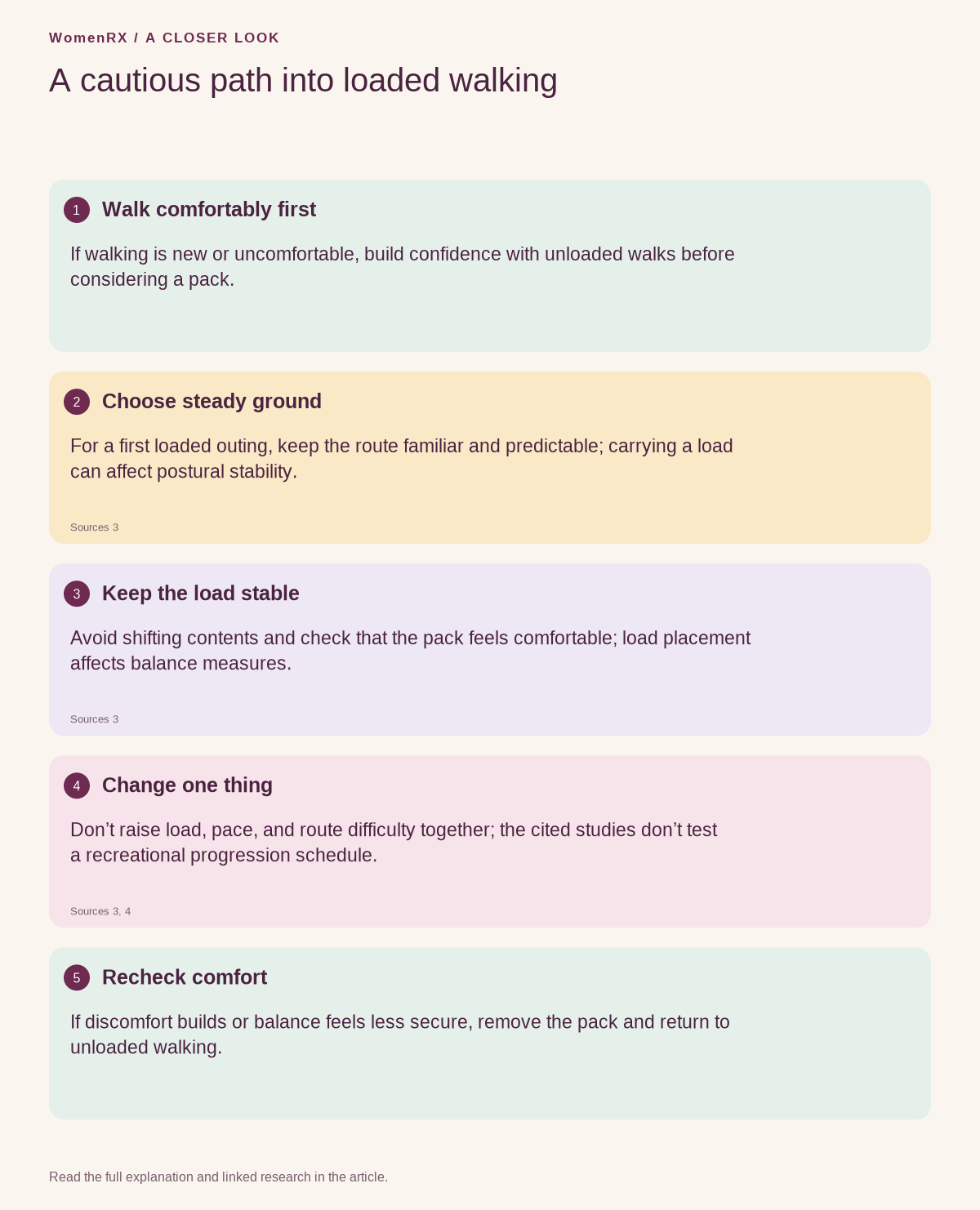
A cautious path into loaded walking
Walk comfortably first: If walking is new or uncomfortable, build confidence with unloaded walks before considering a pack.
Choose steady ground: For a first loaded outing, keep the route familiar and predictable; carrying a load can affect postural stability.3
Keep the load stable: Avoid shifting contents and check that the pack feels comfortable; load placement affects balance measures.3
Change one thing: Don’t raise load, pace, and route difficulty together; the cited studies don’t test a recreational progression schedule.34
Recheck comfort: If discomfort builds or balance feels less secure, remove the pack and return to unloaded walking.
Read the figure as text
Use this as a practical sequence, not a validated training plan. Load-carriage research identifies balance effects but does not supply a recreational beginner protocol.- Walk comfortably first: If walking is new or uncomfortable, build confidence with unloaded walks before considering a pack.
- Choose steady ground: For a first loaded outing, keep the route familiar and predictable; carrying a load can affect postural stability.3
- Keep the load stable: Avoid shifting contents and check that the pack feels comfortable; load placement affects balance measures.3
- Change one thing: Don’t raise load, pace, and route difficulty together; the cited studies don’t test a recreational progression schedule.34
- Recheck comfort: If discomfort builds or balance feels less secure, remove the pack and return to unloaded walking.
More questions, answered
Should I increase distance or pack weight first?
The balance review and cadet time trials don’t test a progression schedule for recreational walkers. As a cautious approach, change only one thing at a time, so you can tell what feels manageable. That’s practical judgment, not a validated schedule. 3 4
Does rucking replace strength training?
The balance review measured postural stability, and the cadet study examined time-trial performance; neither compared recreational rucking with a strength-training program. Don’t assume that walking with a pack provides the same benefits as strength training. 3 4
Sources you can check
- Back PainAccessed 2026-09-25Return to first citation
- Fracture | MedlinePlusAccessed 2026-09-25Return to first citation
- Effects of load carriage on measures of postural sway in healthy, young adults: A systematic review and meta-analysis.Martin J, Kearney J, Nestrowitz S, Burke A, Sax van der Weyden M. · Applied ergonomics · 2023Return to first citation
- The Impact of Critical Speed and Lean Body Mass on Load Carriage Performance for Army Reserve Officers' Training Corps Cadets.Dicks ND, Mahoney SJ, Barry AM, Christensen BK, Pettitt RW, Hackney KJ. · Military medicine · 2025Return to first citation
- Effects of weighted vest on bone health and body fat in middle-aged and older adults: a systematic review and meta-analysis.Wang X, Zhou L, Shi T, Meng X, Li C, Zhu C, Guo C, Yue C, Tang Y, Liu Y. · Osteoporosis international : a journal established as result of cooperation between the European Foundation for Osteoporosis and the National Osteoporosis Foundation of the USA · 2026Return to first citation