Tai Chi for Balance: Choosing a Beginner Class
Tai Chi’s slow weight shifts and controlled steps have been studied for balance in older adults, but the best class is one you can follow safely and comfortably.
Tai Chi is a reasonable option to try for balance and gentle movement: research in older adults finds improvements in balance measures, though that doesn’t guarantee fewer falls for every person. 16 Look for a beginner class with a pace you can follow, movements that can be adjusted, and a stable support nearby if you need it. A prefrail older-adult trial reported results for women and men together; an evidence map does not establish whether effects differ by sex. 57
Tai Chi may be worth trying if you want gentle movement that asks you to shift your weight, step, and coordinate your movements at a controlled pace. Studies in older adults have found benefits on balance measures, but those results don’t mean a class will prevent falls for everyone or replace individualized balance or rehabilitation care. 16
What Tai Chi has been studied for
Balance is the clearest fit for this decision. A systematic review and meta-analysis of 21 randomized trials in healthy older adults reported improvements in balance measures, walking speed, and confidence about preventing falls. Those are encouraging findings, but changes in test scores or reported confidence aren’t the same as proof that every participant avoided a fall. 1
A broader network meta-analysis of exercise trials in adults 60 and older also found a favorable estimate for Tai Chi on global balance. Different exercise types appeared useful for different balance domains, and the authors cautioned that the estimates don’t establish that one type is superior. So Tai Chi is one reasonable choice, not the only effective way to work on balance. 6
Some individual trials have also measured mobility and walking. For example, a randomized trial in prefrail older adults, including 31 women and 33 men, reported better postural stability and some gait measures after a 12-week Tai Chi program than after health education alone. The results were reported for the group as a whole, not as separate effects for women and men. 5
That distinction matters if you’re looking for research specifically in women or after menopause. An evidence map of Tai Chi reviews noted that 42 reviews included a female-majority population, but that doesn’t tell us whether women benefited differently from men. The available findings support discussing Tai Chi as an option studied in older adults, not making a distinct claim about its effects in postmenopausal women. 7
Choose a class for the movement you can do
Tai Chi involves controlled weight shifts, changes in body position, and coordinated stepping. Those features help explain why it has been studied for balance, but they can also make a long sequence of movements challenging to learn. 13
Use a first class to see whether the teaching style and movement options suit you:
- If you’re new to it: Ask whether the class is specifically for beginners and whether the instructor teaches movements in smaller parts before linking them together.
- If standing balance is uncertain: Ask whether you can use a chair or other stable support while learning, and whether movements can be done with a smaller range of motion. If the class expects you to move unsupported, it may not be the right starting point.
- If getting down to the floor is difficult: Ask whether the session is standing throughout and whether seated variations are available. Don’t assume every class includes them.
- If you have prefrailty or more limited mobility: Look for supervised instruction that can adjust the pace and movements. One trial in prefrail adults required participants to walk independently and meet a balance-score eligibility criterion, so its results don’t establish what’s appropriate for people with greater mobility limitations. 5
A useful question before enrolling is: “What changes can you offer if I can’t comfortably do a movement?” A clear answer is more helpful than a promise that one style or sequence works for everyone. Research protocols vary, and a recent older-adult trial compared different Tai Chi formats, underscoring that class structure and movement choices aren’t interchangeable. 2
What not to expect from a balance class
The balance trials and analyses used to guide this class decision focus on balance, mobility, gait, or related movement measures. They don’t establish Tai Chi as a weight-loss method, nor do they show that a beginner class treats or prevents a particular disease. A balance benefit is a more evidence-aligned reason to try it than a broad promise about weight or overall wellness.
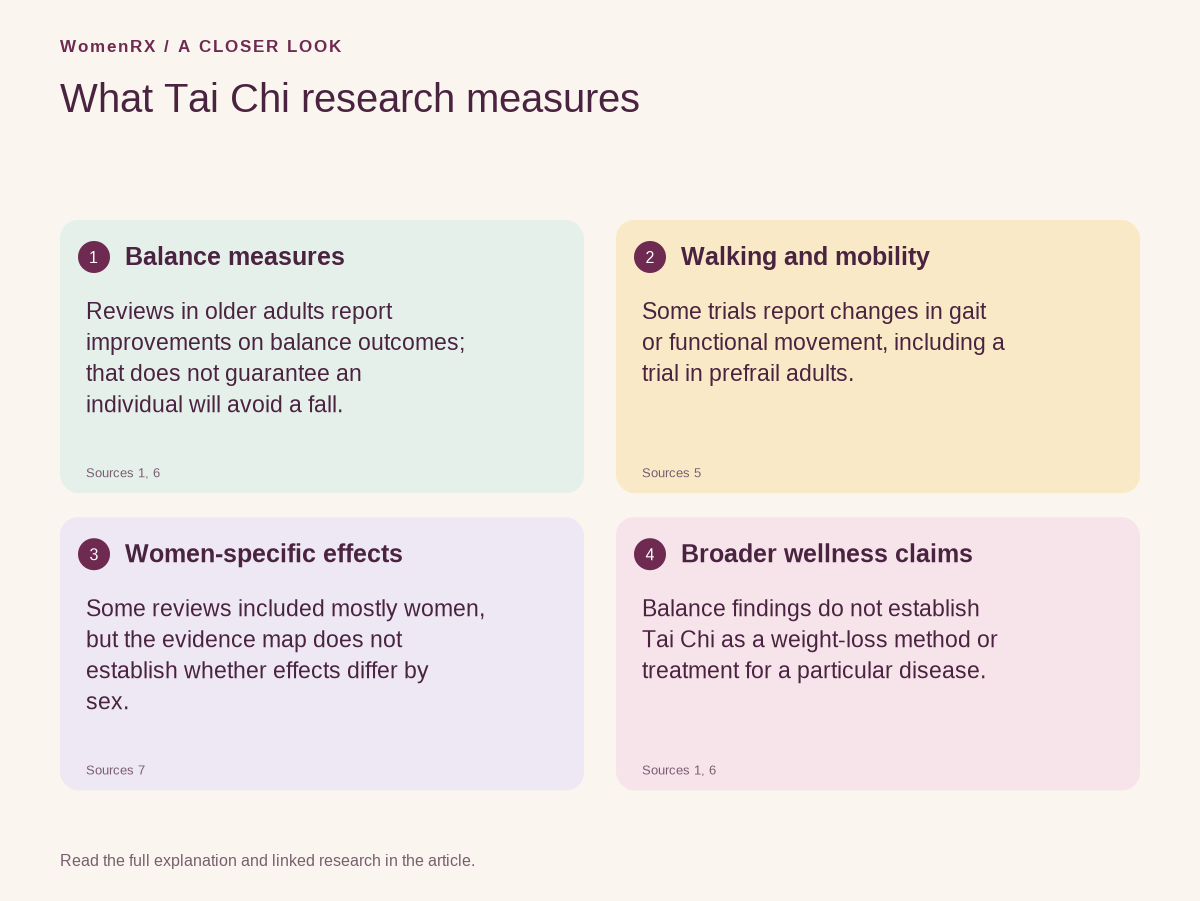
What Tai Chi research measures
Balance measures: Reviews in older adults report improvements on balance outcomes; that does not guarantee an individual will avoid a fall.16
Walking and mobility: Some trials report changes in gait or functional movement, including a trial in prefrail adults.5
Women-specific effects: Some reviews included mostly women, but the evidence map does not establish whether effects differ by sex.7
Broader wellness claims: Balance findings do not establish Tai Chi as a weight-loss method or treatment for a particular disease.16
Read the figure as text
These findings point to balance and movement as the most relevant reasons to consider Tai Chi, while showing where evidence should not be stretched.- Balance measures: Reviews in older adults report improvements on balance outcomes; that does not guarantee an individual will avoid a fall.16
- Walking and mobility: Some trials report changes in gait or functional movement, including a trial in prefrail adults.5
- Women-specific effects: Some reviews included mostly women, but the evidence map does not establish whether effects differ by sex.7
- Broader wellness claims: Balance findings do not establish Tai Chi as a weight-loss method or treatment for a particular disease.16
More questions, answered
Does Tai Chi have to be done in person?
Not necessarily, but digital classes haven’t shown a clear added advantage for physical balance measures. A review of digital Tai Chi trials found no statistically significant improvement in the Berg Balance Scale or Timed Up and Go compared with controls; the authors rated evidence quality from very low to moderate. If you choose online instruction, consider whether you can see and follow the movements safely in your space. 4
Is one Tai Chi style best for balance?
Current research doesn’t identify one best Tai Chi style for everyone. Programs and teaching formats vary, and a favorable estimate for Tai Chi in a broad balance comparison doesn’t show that one class format will suit your mobility or balance needs better than another. 26
Sources you can check
- Effects of Tai Chi on balance and fall prevention in healthy older adults: a randomized controlled meta-analysis.Dong R, Hamzah MSGB, Awang MMB, Qiu J, Chen S. · Frontiers in public health · 2025Return to first citation
- Efficacy of Tai Chi and Roliball Exercise on Balance, Mobility, and Cognitive Function in Community-Dwelling Older Adults: A Randomized Controlled Trial.Yang Y, Li E, Hua Y, Yang X, Zhao Z, Zhu X, Li X, Tang J. · Clinical interventions in aging · 2025Return to first citation
- Additional Effects of 1-Hz rTMS Combined With Tai Chi Chuan on Dual-Task Performance Among Older Adults With Sleep Disorders and MCI: An fNIRS-Based Randomized Controlled Trial.Guo Z, Xu K, Bai L, Sun Y, Zhang L, Gao J, Chen L, Liu Z. · Brain and behavior · 2026Return to first citation
- Impact of digital Tai Chi interventions on the physical and mental health of older adults: a systematic review and meta-analysis.Zhao C, Hu G, Li D, Li Y. · Frontiers in public health · 2026Return to first citation
- Effects of a 12-week Tai Chi program on postural stability and gait biomechanics in prefrail older adults: a randomized controlled study.Gao J, Tu X, Chen J, Huang S, Lu Z, Jia X, Chang J, Jiang C, Lin Z. · Journal of neuroengineering and rehabilitation · 2026Return to first citation
- Exercise modalities for overall and domain-specific balance performance in older adults: A systematic review and Bayesian network meta-analysis.Wang J, Guo S, Yang Y, Liang Y, Guo C, Cheng Y, Li Y, Qiu B, Ma S, Chen P, Zhuang J. · Ageing research reviews · 2026Return to first citation
- Evidence map of Tai Chi interventions for older adults.Fogaça LZ, Schveitzer MC, Ferreira A, Feitosa ADC, Pratt M, Schlechta Portella CF, Ghelman R, Ramos LR. · Frontiers in public health · 2026Return to first citation